


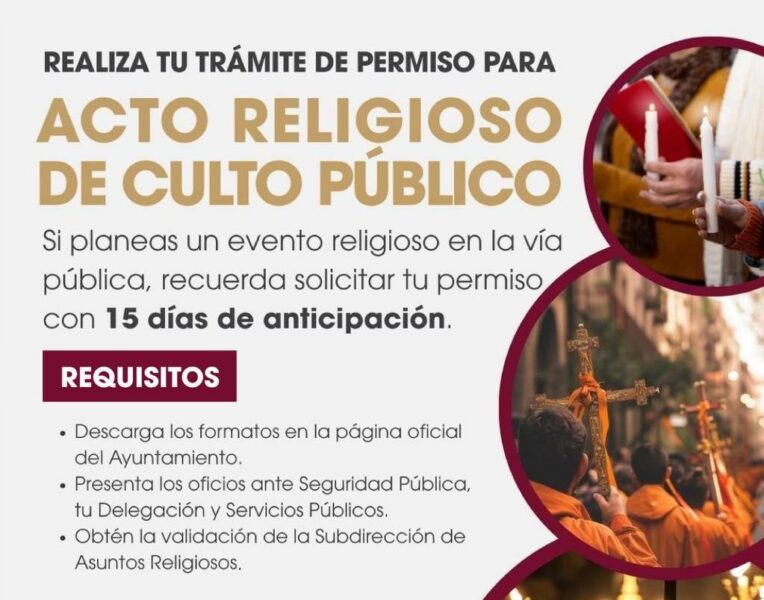
One week before the start of Holy Week 2026, the Tijuana city council, governed by the ruling party, has placed thousands of Catholic faithful at the center of a deep controversy. Through its official portal and a flyer widely disseminated on social networks, the municipal government reminds religious associations that they must process a “Permit for Religious Act of Public Worship” at least 15 days in advance if they wish to hold Via Crucis processions, processions, pilgrimages, or any act of worship outside the temples.
The Subdirectorate of Religious Affairs of the Municipal Government Secretariat cites article 22 of the Law on Religious Associations and Public Worship. The text states that organizers of extraordinary public worship acts must give prior notice to the authorities at least fifteen days before the date, indicating the place, date, time of the act, as well as the reason; however, it does not mention the imposition of fees or rights.
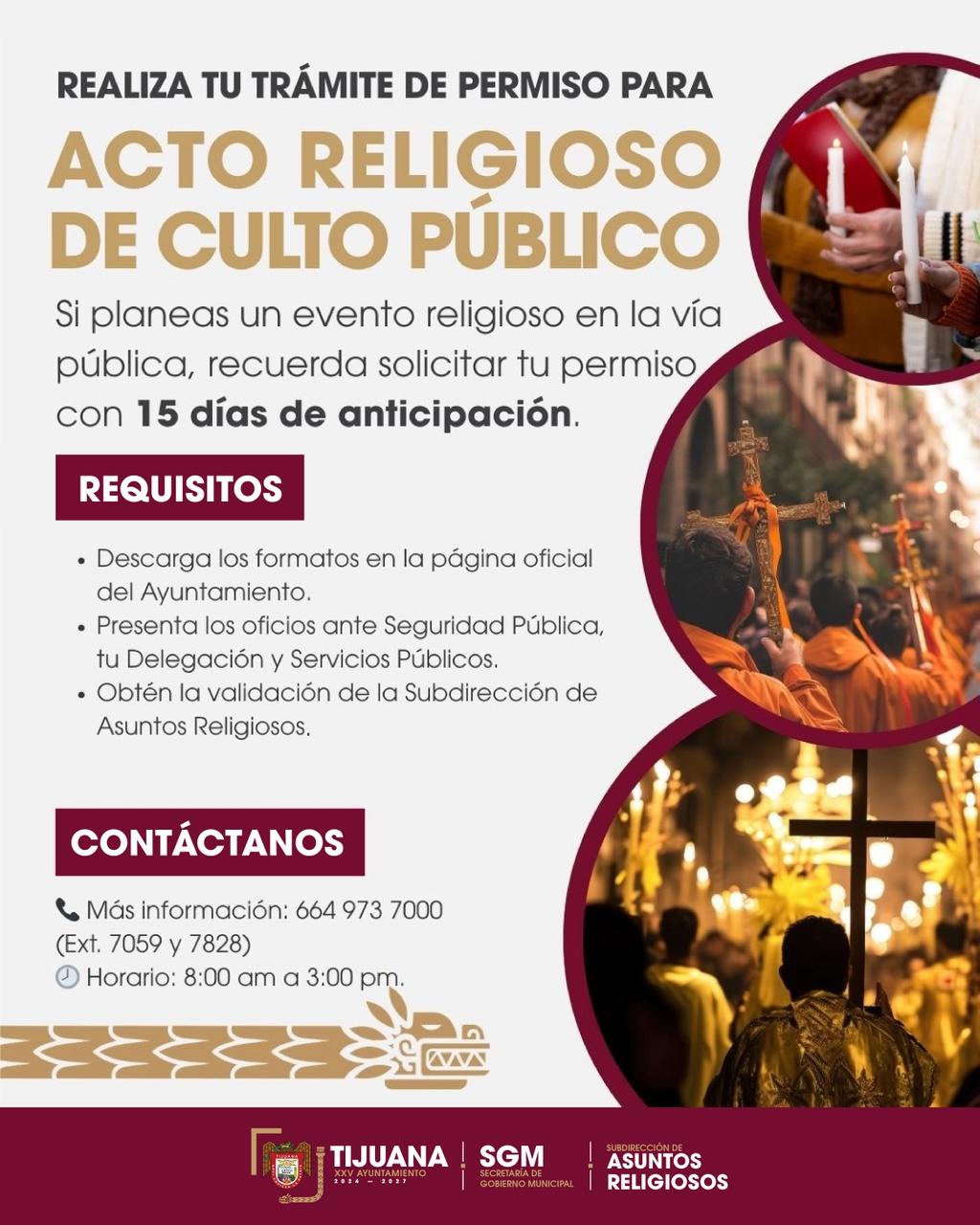
The procedure, which is only carried out in person, requires downloading official forms from the tijuana.gob.mx website, presenting documents to municipal Public Security, the corresponding delegation, and Public Services, and obtaining final validation from the Subdirectorate of Religious Affairs. Up to this point, it might seem like a mere public order measure. However, what has generated indignation is the part that the flyer does not highlight, but which does appear on the municipal portal and in the 2026 Income Law: “The cost per issued permit varies according to the type of event and number of attendees”.
According to the municipal Income Law itself, religious events on public roads contemplate payments equivalent to 26 UMAs or more —around 3,050 pesos as a base—, but which multiply according to attendance and characteristics, easily exceeding 7,000 pesos. Although the site does not publish an official price table, on social networks and groups of faithful, screenshots of fee schedules that confirm this circulate.
Local Catholic organizations and activists have qualified the measure as “extortion disguised as regulation” on acts of devotion to turn them into a bureaucratic and payment procedure. This openly contrasts with historical practice in the city. Previously, opinions and permits have been granted to hold extraordinary religious celebrations on streets and public squares without verifying prior payment of fees, as evidenced in official documents on the municipal portal where similar events were authorized without any mention of economic fees nor the need to “pay fees” before validation.

The annoyance is greater because Holy Week multiplies celebrations on streets and squares, Via Crucis in popular neighborhoods, processions of the Holy Burial, youth pilgrimages, and parish fairs. Traditionally, these manifestations were carried out with a simple permit to close a street or with logistical support from delegations and civil protection. Now, the government requires that everything go through at least four municipal agencies and a collection box.
From a legal point of view, the city council relies on the same article 22 of the Law on Religious Associations and Public Worship, which allows authorities to “prohibit the celebration” if there are risks to security, health, or public order. In recent statements, the municipality itself has invited churches to “manage their permits in time to ensure that activities are carried out in an orderly and safe manner”. The Subdirectorate of Religious Affairs defends the measure as a strict application of federal law.
For the faithful, however, the interpretation is different, seeing it as a limitation on religious freedom. Until now, the ecclesiastical authorities of the Archdiocese of Tijuana have not issued statements; however, in previous days, pro-life demonstrations were held that gathered thousands of people on the streets of the border city. Nor have public statements from leaders of other Christian churches or religious denominations in the city been recorded.
The controversy has transcended Tijuana. In national Catholic groups, there is already talk of “alert” and resources are being prepared before federal instances. At bottom, the debate touches a sensitive nerve: the balance between the right to publicly manifest faith and the State’s faculty to regulate the use of public space.
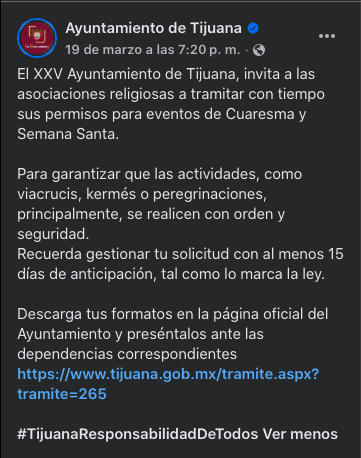
The Law on Religious Associations maintains the principle that ordinary acts are celebrated inside temples and extraordinary ones require notice, but never before in Tijuana had the economic aspect been emphasized so much right at the date of greatest religious fervor of the year and with social media publications by municipal agencies barely disseminated on March 20.
The irony is not lost; the same government that disseminates photos of popular devotion now puts a price on them. Freedom of worship, like any right, is not absolute. But when the State turns it into a variable payment procedure according to the number of devotees —contrary even to previous permits without cost—, many Catholics in Tijuana feel that it is not being regulated… it is being charged. And that, for them, is a heavier cross than the one they carry every Good Friday.