


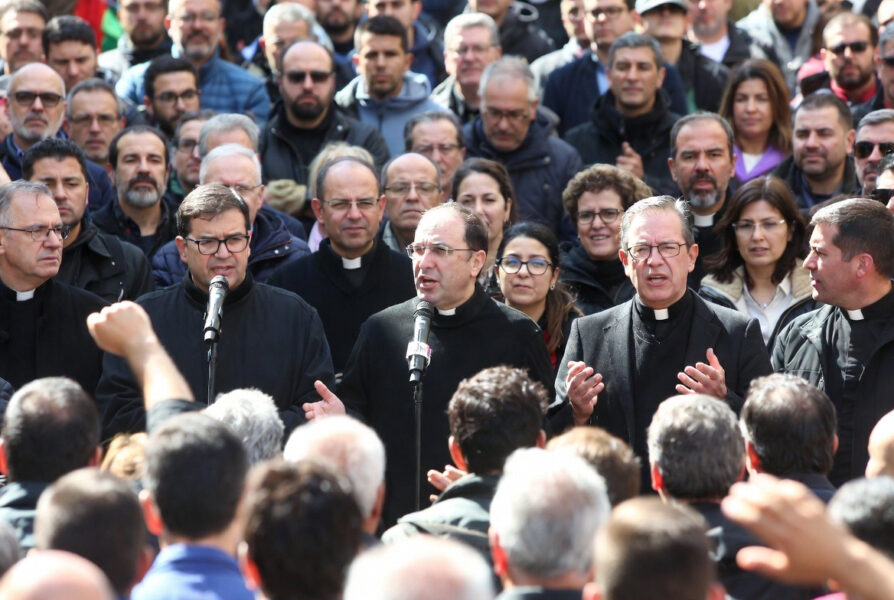
In a context of growing debate on secularism and human rights in Mexico, Senator Pablo Angulo Briceño, from the Institutional Revolutionary Party (PRI), has presented an initiative in the LXVI Legislature of the Senate that seeks to reform article 130, subsection e), of the Political Constitution of the United Mexican States.
Published in the Parliamentary Gazette in February 2026, it seeks to be an effort from the opposition to modernize the legal framework that regulates relations between the State and churches, strengthening the rights of ministers of worship without compromising the principle of secularism. The initiative not only updates anachronistic restrictions but also aligns the regulations with international human rights standards, directly benefiting figures such as Catholic priests, evangelical pastors, and other religious leaders who have historically been limited in their public expression.
The central object of the parliamentary document is a novel reform to subsection e) of article 130, which currently imposes strict restrictions on ministers of worship in the political-electoral sphere. The proposal introduces key changes to balance secularism with freedom of expression. For example, an initial paragraph is added that establishes that «ministers of worship shall not be subject to restrictive measures that may impair the freedom of manifestation and dissemination of ideas.»
This means that ministers, as full citizens, will be able to express opinions on social, moral, or public issues without fear of sanctions, as long as they do not cross specific limits. Among the benefits, protection against marginalization for their opinions stands out; for instance, a Catholic priest could criticize public policies or defend ethical values without being accused of «opposing the laws of the country or its institutions,» an ambiguous phrase from the current text that has generated restrictive interpretations.
However, the reform maintains essential safeguards to preserve state neutrality. It prohibits direct political proselytism in favor of or against candidates, parties, or political associations, especially in public worship acts or in the exercise of their ministry. Additionally, it replaces the generic prohibition of «offending patriotic symbols» with a more precise one, they shall not incite hatred or discrimination in public meetings, religious propaganda, digital media, or religious publications.
Another advance is the explicit recognition of the right to peaceful assembly for lawful purposes, although political proselytizing meetings in temples, worship sites or places are strictly prohibited. Finally, the formation of groups or political parties with names related to religious confessions is prohibited, updating the language for greater legal clarity.
These purposes would benefit ministers by eliminating barriers that turn them into «second-class citizens,» as argued by Senator Angulo. For example, a Catholic priest could participate in public debates on poverty or education without the risk of electoral nullity, as has occurred in historical cases analyzed by the Electoral Tribunal of the Judicial Power of the Federation (TEPJF), such as the one in Zimapán where a municipal election in Hidalgo was annulled due to inducement to vote by ministers of worship in favor of the PRD or the Archdiocese of Mexico with sanctions for criticisms of PRD policies on same-sex marriage and abortion.
The reform aligns these limitations with the pro person principle of constitutional article 1 which requires interpreting norms in favor of the broadest protection of human rights, including freedom of conscience and religion enshrined in article 24.
In the current landscape, the human rights of ministers of worship face evident contradictions. Although the 1917 Constitution and its subsequent reforms promote the universality, interdependence, and indivisibility of rights, article 130 maintains anachronistic restrictions dating back to post-revolutionary anticlericalism.
Ministers cannot associate for political purposes or publicly oppose laws or institutions, which contrasts with freedom of expression, of the press, and of assembly. These limitations are disproportionate in a plural society of the 21st century. According to experts cited in the initiative, such restrictions violate the principle of non-discrimination on religious grounds and do not align with international treaties such as the International Covenant on Civil and Political Rights or the American Convention on Human Rights. In practice, this marginalizes ministers, preventing them from contributing to the common good without implying state interference.
The last five years (2021-2025) have seen concrete examples of Catholic priests and bishops denounced for their opinions on social, political, and moral issues, highlighting the urgency of the proposed reform. In April 2024, the then presidential candidate opponent Xóchitl Gálvez denounced that at least 60 priests were being investigated by the federal Government for expressing political opinions, such as criticisms of insecurity and corruption, in the context of federal elections. This accusation underscores how the restrictions of article 130 are used to intimidate clerics who address social issues such as cartel violence or poverty.
In December 2025, Morena filed a complaint with the Electoral Institute of the State of Zacatecas against Bishop Sigifredo Noriega Barceló for questioning 4T policies related to discontent in the peasant sector and search collectives, calling to attend to «the victims of the 4T,» which was interpreted as an undue incursion into public life that violates secularism and the separation of Church and State.
Additionally, during this period, legislative initiatives have been promoted to further restrict the opinions and activities of ministers of worship, exacerbating tensions. In November 2025, regime-affiliated deputies presented an initiative to reform article 16 of the Law on Religious Associations and Public Worship, seeking to regulate the digital content of priests and pastors on social media under pretexts of «digital neutrality» and «prevention of hate speech».
This proposal, which would require submissions of publications to guidelines from the Secretariat of the Interior and a Digital Transformation Agency, was withdrawn after protests from activists of various confessions, but it evidenced censorship attempts. This style of legislative proposals reflects a pattern of attempts to limit the religious voice in the public space, contrasting with Senator Pablo Angulo’s proposal that seeks to expand freedoms.
Since the 1992 reforms, published on January 28 in the Official Gazette of the Federation, Mexico took a step toward secularism and the recognition of churches. Those amendments to articles 3, 5, 24, 27, and 130 granted legal personality to religious associations, allowed ministers to vote, and moderated prohibitions such as church ownership of property or media. This culminated in a radical and hostile separation.
In 2011, the reform to constitutional article 1 incorporated the pro person principle and the progressivity of rights, strengthening the protection of religious freedom. However, subsection e) of 130 remained intact, perpetuating limitations that did not evolve with democracy.
Senator Angulo Briceño’s initiative contributes at an opportune moment to update regulations on religious freedom. Mexico, as a democratic and secular republic, must fully recognize the human rights of ministers of worship, aligning article 130 with social and legal evolution. This reform, according to the proponent, does not weaken the State-Church separation, but consolidates it, promoting respectful coexistence in a plural society.
The proposal invites a national debate on how to balance secularism and rights, avoiding faith being used as a pretext for discrimination. If approved, it could mark a milestone in Mexican democratic maturity, benefiting not only ministers but all citizens by fostering more inclusive dialogue, especially when legislation on relations between the State and churches needs modernization by recognizing that religious associations are fundamental actors in a Mexico where dialogue and debate must prevail over the authoritarianism and populism of the regime.
Senator Pablo Angulo’s initiative can be consulted here: