


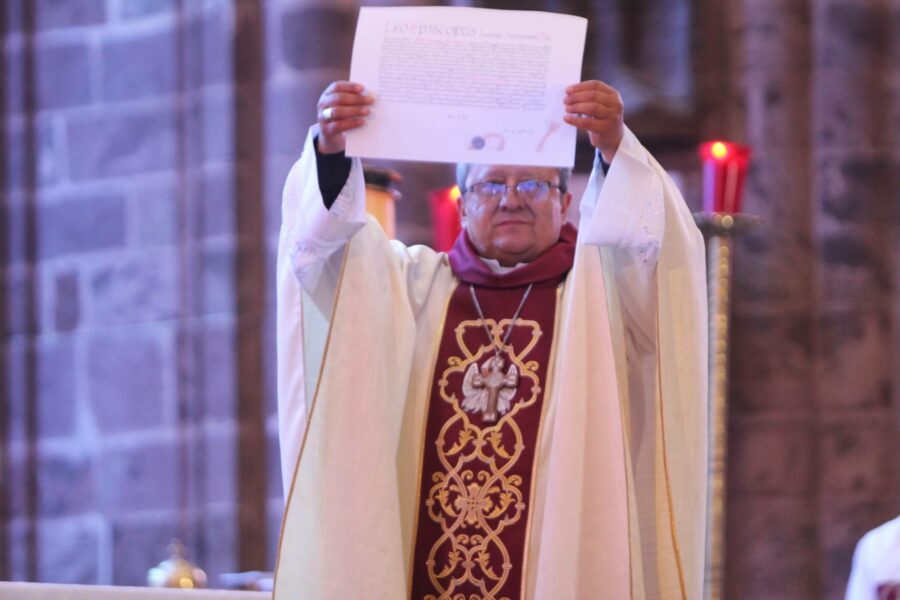
In a ceremony laden with symbolism and hope, immersed in Purépecha culture, Joel Ocampo Gorostieta took possession as the eleventh bishop of the Diocese of Zamora on January 20, in the neo-Gothic cathedral of Our Lady of Guadalupe in that Michoacán locality. With a good number of faithful, priests, and about thirty bishops from various parts of Mexico, the new pastor of the local Church delivered a pastoral message calling to overcome fears, live the faith seriously, and promote justice and peace in a region marked by violence and social challenges.
The arrival of Ocampo Gorostieta began with the profession of faith and the oath of fidelity in Zamora Cathedral, where he reaffirmed his commitment to the Catholic Church and the Pontiff. Subsequently, during the celebration, the papal bull confirming his appointment, issued by Pope Leo XIV on November 20, 2025, was read. The beginning of the episcopal ministry marks a new chapter for the diocese that encompasses regions such as the Ciénega, Lake Chapala, the Purépecha Plateau, and the central valleys of Michoacán, and it arrives in a context of declining priestly vocations and persistent security problems in the state.
Ocampo Gorostieta, 62 years old, arrives in Zamora after a priestly career that has forged him in difficult and complicated environments. Originally from Tacámbaro, Michoacán, where he was trained as a «village priest,» he was bishop of Ciudad Altamirano before this appointment. In his message, he shared personal anecdotes, such as the advice from his sister, a consecrated nun, who urged him to be «a bishop of the people.» He accepted the position after a period of discernment, convinced that «if the Pope asks for it, God asks for it.» His episcopal motto, the axes of his pastoral mission—unity, justice, and peace—summarizes his pastoral vision, emphasizing that peace is «the fruit of justice, a gift from God and a task for us.»
The central message of his taking possession was a call to the Catholic community to overcome fears and commit to an authentic faith. «I invite you to overcome fears and let us live our faith seriously,» exhorted Ocampo Gorostieta, urging that the light of Christ shine in challenging social environments. In a society described as secularist, hedonistic, and materialistic, where God has been displaced, he urged redoubling efforts to recognize and promote the gift of life. He prioritized attention to priests and consecrated life, arguing that «if we are well, we will be able to better attend to our lay faithful whom we must serve with true love, with the love of Jesus Christ, the Good Shepherd.»
Another key aspect was the emphasis on a synodal Church strengthening communion to bring the Gospel to the peripheries, especially to the poor and needy. He invited overcoming weariness, conformism, and comfort zones, promoting active evangelization in mission centers with joy and dedication. Addressing families and pastoral agents, he called for commitment to the catechesis of new generations, transforming the home into «the domestic Church, where one learns to respect the dignity, rights, and life of others.» He did not forget the seminarians, whom he greeted affectionately, nor the Purépecha communities and migrants, sending them a special blessing.
The ceremony was attended by prominent figures such as the Apostolic Nuncio in Mexico, Joseph Spiteri, Cardinal Alberto Suárez Inda, the Archbishop of Morelia, José Armando Álvarez Cano, the Archbishop Emeritus of Morelia, Carlos Garfias Merlos, the Archbishop of León, Jaime Calderón Calderón; José Antonio Fernández Hurtado of Tlalnepantla, Leopoldo González González of Acapulco, and Rogelio Cabrera López of Monterrey, who in his homily spoke of the challenges and axes required in the episcopal ministry: anointing, unity, and the giving of one’s own life.
Civil authorities, including mayors of Zamora, Jacona, Purépero, Chilchota, and Sahuayo, as well as local deputies and public officials, also attended, highlighting the ecclesial and social relevance of the event. Among the bishops present, there was a national representation that underscores the unity of the Mexican Episcopal Conference.
In the context of Michoacán, a state battered by violence, Ocampo Gorostieta’s message takes on particular relevance. The Diocese of Zamora is known for being the birthplace of the Cristero martyr Saint José Sánchez del Río, a symbol of unwavering faith. The new bishop acknowledged this reality, demanding greater Christian witness to transform ecclesial and social life, eradicating acts of violence and promoting peace as a collective task.
With this beginning of ministry, Ocampo Gorostieta invites the community to a process of mutual knowledge, dialogue, discernment, and walking together. He arrives with confidence in divine grace and the spiritual richness of the diocese, without prejudices and with an open heart to serve. His call to intensify prayer for vocations resonates at a time when the seminary, described as the «heart of the diocese,» faces challenges. This event not only strengthens local faith, but inspires the entire Mexican Church to face fears with hope and commitment.