


The murder of the mayor of Uruapan, Carlos Manzo Rodríguez, on November 1st, has exposed like never before the rot of a system where politicians and drug traffickers play on the same field against civil society.
This crime, executed by a 17-year-old teenager in the heart of the city with the National Guard «disappeared» until the moment of finishing off the hitman already subdued, is not an isolated incident, it is the symptom of a lethal symbiosis between organized crime and political power in Michoacán, which threatens to spread to the rest of the country, as denounced by report 32 of Analysis and Social Citizenship of the Catholic Citizenship, a document that, from a Christian ethical perspective, dissects the causes of this crisis and calls for citizen action.
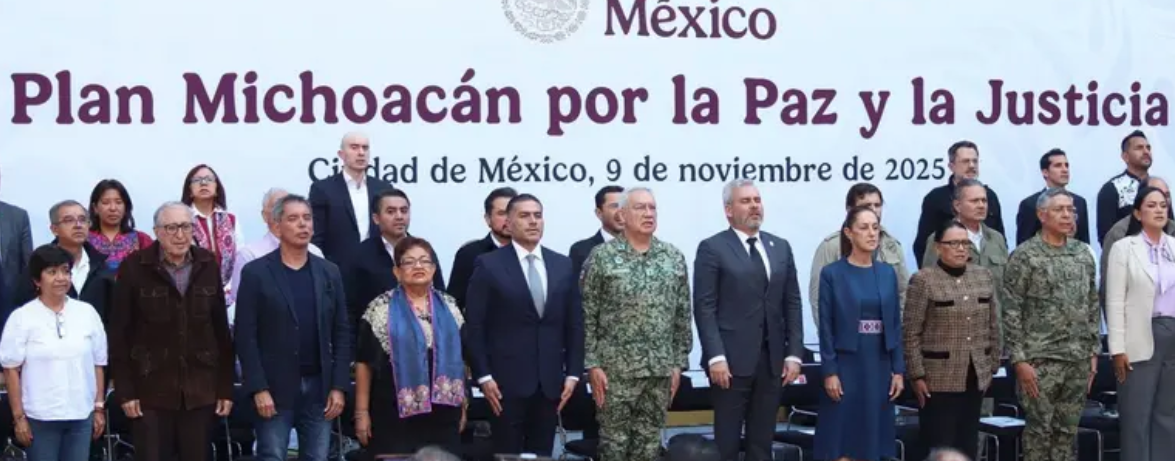
In parallel, President Claudia Sheinbaum presented on Monday, November 10th, the «Michoacán Plan for Peace with Economic Investment», an initiative that promises 15 billion pesos in works and jobs, but which critics see as an insufficient patch given the magnitude of the narco-state.
The report from the “Carlos Manzo Observatory: Michoacán uncovers the dissolution of the rule of law” starts from a quote from the Compendium of the Social Doctrine of the Church (n. 118), which defines as «social every sin against justice» in human relations and against the common good.
In this context, the murder of Manzo –a leader who was growing in moral stature by challenging the federal government and organized crime– is presented as an act of calculated vileness. Captured on video by witnesses, the attack occurred in the central square of Uruapan, in front of a crowd, with the mayor receiving multiple shots from a minor. The National Guard, assigned to his protection, mysteriously absented itself, reappearing only to take down the executor when he was already neutralized by the crowd. «This coordinated action between federal police and the assassins reveals a consolidated narco-state», the document states, citing sources like Publimetro México and YouTube videos on extortions by groups such as Los Viagras, Cárteles Unidos, and Los Blancos de Troya.
It is not an isolated case. The report links this homicide to that of Bernardo Bravo, leader of the Michoacán lime growers, murdered on October 22nd with signs of torture. Both crimes respond to a logic of territorial control: Michoacán, axis of «indomitable criminality», is a geostrategic prize due to its key ports –Lázaro Cárdenas (industrial) and Manzanillo (commercial)– that receive shipments of chemical precursors from Asia and drugs from South America. Airports like Uruapan’s facilitate shipments to the U.S., while modern highways distribute fentanyl and methamphetamines to clandestine labs. «Politicians and narcos converge against civil society, entrepreneurs, industrialists, and peasants», the text denounces, illustrated with Bing and Google maps that highlight Michoacán’s position among these narco nodes.
The report’s analysis delves into the causes, a «symbiosis of interests» between drug traffickers and local politicians, forged in the PRI-PRD struggle and culminated in Morena. Figures like Leonel Godoy (former PRD governor, now federal deputy for Morena), the governor Alfredo Ramírez Bedolla and Raúl Morón (senator and aspirant to the governorship in 2027) are pointed out for their alleged alliance with cartels like La Familia Michoacana –whose leader, Servando Gómez «La Tuta», was a member of the CNTE–. Journalistic evidence, such as reports from Quadratín and El Financiero, link Bedolla to Cárteles Unidos, while polls gave Manzo a crushing advantage over Morón, making him an electoral threat.
The document criticizes the federal response. Sheinbaum took 14 hours to speak out, omitting the victim’s name and blaming «Calderón’s war». Worse still, a «crude setup» in the Zócalo –where a supposed aggressor touched her lasciviously, orchestrated by advisors like Jesús Ramírez Cuevas and Epigmenio Ibarra– served as a distraction, according to media like La Jornada. «This shows the alignment of the National Palace with the interests of the cartels«, the report states, alluding to privileged information from Omar García Harfuch and Lázaro Cárdenas Batel (former governor and collaborator of Sheinbaum).
In annexes, the operations of cartels in Michoacán are detailed: Cárteles Unidos (anti-Zetas alliance, fentanyl producers), Los Viagras (sanctioned by the United States), Los Blancos de Troya (extortionists allied with Viagras), La Nueva Familia Michoacana, Los Caballeros Templarios, and the Jalisco New Generation Cartel, which would have ordered the magnicide in revenge for the capture of «El Rino». A final list enumerates synthetic drugs like cannabinoids, mephedrone, and fentanyl precursors destined for these ports.
In the face of this dissolution of the rule of law, the report calls on Catholic and social citizenship: 1) Examine conscience to reject all corruption; 2) Recover the value of human life, without normalizing the murders of leaders; 3) Join denunciations in marches, networks, and debates with Christian values; 4) Expose the hypocrisy of those who slander critics while hiding corrupt practices; 5) Study successes like the recovery of democracy in neighboring countries; 6) Maintain hope through prayer, empathy, and participation in building peace.
In response to the wave of violence –which includes this murder and recent narcoblockades–, Sheinbaum announced on November 10th the Michoacán Plan for Peace with Economic Investment, a package of 15 billion pesos for 2025-2026. According to her morning conference, the plan includes: rehabilitation of 500 km of highways (3 billion pesos), construction of 10 hospitals and 50 schools (5 billion pesos), job programs for 100,000 young people in agribusiness and tourism (4 billion pesos), and strengthening of the National Guard with 5,000 elements in Tierra Caliente (3 billion pesos). «No more war, yes to peace with social justice», emphasized the president, promising coordination with Governor Bedolla and Senator Morón.
Report 32 can be read here.
Catholic Citizenship and Social Analysis 32