


The Basilica crisis has unleashed severe questions that, at the end of Archbishop Aguiar’s government, imply the meaning of the paths that the Archdiocese of Mexico has taken since 2018. In the end, this potential scandal that carries a clockwork similar to that of a time bomb could explode in the hands of Aguiar Retes himself, uncovering other fronts that are also under the shadows of the opacity that characterizes him.
Many things can be said about the decadent archbishop, and among the cluster of “qualities” are those of promoting and betraying. One of those cases is that of Monsignor Canon Rector of the Insigne and National Basilica of Guadalupe, Efraín Hernández Díaz. Those who know him do not hesitate to affirm that “Efra” is a humble priest and not at all ambitious. According to the national ecclesiastical directory, he was born in November 1961 in Michoacán. He entered the minor seminary of the Archdiocese of Mexico in 1975 and was ordained on May 5, 1990, in Azcapotzalco, during the pontificate of Cardinal Ernesto Corripio Ahumada.
His ministry has been characterized by service and apostolates highlighting his role as director of the Archdiocesan Vocational Promotion Commission, a position he held with dedicated efficiency, and chaplain of the Serra Club for 18 years. His fellow priests appreciate him for his closeness and pastoral commitment; in ecclesiastical announcements, he is described as a «faithful pastor» who responds generously to the divine call. The one writing this knew him personally and on two occasions, one during those collections for the Conciliar Seminary in Iztapalapa, and the impression I had of him was very positive, kind, courteous, diligent, dedicated. The second was when Aguiar Retes took possession of the archbishopric in February 2018, “Efra” and I greeted each other, if not effusively, then with pleasure and joy at reuniting at that moment.
To “Efra” fell the tiger raffle that took him out of his comfortable position in rather discreet roles to be used as a wildcard in the new archbishopric. First, as general economer of the archdiocese and second, as pastor of Capuchinas, a true goldmine that would give him the privilege of being one of the VIP parishes, a system that he designed, in terms of the generous quotas it contributed to Archbishop Aguiar’s piggy bank.
“Efra” seemed predestined for something superior thanks to the change in administration. His personal connection to the Basilica –he was an altar boy in the parish of Santa María de Guadalupe «Capuchinas» and played casual soccer in the atrium – seemed to elevate him to something more serious.
And that was when our archbishop all-terrain placed him, in September 2023, as rector of the most important shrine on a continental level, a position of enormous responsibility that involves managing millions, not only of visitors, but also millions in financial resources.
But he was losing ground… In fact, after the critical articles on the administrative and economic management of the archbishopric published on this blog, I learned of his annoyance, like that of many others, labeling me as an “enemy of the Church”. And so it was that he decreed, emphatically, that this blogger was persona “non grata”, ordering that I be denied entry to any activity both in Capuchinas and in the Basilica. In short…
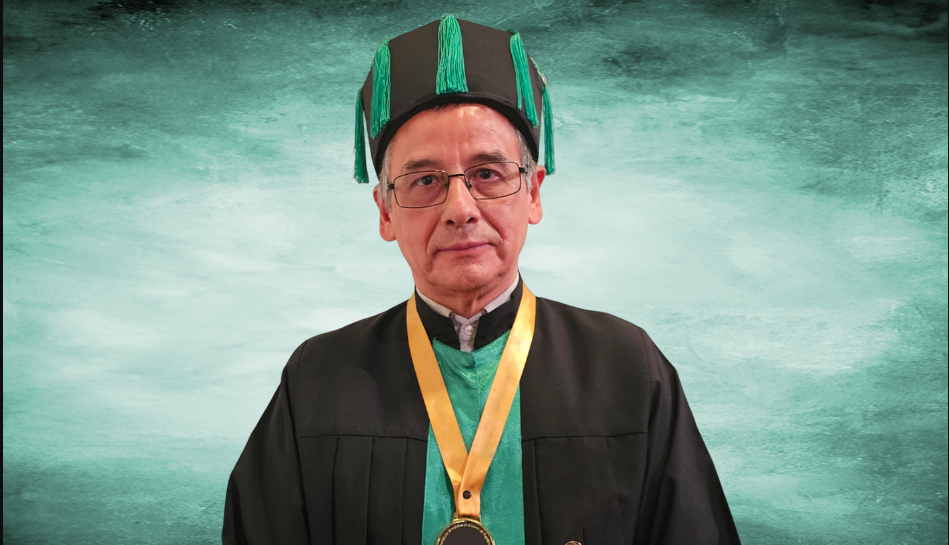
Monsignor “Efra”’s facade of simplicity began to crumble with facts that suggest the opposite. His tenure as rector was noticeable in small things that made it clear that the Basilica was not doing well. “Efra” shielded himself with a couple, his compadres, sinister characters who controlled everything, even bordering on unheard-of violence. VIP visits to the Virgin’s dressing room, decline in the quality of administrative services… but every ego must be fed and “Efra” no longer measured the consequences feeling protected by the pastor. Dubious institutions like one that has self-proclaimed to have the «best Doctoral Cloister in Mexico and the world», gave a “fake” honorary doctorate, with gown and biretta, as evidenced in the photo that accompanies this section, given «with love and pride» for his appointment as rector, highlighting aspects such as a trajectory in social and humanitarian fields (sic). The congratulation evokes a recognition that clashes with his supposed lack of ambitions to get into the showcase of «leaders» in various fields without evident academic rigor, a bonfire of vanities putting into question whether these honors do not reveal a search for personal prestige.
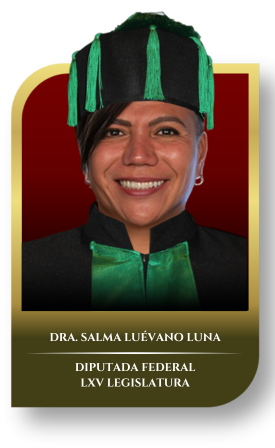
For example, that same institute hands out doctorates left and right, prior fee of course, the same to Pope Francis or to trans deputies like Salma Luévano who in September 2022, went up to the San Lázaro podium to present an initiative parodying a bishop. So the quality of the doctors…
But this climax arrives at the current crisis in the Basilica of Guadalupe that erupted in the last quarter of 2025. Doctor “Efra” has been absent since August, generating uncertainty in the logistics and finances of the most visited temple in Latin America. Questions that the Guadalupe chapter has bravely raised led to his removal in September and a preliminary canonical investigation in October. What follows? This web, wrapped in opacity, has already reached Rome and it is known that things are not well, especially when the Church of Mexico has its eyes fixed on 2031, the 500th anniversary of the apparitions. This scandal suggests something deeper.
Rector Efraín Hernández is a loyal man, but not at all shrewd. And although he is still seen in the Basilica, the chapter knows that his presence is a risky gamble. But in all this, he is not alone… we must look upward, indeed, toward the one who placed him and those around him, especially those agents who have turned the Archdiocese of Mexico into a business that idolizes Mammon.
–00–
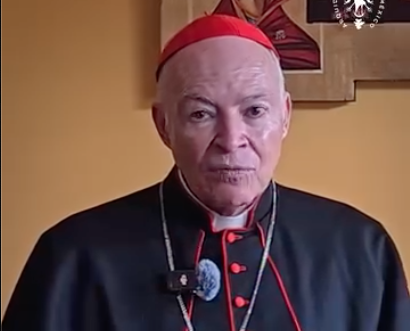
The time of the tithe has arrived. From the commandments of the Holy Mother Church. In one way or another, we know the meaning of this precept and the implications for the life of the community. How attractive is it for this to become a generous contribution rather than an imposition? Since the arrival of Aguiar Retes to the Archdiocese of Mexico, the tithe has been justified in various ways. Through unsuccessful campaigns or under blackmails like that of 2020 when the sweetened archdiocesan media claimed that the tithe was “a special opportunity to calibrate the seriousness with which we assume our faith”
In one of those new gimmicks to get the much-needed tithe, the promotion for this year 2025 corresponded to the beloved pastor. His appearance, to say the least emaciated, contrasts with the arguments to convince the faithful because the tithe, according to the archbishop, is a “need that we all have to put a little of our own to maintain the activities of the Church. That is what the tithe means, that is, a part of yours from what comes in, from what you have in goods, in gratitude to God for receiving life and all the capacities and potentialities that have been developing, give us the tithe…
So accident-prone and stumbling, Don Carlos’s argument concludes that tithe contributions to the archdiocese also go to the Holy See! «Not only does it help the diocesan Church, it is also how we help the universal Church in the different living conditions it has on other continents, by sending that money to the Holy See, to Rome». It would be interesting to know how much the Pope receives from the Archdiocese of Mexico in tithe, after all, it is the money contributed by the faithful. Let the kind reader judge for himself the archbishop’s message. Do you feel like giving your tithe?…
https://youtube.com/shorts/fcYyj7VEVPk?feature=share
–00—
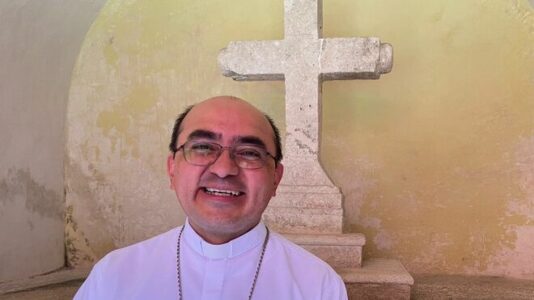
We pause to express congratulations to the second bishop of Cancún-Chetumal, Bishop Salvador González Morales. Curia moderator and vicar general. Ordained bishop in 2019, Monsignor “Chavita” was the one who, practically, exercised government and command in the archdiocese of gimmicks. His sending to Cancún-Chetumal was a blow to Archbishop Aguiar who, in practice, is left without that dam of containment that Bishop Salvador meant between him and the clergy, particularly in the metropolitan cathedral facing a chapter that is not at all docile, very questioning and feisty. Cancún-Chetumal is a young diocese, but with a peculiar characteristic, it is the stronghold of the Legionaries of Christ. Ex-Legionaries and critics of that congregation indicate that the former prelature was a kind of exile territory, in the manner of Don Porfirio with his political enemies in Quintana Roo, for Legionary priests under suspicion of sexual abuses. Bishop Salvador ends an era and will face difficult decisions in a contrasting territory: from the power and economic drive of areas like Cancún to the poverty of indigenous and border regions with Belize like Chetumal. According to the 2024 pontifical yearbook, the diocese has 114 priests serving just over a million Catholics. Since its creation, the prelature suffers from the progressive erosion of Catholicism, typical of the Mexican southeast. With 74 parishes, Bishop Salvador will govern a system created by the Legionaries of Christ that now must embark on other paths, especially to foster native vocations. As of 2023, the diocese had 55 diocesan priests compared to 89 religious (mostly Legionaries), but with an interesting potential, that of the religious sisters who were, until that year, 136. In time, we will see the work of Bishop Salvador… facing an apparatus that may be difficult to tame, that of the Legionaries mired in scandal. Our sincere prayers for a fruitful episcopal ministry. And by the way, it is known that the one in the sights to be «interim curia moderator» is a canon of the Basilica, Monsignor Martín Muñoz.
–00—
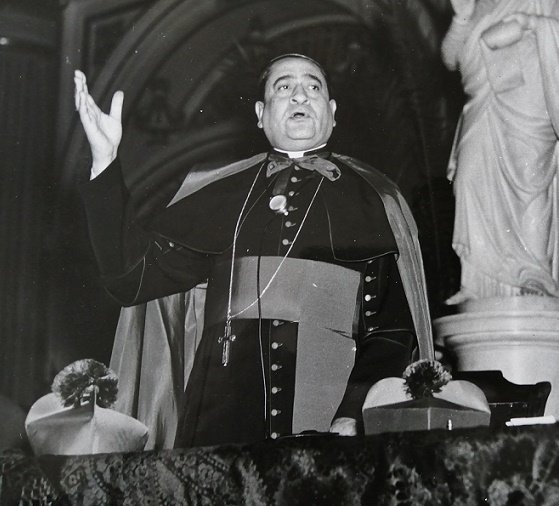
We remember other interesting events in the life of the Archdiocese of Mexico that marked its splendor. This December 20, 70 years were commemorated since the designation of the Bishop of Tulancingo, Miguel Darío Miranda (whose birth 130 years ago is also remembered, on December 8, 1895) as coadjutor of the Archbishop of Mexico, Luis María Martínez. The second Mexican cardinal, created in 1969, was a definitive turning point in the history of the archdiocese. Not only was he one of the conciliar fathers at Vatican II, he also laid the foundations for the administrative organization of the archbishopric that was consolidated with Cardinals Corripio Ahumada and Rivera Carrera.
Nor does a particular Christmas message from Cardinal Ernesto Corripio Ahumada escape memory. On December 22, 1991, a significant date due to the accelerated changes regarding the legal personality of the Church, the prelate said that that Christmas of 1991 “would be very special for the Archdiocese of Mexico” not only because of the new conditions between the State and the Church, but also because the archdiocese was in a “state of synod”. Corripio, in that message, went hard and deep: “In the Archdiocese of Mexico, it is urgent to formulate new legislation on sacraments, administration, and customs that corrects errors and unifies everyone’s work”, he expressed in a particularly special context as he headed toward the golden jubilee of his priesthood in 1992. For those who get excited about “walking together”, 34 years ago, Archbishop Corripio already had it clear: “We must walk together to find adequate responses to the needs of the People of God”.
And finally, in the dawns of 2026, the first archdiocesan pilgrimage presided over in 1996 by the then Archbishop of Mexico, Norberto Rivera Carrera, who on this December 21, 2025, marked 40 years of episcopal life, will be remembered. What is interesting is that in January 2026, 30 years will be commemorated since the first pastoral instruction that he delivered to the Archdiocese of Mexico on the New Age. Rivera Carrera did not arrive empty-handed. He entered the archbishopric with a document that, at the time, generated great expectations to understand everything related to those esoteric currents and their impact on the life of faith. On January 7, 1996, a booklet, “18 Questions About the New Age” was distributed like hot bread so that the written word would reach thousands of faithful: “Very dear brothers and sisters”, wrote the young Archbishop Rivera Carrera, “For greater diffusion and understanding (sic) of the content of my First Pastoral Instruction on the New Age, I present to you this booklet “Eighteen Questions About the New Age”. I hope that the reading of the Pastoral Instruction and the answers on these topics of such timeliness illuminate your faith and lead you to love Jesus Christ and his Church more. Your brother and servant, Norberto Rivera Carrera, Primate Archbishop of Mexico”… Without a doubt, they were different times.