


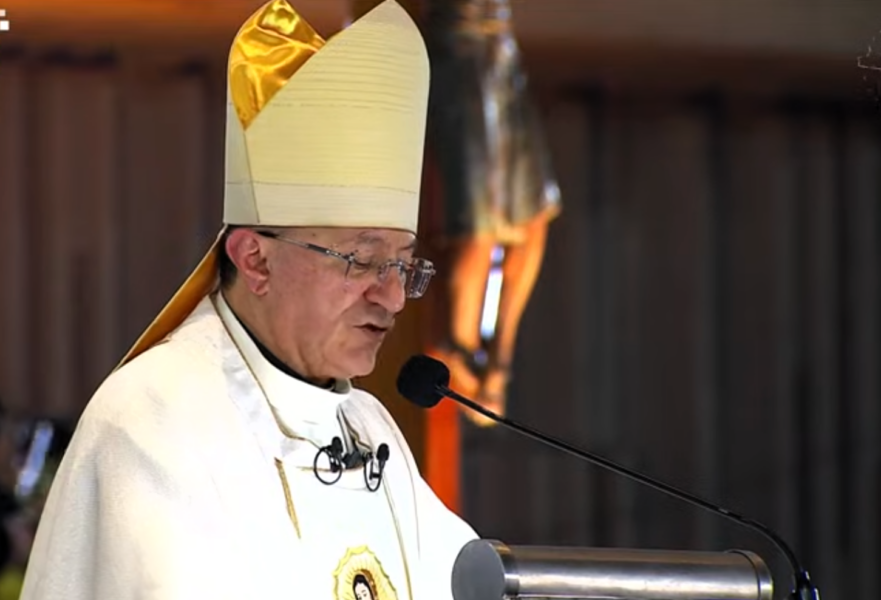
Unusual presence of the apostolic nuncio who presided over the midnight mass
Under the incessant echo of «Las Mañanitas,» millions of pilgrims from Mexico and around the world gathered this midnight at the Basilica of Guadalupe to honor the Morena del Tepeyac. The moving Midnight Mass, presided over by the apostolic nuncio in Mexico, Archbishop Joseph Spiteri, and concelebrated by Bishop Héctor Mario López Villarreal, general secretary of the Mexican Episcopal Conference (CEM), and the auxiliary bishop of El Paso, Texas, Mons. Tony Celino, marked the climax of a devotional day that brought together more than 10 million faithful, according to preliminary estimates from ecclesiastical authorities and civil protection. This massive celebration, which transforms the surrounding streets into a human river of rosaries and candles, reaffirms the Guadalupan rootedness as a symbol of living faith in times of global challenges.
At the start of the Eucharist, Nuncio Spiteri conveyed a special message from the Holy Father Leo XIV, who sent his warm greeting and apostolic blessing to the Mexican faithful, recalling the Pope’s intention to visit the Basilica «some day.»
In his homily, Spiteri, addressing the «dear pilgrims» gathered in the «sacred little house» of the Most Holy Virgin Mary of Guadalupe, «Mother of the true God by whom one lives,» evoked the joy of beginning December 12 under her «gaze full of tenderness.» He recalled how, almost 500 years ago, the Tonantzin Guadalupe chose the hill of Tepeyac to visit the indigenous peoples, represented in the humble figure of Juan Diego Cuauhtlatoatzin. «Not only to those of the Valley of Mexico, but to all the indigenous peoples of this continent, from the far north to the south,» emphasized Spiteri, inviting «all the sons and daughters of the Virgin» to identify with the holy Indian in his filial devotion.
In a passage laden with historical symbolism, the prelate underlined that the apparition occurred at a «crucial moment» of encounter between indigenous people and Spaniards, a «mismatch full of lights and shadows» that did not yet foresee «new realities.» The Virgin, bearer of Jesus in her womb—as in the Sacred Tilma—, does not seek her own glories, but to direct us to her Son, the Redeemer. Spiteri compared this visit to that of Mary to Saint Elizabeth, an act of humble service before the vulnerability of a pregnant elderly woman. «She continues to tell us: with a spirit of service, attention to others’ needs, and fraternal love, we will build something new, unprecedented, for the good of all,» he proclaimed, alluding to Christ’s supreme testimony on the Cross.
Hope emerged as the central axis of the reflection, in tune with the Jubilee of Hope promoted by Pope Francis «of happy memory» and continued by Leo XIV. «Amid everyday anxieties, family and work problems, Our Lady repeats: ‘Do not fear, you are under my shadow and protection,'» quoted the nuncio, words that filled the exhausted multitude with consolation after hours of pilgrimage. Spiteri called for healing the «wounds» of a society marked by injustices, divisions, and lack of respect for human dignity, through a «deeper relationship with Jesus and Mary.» Following Pope Leo, he urged seeking «communion and unity» born of «fraternal service,» to be, like Juan Diego—whose name in Nahuatl means «messenger of precious and divine things»—builders of peace and bearers of hope: “We too will be messengers of precious and divine things, this is the meaning of his name in Nahuatl, messenger of precious things and we too can be these messengers of divine things, we will be with Juan Diego, true builders of peace under the gaze of our Most Holy Mother,” he stated.
The close of the homily was a poetic prayer, greeting the Mother with Elizabeth’s words: «Blessed are you among women and blessed is the fruit of your womb.» He asked for her intercession for peace, justice, and conversion of abusers, to «change hearts that impose themselves with force on the smallest and most helpless.» He invoked strength not to stray from Christ, to strengthen fraternal actions, serve the needy, and be witnesses of light in the darkness. «With you, Virgin Mary, we want to praise the Lord and repeat: ‘My soul magnifies the Lord and my spirit rejoices in God my Savior,'» he concluded, uniting voices in the Guadalupan Magnificat.
This celebration not only honors 494 years of the apparitions but also rekindles the Guadalupan call for a more just Mexico—and world. As Spiteri said: «With our little Mother, animated by God’s love, let us build a fraternal world.» So be it.