


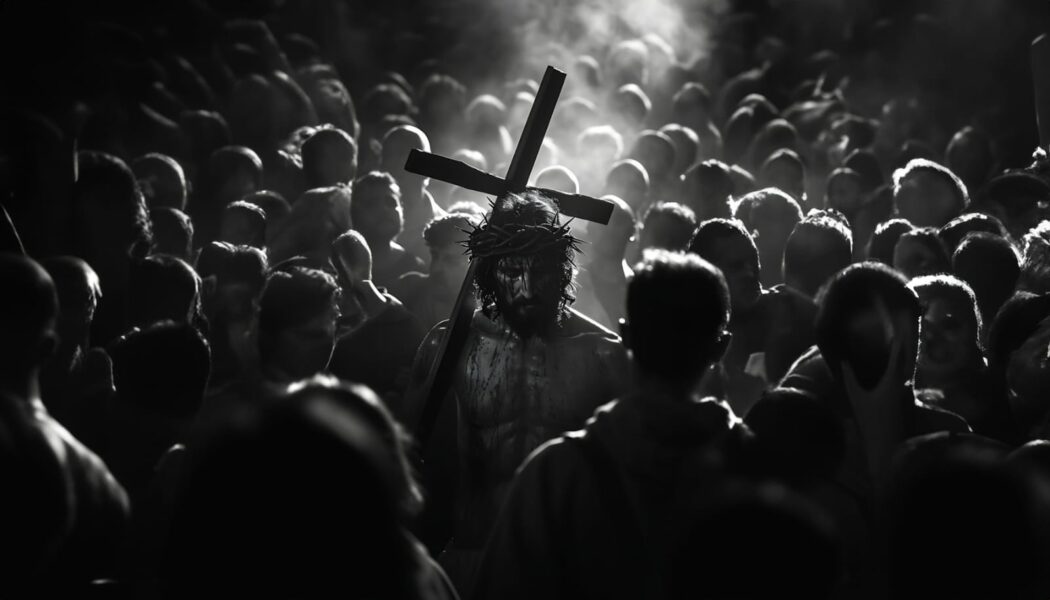
In a message disseminated at the start of Holy Week, the bishops of Mexico have addressed the People of God with a clear and urgent exhortation: “Mexico needs the hope of the Risen Crucified One.” The phrase, pronounced by the archbishop of San Luis Potosí and treasurer of the CEM, Jorge Alberto Cavazos Arizpe, summarizes the core of a document that goes beyond liturgical devotion, directly addressing the pains and divisions of current Mexican society.
The message, sent by the members of the CEM’s Presidency Council, was presented in an official video that is widely circulating on social networks. In it, the pastors recall that the passion, death, and resurrection of Christ “is not just about remembering a past event; it is about opening the heart so that Christ may transform our life and the history of our people once again,” as expressed by the president of the CEM and bishop of Cuernavaca, Ramón Castro Castro.
The Church in Mexico, the bishops affirm, “walks with its people, walks with those who suffer, with those who seek hope, with those who cry out for peace, and with those who cry out for justice.” It is a concrete journey, embodied in the harshest realities of the country: the violence that leaves victims, the families still searching for their disappeared loved ones, and the hopelessness that gnaws at thousands of Mexicans. The CEM’s general secretary and auxiliary bishop of Mexico, Héctor Mario Pérez Villarreal, presented it as the time to “listen to the cry of the poor, of the victims, of those who cannot find their loved ones or who live in hopelessness.”
But the message goes beyond social denunciation. It strongly highlights a concrete and very current purpose: to overcome the polarization that poisons Mexican public debate. The CEM’s vice president and archbishop of León, Jaime Calderón Calderón, recalled the Pope’s invitation to “disarm language.” “By renouncing words that hurt and sowing words that build communion,” he said. In a country where insults, accusations, and polarization multiply easily on social networks and in political discourse, Christ’s disciples are called “to speak with truth, with respect, and with charity.” The cross, he emphasized, “does not divide; it reconciles.”
This call takes on special relevance in a national context marked by deep political, social, and cultural divisions. The bishops do not limit themselves to lamenting reality; they propose a spiritual and ethical path to overcome it. Holy Week is presented as a privileged opportunity to “learn once again to listen,” to listen to God in his Word and to listen to the hearts of brothers and sisters. Listening, in short, is the first step to rebuilding the broken social fabric.
The treasurer Cavazos Arizpe delved into the hopeful dimension of the Easter message. “Evil does not have the last word. The suffering of the cross does not end in the darkness of the tomb. God always opens a new path of life.” Therefore, Easter is “the great hope of humanity.” The Risen Christ demonstrates that “life is stronger than death, that love is stronger than hate, and that hope is stronger than fear.” And he applies it directly to Mexico: “Today Mexico needs the hope of the Risen Crucified One. It needs men and women who live their faith with courage, coherence, and fidelity.”
The first vocal, bishop of Ciudad Valles, Roberto Yenny García, invited concrete communities—parishes, families, youth—to make these days “a time of encounter with God. A time to reconcile. A time to love again. A time to renew our hope.” The second vocal, bishop of Ciudad Obregón, Rutilo Felipe Pozos Lorenzini, entrusted the Mexican people to the intercession of Our Lady of Guadalupe, “Mother who accompanies the faith and hope of our Nation,” and called Jesucristo “Prince of Peace.”
The president Ramón Castro Castro closed the message with an affirmation of closeness: “The bishops of Mexico walk with you. We invite all the faithful, all families, all young people, and communities to live this Holy Week deeply with faith.”
The document is not merely a devotional text. It is a call that unites contemplation and social action. In a country where polarization threatens to fracture coexistence even further, the bishops propose the cross as an antidote, not as an instrument of condemnation, but as a sign of love that reconciles. Holy Week ceases to be just a liturgical remembrance to become a time of collective conversion: conversion of language, conversion of listening, conversion of hope.
Faced with the violence that continues to claim lives, faced with the hopelessness of families of the disappeared, faced with the temptation to respond to hate with more hate, the bishops offer the only truly Christian response, the transformative power of the Risen One. They do not promise magical solutions or political programs, but something deeper: the certainty that Christ’s love can change hearts and, from there, change the history of a people.
This message arrives at an opportune moment. Holy Week 2026 is not just a religious holiday; it is an opportunity for Mexico to pause, look at its reality with sincerity, and decide, as a nation, to disarm the words that hurt and embrace those that build. The bishops have said it clearly: the cross reconciles, Easter defeats evil, and Mexico, more than ever today, needs the hope of the Risen Crucified One.