


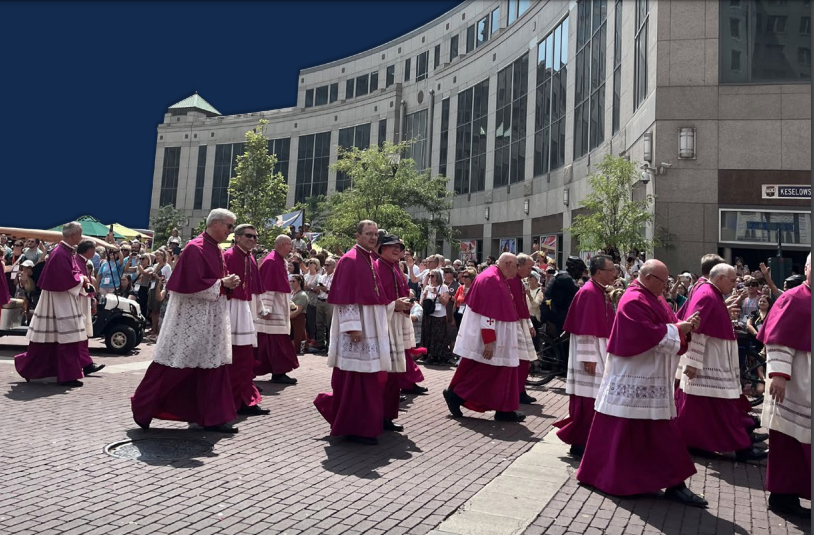
Fr. Hugo Valdemar Romero / The National Study of Catholic Priests 2025, conducted by the Catholic University of America, offers a precise and revealing snapshot of the Catholic clergy in the United States. The report not only measures the personal and ministerial well-being of priests but also highlights a profound generational shift, especially evident among those ordained in the last two decades.
The data confirm a reality that many intuited: the generational turnover is giving rise to a presbyterate that is more conservative, more focused on the spiritual and doctrinal, and less aligned with the sociopolitical priorities that dominated past decades.
On an individual level, the study offers an encouraging finding: U.S. priests maintain high levels of personal well-being, with an average score of 8.2 out of 10 on the Harvard well-being scale.
Pastoral overload remains a significant challenge: 39% of priests report at least one symptom, which is more common among diocesan priests and, particularly, among those ordained after the year 2000, who declare a greater overload of pastoral responsibilities than previous generations.
One of the report’s most striking findings is the clear generational polarization in theological and ideological terms. While more than 70% of priests ordained before 1975 identify as theologically progressive, the landscape changes radically among young priests: more than 70% of those ordained since 2010 describe themselves as “conservative or orthodox” or “very conservative,” and only 8% consider themselves progressive.
This shift is also reflected in the political sphere. Only one in ten young priests identifies as liberal, while approximately half define themselves as conservative to some degree. In previous generations, this proportion was practically the inverse. This change indicates a conscious search for priestly identity, more anchored in doctrine, liturgy, sacramental life, and theological clarity.
Another key aspect of the study is the reconfiguration of pastoral priorities. Although 94% of priests affirm that youth ministry, family formation, and evangelization should be the Church’s major priorities, only 71% have an active youth ministry, revealing a mismatch between ideals and real possibilities.
It is significant that issues such as social justice, climate change, or care for migrants are losing centrality among young priests, unlike previous generations. Instead, interest is growing in Eucharistic devotions, adoration, intense spiritual life, and, in a still minority but growing way, the Traditional Latin Mass. This shift should not be read as social indifference, but as a reaffirmation of the core of the priesthood: sacramental mediation, the preaching of revealed truth, and the care of the Christian people’s spiritual life.
The report also points to a concerning finding: priestly loneliness is greater among the young. 45% of those ordained after 2000 feel at least “somewhat alone,” compared to 27% of those ordained before 1980. This isolation, combined with pastoral burden, partly explains the greater risk of emotional burnout.
Regarding the synodal process, enthusiasm is limited: 37% consider it a waste of time and only 25% judge it useful. However, the majority already practices concrete forms of synodality at the parish level, indicating that the rejection is not of participation, but of models perceived as excessively bureaucratic or ideologized.
Confidence in bishops remains low, though with a slight improvement. 52% trust their bishop: this is evident when the bishop truly cares for his priests.
The generational turnover is shaping a more conservative clergy, more spiritually and doctrinally focused, but also more vulnerable to loneliness and burnout. Far from being just a cause for alarm, this change can be interpreted as an opportunity: a generation seeking spiritual depth, doctrinal clarity, and priestly coherence. The challenge for the Church will be to accompany