


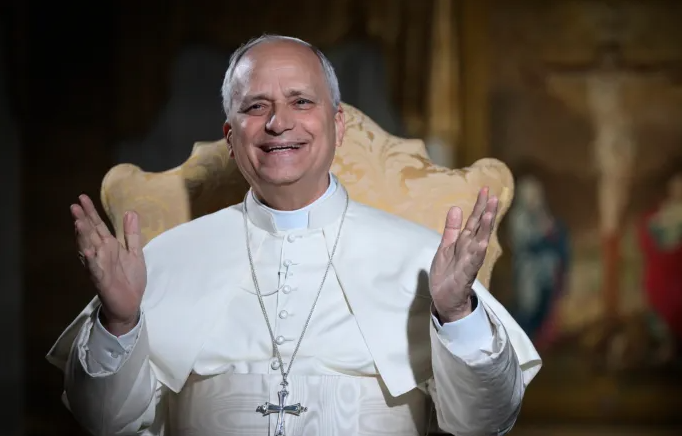
The Record / Cindy Wooden, Catholic News Service.- Pope Leo XIV urged American high school students to be “aware” or “intentional” about the time they spend in front of screens, the time they dedicate to prayer, and their participation in their local parish.
“One of my personal heroes, one of my favorite saints, is St. Augustine of Hippo,” the Pope said to 16,000 Catholic youth gathered in Indianapolis. “He sought happiness everywhere, but nothing satisfied him until he opened his heart to God. That’s why he wrote: ‘You have made us for yourself, O Lord, and our heart is restless until it rests in you.’”
Through a live connection, Pope Leo spoke for nearly an hour on November 21 with participants in the National Catholic Youth Conference (National Catholic Youth Conference, known as NCYC for its English acronym), held at Lucas Oil Stadium in Indianapolis.
The Holy Father responded to questions from five high school students: Mia Smothers, from the Archdiocese of Baltimore; Ezequiel Ponce, from the Archdiocese of Los Angeles; Christopher Pantelakis, from the Archdiocese of Las Vegas; Micah Alcisto, from the Diocese of Honolulu; and Elise Wing, from the Archdiocese of Dubuque, Iowa.
The questions were prepared in meetings with other students and adults and were sent to the Pope in advance.
Pope Leo responded to a question and a comment from Katie Prejean McGrady, who moderated the event. She mentioned that she had given the Pope a pair of socks some time ago and said she wanted to know what word he uses as the starting word when playing Wordle each day.
“I just want to say that I only wear white socks (White Sox) and that I use a different word for Wordle each day, so there’s no fixed starting word,” the Pope said, before moving on to the questions from the young teens.
Pantelakis asked the Pope for advice on how to balance smartphone and social media use with “building faith connections outside of technology.”
Pope Leo, using technology to address the students, listed many good things that technology brings. For example, “it allows us to stay connected with people who are far away,” he said, and there are “amazing tools for prayer, for reading the Bible, for learning more about what we believe, and it allows us to share the Gospel with people we may never meet in person.”
“But, despite all that, technology can never replace real and personal relationships; simple things (like) a hug, a handshake, a smile… All those things are essential for the human being and it’s important to have them in a real way, not through a screen.”
Pope Leo encouraged the students to follow the example of St. Carlo Acutis, who used technology to spread Eucharistic devotion, but limited his time on the Internet and made sure to attend Mass, dedicate time to Eucharistic adoration, and serve the poor.
“Be aware of the time you spend in front of the screen,” the Pope told the young people. “Make sure that technology serves your life and not the other way around.”
Alcisto asked for advice on using ChatGPT and other forms of artificial intelligence.
Although Pope Leo has continued to press artificial intelligence (AI) developers and governments to formulate ethical guidelines and include safeguards to protect young people, he told the high school students that “safety is not just about rules. It’s also about education and personal responsibility. Filters and guidelines can help you, but they can’t make decisions for you. Only you can do that.”
“Using AI responsibly means using it in a way that helps you grow, never in a way that distracts you from your dignity or your call to holiness,” the Pope said. “AI can process information quickly, but it can’t replace human intelligence. And don’t ask it to do your homework!”
AI, he said, “will not judge between what is truly right and wrong. And it will not authentically marvel at beauty, the beauty of God’s creation. So be prudent. Be wise. Be careful that your use of AI does not limit your true human growth.”
“Use it in such a way that, if it disappeared tomorrow, you would still know how to think, how to create, how to act on your own, how to form authentic friendships,” the Pope said. And “remember, AI can never replace the unique gift that you are to the world.”
In response to Wing, who asked about the future of the Church, Pope Leo told the young people that they are an important part of its present. “Your voices, your ideas, your faith matter right now, and the Church needs you,” he said.
But, looking to the future, he asked them to ask themselves: “What can I offer to the Church for the future? How can I help others know Christ? How can I build peace and friendship around me?”
Smothers asked the Pope if it ever felt difficult for him to accept God’s mercy.
“We all struggle with this sometimes,” the Pope replied. “The truth is that none of us is perfect.”
But, he added, it is also true that God always forgives.
“It may be hard for us to forgive, but God’s heart is different,” Pope Leo told the teens. “God never stops inviting us to return.”
“We experience this mercy of God in a special way in the sacrament of reconciliation; in confession, Jesus meets us through the priest. When we honestly confess our sins and accept our penance, the priest gives us absolution and we know with certainty that we are forgiven.”
“Don’t focus only on your sins. Look to Jesus, trust in his mercy, and approach him with confidence. He will always welcome you home,” Pope Leo said amid applause.