


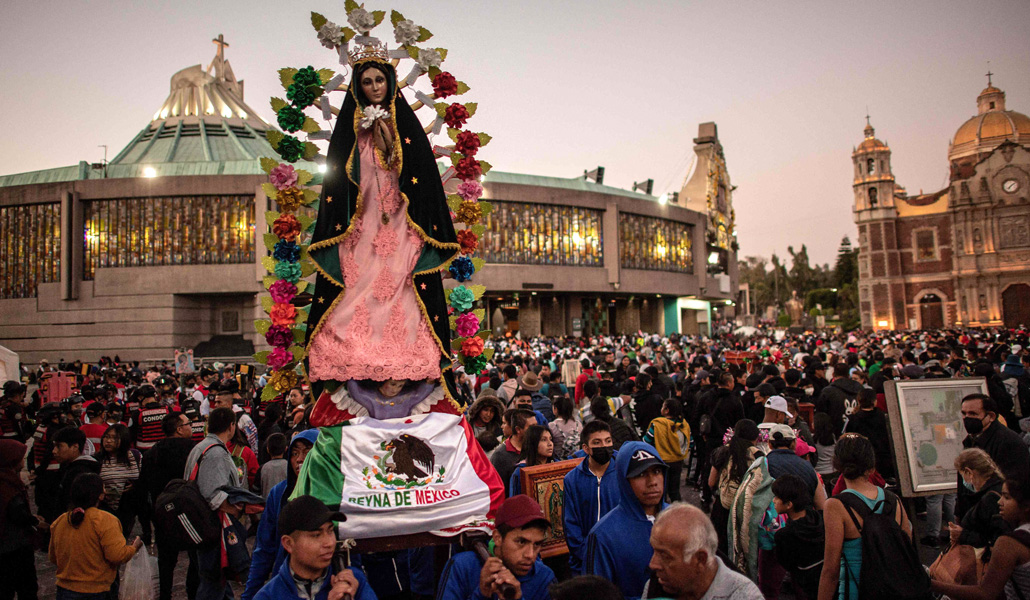
Pbro. José Juan Sánchez Jácome / ACN.– These days when the presence of Mary is felt everywhere, we recognize the immense blessing of being part of a deeply Marian people. It is not only the hope placed in the Most Holy Mary, but also the immense affection expressed toward the Mother of the Savior.
Our people overflow with attentions toward Her and come to manifest, in an emotional and warm way, the love for the Sweet Lady of Heaven. This Marian imprint comes to us especially from San Rafael Guízar Valencia and from the generation of laypeople, families, religious, and priests that he formed, during nineteen years of pastoral care in the lands of Veracruz.
They were very turbulent times due to poverty and the consequences of the revolution, as well as the religious persecution that kept him out of his diocese for several years, although he demonstrated his zeal for souls by continuing to make himself present amid dangers and threats, and by instilling hope through the Most Holy Virgin Mary.
It is, therefore, a devotion that comes from far away and that has marked the pastoral path of our bishops, who have listened to the Marian clamor of this people, as in the Council of Ephesus (year 431) when the faithful gathered on both sides of the basilica door where the bishops met, to shout: “Mother of God!”
The faithful, by asking that this Marian title be officially defined, demonstrated that they already recognized the divine motherhood. It is the spontaneous and sincere attitude of children who know their mother well because they love her with immense tenderness.
Like San Rafael Guízar Valencia, Cardinal Sergio Obeso Rivera was also a Marian bishop. Having established himself as a learned and erudite person, he had the simplicity to allow himself to be instructed by the people of God who also formed him as a person devoted to the Virgin Mary.
In his person, preparation and Marian piety, erudition and Guadalupan devotion were combined. That is why he always had words to provoke admiration and kindle love for the Mother of Jesus, every time he preached about Her in catechesis and liturgy, or when he discoursed on Mary in academic events.
His devotion went beyond the piety and fervor that he visibly manifested, leading him to research and study the Marian mystery and, especially, the Guadalupan phenomenon.
Cardinal Obeso was a pastor who never failed to go out to meet the poor in the Zongolica mountains, in the sugarcane region, in the industrial zone, on the Veracruz coast, and in various rural communities of what was then the Archdiocese of Xalapa.
The older priests remember his Pauline spirit and his almost Olympic journeys, making himself present in the morning in the Sierra de Zongolica and in the afternoon in the remote communities of Altotonga; or, attending academic and cultural commitments in Mexico and then catechizing and celebrating in the various communities.
Just as he traveled throughout his diocese, he had the ability to be present in cultural debate forums in Mexico and abroad, to qualifiedly present various topics of the faith and the Guadalupan fact. I particularly had the opportunity to hear his masterful lecture at a high-culture forum organized in Mexico City.
Regarding his Marian devotion, I would like to refer to one of his last conferences on the Guadalupan event. Fr. Juan Beristain de los Santos organized, in December 2018, at the Colegio México de Coatepec, a forum on the Virgin of Guadalupe with the participation of Cardinal Sergio Obeso Rivera.
With the elegance of his word, he properly cited authors and important figures, making it possible for the topic not to lose interest due to the academic aspects that are usually presented in a reflection like this.
To highlight the religious nature of our ancestors, he emphasized the reflection of Fray Toribio de Benavente, “Motolinía”: “It is hardly possible to find a people so prepared to receive the truth of the Gospel as that of these natives.”
Regarding the questions that continue to exist about the way evangelization was carried out, he highlighted that “the friars were the pride of Christian humanism, for one cannot embrace the Catholic faith without deeply loving the person, whoever they may be, whatever color their skin may be, since we are all brothers. This is the faith that the first friars brought.”
He cited the case of Fray Bartolomé de Olmedo who, when Hernán Cortés reacted furiously to try to place an image after witnessing a human sacrifice from a distance in Cempoala, had the courage to tell him: “Captain, this is not how the faith is spread.”
Cortés heeded the friar’s words because, amid everything, he was a believer, although Cardinal Obeso recalled what was said about him: “Hernán Cortés, from Extremadura, conqueror of Mexico, hearer of Masses and so fond of women that more than a Christian he was considered a pagan.”
After setting the historical context, he underlined how Mary is present in the birth of Mexico as a nation. “What there was at the beginning of the 16th century were different ethnic groups scattered across what is currently the national territory. But suddenly, before the presence of Mary of Guadalupe, they unite so that one can speak of Mexico. Before these events, one could not speak of Mexico. Official history makes us see that Mexico existed before the conquest, but it is not so, nor did the word Mexico exist.”
In this way, Mary of Guadalupe has been building us as a nation. There have been times when Mexico as a nation is in danger and in those moments it has always been able to move forward due to an element of unity that is the presence of Mary of Guadalupe.
The Cardinal pointed out: “I do not say the cult because the presence of Mary of Guadalupe goes from a deep, sincere, perfectly recognized Guadalupanism, to a Guadalupanism that is the acceptance of Mary of Guadalupe with other feelings.”
Mr. Obeso recognized that “Mary of Guadalupe is linked to Mexico in the Catholic religious sense and in other senses that are hardly separable, which gives us unity, and explains how in the adventurous history of Mexico and in delicate moments we have not disappeared due to the presence of the Guadalupana”.
We must consider his words so that amid the polarization we live in, we do not lose hope of achieving unity, for “we are part of a deeply divided country, but a day comes when everyone agrees on the same thing, and we clerics have nothing to do with everything that happens on that day when manifesting love for Mary. It is inexplicable how a divided people suddenly unite around Mary. Mexico is one for one day a year, December 12; all differences are forgotten to unite in the manifestation of love for the Virgin”.
The Mexican has felt in the depths of his heart, as John Paul II says, that: “Mary is a mother… a mother must be loved”. It is exceptional the way the Mexican expresses these days his affection and tenderness toward the Most Holy Virgin Mary. He recognizes and venerates her as his mother since on the hill of Tepeyac she stayed forever with us on the tilma of Juan Diego as the mother of the true God by whom one lives, as Our Lady of Guadalupe who forges the Mexican nation.