


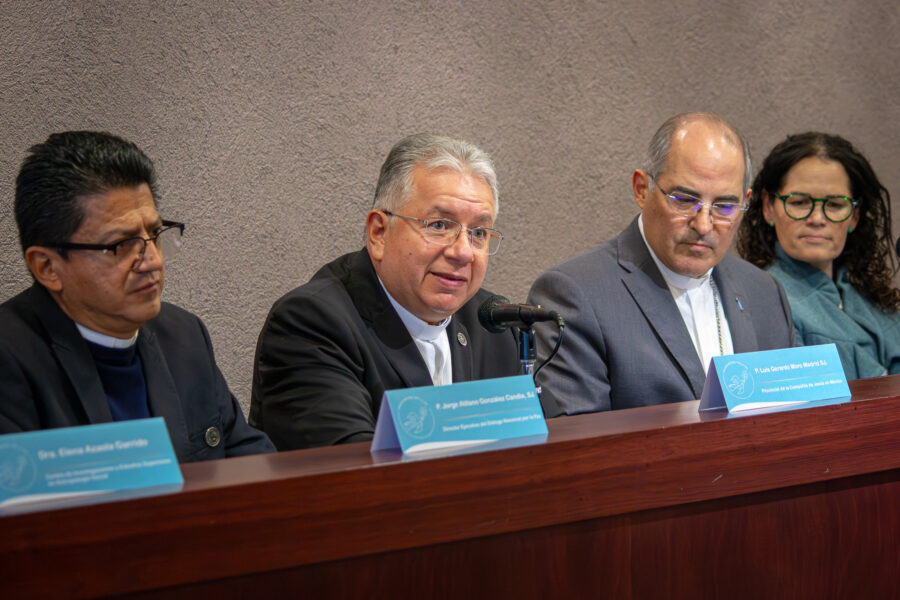
With an urgent call to break the normalization of violence and assume collective co-responsibility, leaders of the Catholic Church, the Society of Jesus, academics, victims, and civil organizations presented the Second National Dialogue for Peace this Monday. The event, to be held from January 30 to February 1, 2026, at the Instituto Tecnológico y de Estudios Superiores de Occidente (ITESO) in Guadalajara, will bring together more than 1,370 people from across the country to move from listening to concrete action: building territorial, sustainable peace beyond six-year cycles.
In the press conference held at the headquarters of the Mexican Episcopal Conference (CEM) on January 12, Mons. Héctor M. Pérez Villarreal, general secretary of the CEM, summarized the historic moment the country is experiencing: “Mexico faces this historic crossroads, this historic decision between continuing to tolerate and manage violence in the midst of which we survive, or confronting it with true proposals to build peace.”
The process was born from deep pain, the murder of the Jesuit priests Javier Campos and Joaquín Mora, along with tour guide Pedro Palma, in Cerocahui, Chihuahua, in June 2022. That crime, framed within hundreds of thousands of homicides and forced disappearances, triggered an unprecedented listening movement: more than a thousand forums across the national territory, more than 20,000 documented voices from victims, indigenous communities, youth, businesspeople, academics, churches, and civil organizations.
From the First National Dialogue for Peace, held in 2023 in Puebla, emerged the National Peace Agenda and a devastating participatory diagnosis: vast territories where the State no longer governs, where violence has become the only law and institutions have retreated before organized crime. That gathering culminated in the signing of peace commitments by three presidential candidates, nine governors, and more than 600 aspiring municipal presidents. From there derived 14 priority local actions such as support for victims, dialogue spaces, education for peace, environmental care, citizen participation, and restorative justice, among others.
In these three years, 26 territorial teams have been formed in an equal number of federal entities, increasingly plural and articulated, with alliances between universities, business chambers, churches, victim collectives, and local governments. , coordinator of the Dialogue, emphasized that they arrive “much more articulated” than in Puebla: “We have managed to form territorial teams in 26 states, with representation from businesses, civil society, churches, victims, businesspeople. We have become a valid interlocutor for governments at all levels, searching mothers, and organizations.”
The diversity of participants who will gather at the ITESO reflects the breadth of the movement that has convened 320 members of state teams, 160 from pioneering municipalities, 40 bishops, 75 priests, 210 laypeople (with special emphasis on youth), 70 Jesuits, 100 university students, 50 businesspeople, 50 victim peace builders, 50 representatives of other religious confessions, and 50 civil organizations, among others. This plural composition seeks to ensure that no voice is left out and that peace is built from all sectors of society.
The Second Dialogue is structured over three intentional days according to the following program: “We Look” (January 30), to confront the structural causes of violence (inequality, impunity, criminal economies, lack of opportunities); “We Interpret” (January 31), to gather successful local and international methodologies (with participation from ambassadors of Ireland, Norway, and Switzerland); and “We Act” (February 1), to build by state a “Local Dialogue for Peace” that identifies resources, needs, and concrete commitments, culminating in an Eucharistic celebration.
It was reported that during the meeting, 10 concrete methodologies developed and tested in various territories of the country will be presented, among which are attention to victims and search for people, peace circles in the prison system, Integration circles, family circles, peace circles in schools, safe spaces for good coexistence, businesses for peace, healing to build peace, life project in youth, and spaces for encounter and integration in mobility contexts.
These tools, systematized over three years of territorial work, include from accompaniment to searching families to mental health initiatives in the Sierra Tarahumara (which has already benefited about 6,000 people), passing through proximity policing models and social fabric reconstruction projects in prisons and schools.
Jorge Atilano González Candia, SJ, executive director, emphasized the phase change: “We are no longer seeking what is happening, but rather that each one in the country joins us, assuming in a co-responsible manner the task of building peace.” Fr. Luis Gerardo Moro Madrid, SJ, provincial of the Jesuits in Mexico, recalled that “for decades we have normalized violence, disappearances, impunity, corruption, injustice, and the pain of so many families.” And he added: “There can be no peace without justice, but a country that is not capable of having historical memory to look forward will never have peace or justice”.
An open call was launched to authorities at all levels and parties, churches, businesspeople (“peace is the best climate for business, but it is necessary to invest in it”), civil society, and especially to youth: “This is your opportunity to build the country where you want to live, not where you want to escape.”
In the second year of President Claudia Sheinbaum’s government, the Dialogue has prioritized tables with searching families for technical proposals at the municipal and state levels for access to justice, has shared a proximity policing model with the Secretariat of Security, and has collaborated in emergencies in Chiapas and Michoacán, always betting on strengthening local institutions rather than “imposed diplomacies.”
Hope, according to the speakers, is not naivety or magical optimism, it is a conscious decision not to give up. Mons. Pérez Villarreal evoked “the noble heart of the Mexican, the spiritual sensitivity, the importance of family and community.” Hernández complemented: “Hope is not giving up, articulating ourselves, and acting from what each one does.”
With 250 projects implemented in 2025 and the certainty that “Mexico is not condemned to violence,” the Second National Dialogue for Peace seeks to turn peace into State policy and shared conviction. Cas the organizers concluded: “Peace is either shared or it will not be.” Guadalajara is preparing to be the epicenter of that collective demand.
In the presentation participated Héctor M. Pérez Villarreal, general secretary of the CEM and auxiliary bishop of Mexico; Father Jorge Atilano González Candia, SJ, executive director of the National Dialogue for Peace; Father Luis Gerardo Moro Madrid, SJ, provincial of the Society of Jesus in Mexico; Ana Paula Hernández, coordinator of the National Dialogue for Peace; Elena Azaola Garrido from the Center for Research and Higher Studies in Social Anthropology; and Brother Luis Felipe González Ruiz from the Conference of Major Religious Superiors of Mexico.