


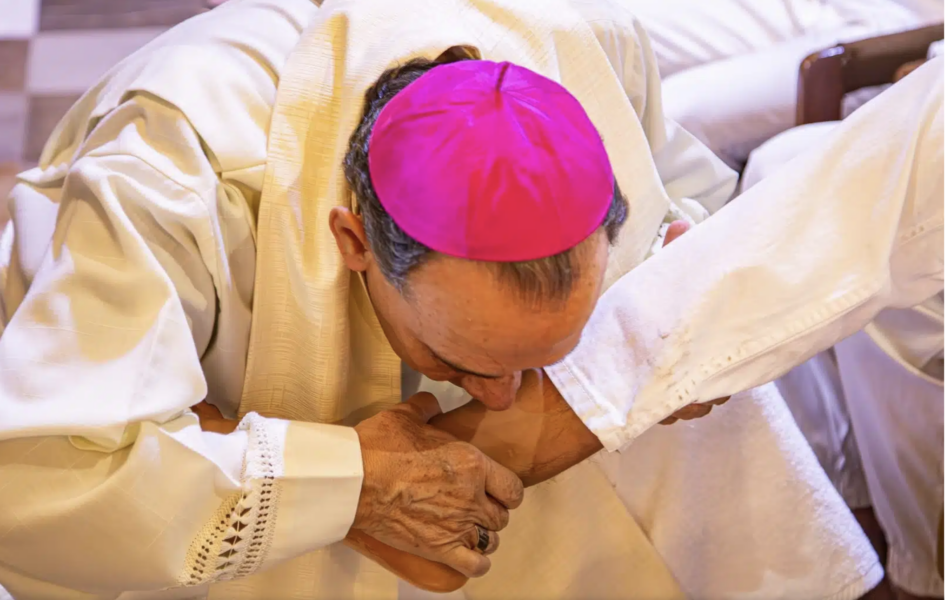
On this Holy Thursday, the day of the commandment of love, of the institution of the priesthood and the Eucharist, in Mexico it is not uncommon to see peculiar celebrations in parishes and cathedrals where representations of the Last Supper, improvised or well-prepared, try to faithfully reproduce what happened that night.
Those who participate in different communities are witnesses to the sincere efforts to worthily represent the apostles chosen to be washed by the celebrant. Dressed in tunics, they simulate the clothes of Christ’s followers in the Cenacle, men and women—from children to the elderly—surrounding the altar as if they were concelebrating the institution of the Eucharist and the greatest commandment.
Other communities do not prepare their actors; they simply set aside one or several places to choose those who can be served through that rite. The aspects can be diverse. There will be very hygienic little fathers who do not want to kiss those of adults and settle for the healthiest feet of babies or very young children, entrust the rite to the deacon or take them evenly, regardless of age and condition, choosing girls, men, women, and the elderly; even some bishops in Mexico have made it a custom to celebrate this day in social rehabilitation centers to perform the washing of feet.
Although this custom has been preserved, ten years ago, in January 2016, the Congregation for Divine Worship and the Discipline of the Sacraments, then presided over by Cardinal Robert Sarah, issued a decree that “opened” the washing of feet.
What was reformed? According to Cardinal Robert Sarah, prefect of the Congregation for the Discipline of the Sacraments, Pope Francis weighed the reform of the rubric on the choice of men for the washing of feet that was in force with the reform of the Holy Week provisions. Prior to the decree, in a letter Pope Francis explains the reasons so that they are no longer only “men or boys.” He explains in one of the paragraphs: ‘After careful consideration, I have come to the deliberation to make a change in the rubrics of the Roman Missal. I therefore decree that the rubric be modified according to which the persons chosen for the washing of feet must be men or boys, so that, from now on, the Pastors of the Church may choose the participants in the rite from among all the members of the People of God. It is also recommended that those chosen be given an adequate explanation of the rite.’ The background of this reform, the same Pope explains, tends to fully express the meaning of the gesture performed by Jesus in the Cenacle, his giving ‘to the end’ for the salvation of the world, his limitless charity.
The decree of January 6, 2016, from the Congregation for the Discipline of the Sacraments, made public on January 22, deemed opportune the considerations of the Holy Father in order to reform the rubrics and guide a different disposition from that contained in the Roman Missal of Paul VI to be applied in that Holy Week that began with Palm Sunday, March 20. In this way, it was provided that »The chosen ones among the People of God are accompanied by the ministers so that the pastors may choose a group of the faithful that represents the variety and unity of each portion of the people of God. That group may be formed by men and women and, appropriately, by young people and the elderly, healthy and sick, clerics, consecrated persons, laity.” Both the papal letter and the decree of the Congregation affirm that the faithful must be prepared by adequate instruction “so that they may participate in the rite responsibly, actively, and fruitfully”.
What was the state of affairs until before the letter that motivated the decree of the Vatican Congregation? If we are observers, the rubrics of Paul VI’s missal address the reform made by Pius XII for the restoration of Holy Week through the Decree Maxima Redemptionis Nostra Mysteria of November 30, 1955. The Instruction of the aforementioned decree advises the washing of feet according to the “pastoral good” of the communities, so from this reading, it could well be performed or not. Pius XII introduced into the Mass of Holy Thursday a rite that came to be complementary in the Eucharistic celebration of the sacred triduum. The washing rite should serve to better understand the precept of Christian charity as it was in the beginnings: “I give you a new commandment…”. In short, it had a pedagogical intention.
The Apostolic Constitution on the Roman Missal of April 3, 1969, elaborates on the essence of Pope Pacelli’s reforms by considering that: “Pius XII initiated this work of revision with the restoration of the Paschal Vigil and Holy Week, which constituted the first step in adapting the Roman Missal to the way of being of contemporary mentality”.
Nevertheless, the pandemic forced the suspension of the washing of feet, but once the so-called health emergency passed, the representation of the Last Suppers returned. Perhaps in these times, there will be an exaggerated openness and it will be reduced to theatricalities that lose the meaning; however, the core of the celebration is the paschal supper that is illuminated by the gesture of the Lord Jesus Christ, Master, who becomes a servant by washing feet, a celebration of service, of humility, so that we can all imitate this same gesture in ordinary life.