


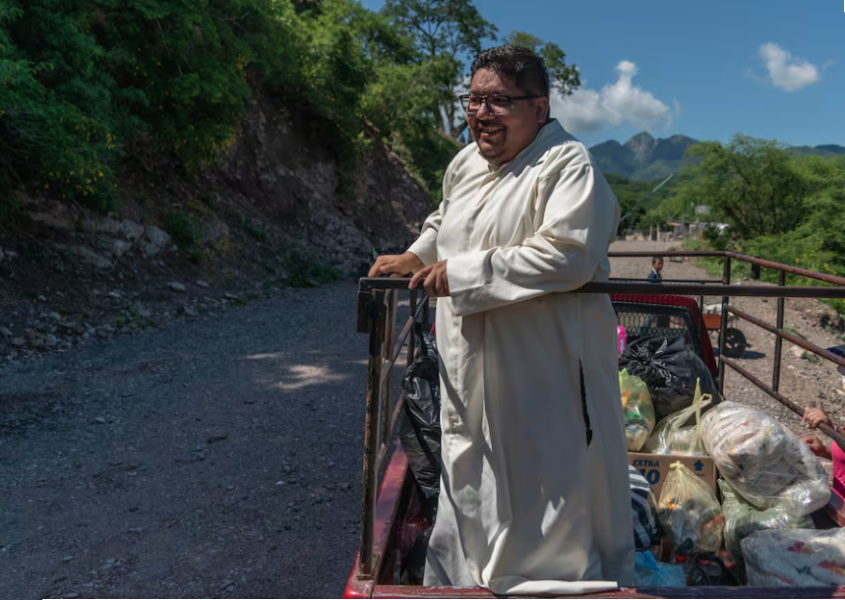
Due to the incessant and growing violence in the state of Guerrero, Fr. Filiberto Velázquez Florencio, Father Fili, has been displaced from the State of Guerrero and the diocese of Chilpancingo-Chilapa due to direct threats from organized crime. The decision, made public by Bishop José de Jesús González Hernández on January 4, 2026, responds to the lack of security guarantees for the priest who has dedicated years to the defense of human rights and mediation in armed conflicts.
Filiberto Velázquez, originally from the State of Mexico, founded the Minerva Bello Human Rights Center in 2018, an organization headquartered in Chilpancingo, which has become a pillar for victims of violence in Guerrero. Since its creation, the center has accompanied families of the disappeared, internally displaced persons, and those affected by clashes between cartels. One of its most notable efforts has been the legal representation in the case of the Ayotzinapa normalista student, Yanqui Kothan Gómez Peralta, murdered by state police on March 7, 2024, in Chilpancingo.
Beyond documentation and denunciation, Father Fili has acted as a mediator between criminal groups, a risky task that began under the previous bishop, Salvador Rangel Mendoza (2015-2021). In February 2024, he facilitated a peace agreement between Los Ardillos and Los Tlacos, known as the Cártel de la Sierra, which ended a wave of violence that paralyzed Chilpancingo and left more than a dozen taxi drivers dead. Subsequently, he intervened in a ceasefire between Los Tlacos and La Familia Michoacana in the municipality of Heliodoro Castillo, stopping confrontations that caused dozens of deaths, suspensions of public services, and forced displacements creating dozens of ghost towns. These humanitarian mediations have allowed the delivery of aid to isolated communities in the Sierra and the Central region of Guerrero, where the state has failed in its security obligations to the population.
In 2021, Velázquez also established the Casa del Peregrino, a shelter in Chilpancingo that provides lodging to family members of patients at the Raymundo Abarca General Hospital, a commitment to the most vulnerable, extending his pastoral work toward direct social assistance. However, these actions have placed him in the sights of organized crime, which sees his interventions as a threat to their territorial and economic interests.
The threats against Father Fili are not new. On October 10, 2023, he survived an attack on the Tixtla-Chilpancingo highway, where his vehicle was shot at. This incident led the federal government to assign him personal bodyguards through the Protection Mechanism for Human Rights Defenders and Journalists, including elements of the National Guard. Despite this measure, the intimidations persisted, including smear campaigns on social media. On October 30, 2025, from his Facebook account, he denounced «informative» publications linked to the Chilpancingo city hall that indirectly accused him of ties to armed actors. «His only commitment and vocation has been to the peace of Guerrero, to the victims, to the communities, and to life«, he wrote, holding the authorities responsible for any attack on his integrity.
This smear campaign, which included accounts related to local political power, not only damaged his reputation but also increased the real risk to his life. In December 2025, in an interview with the newspaper El Sur, he reiterated: «The publications circulating today lack evidence. They indirectly impute criminal acts to me. They damage my honor and good name and, most seriously, place me in a situation of real and imminent risk.» These statements underscore how stigmatization from official structures exacerbates the vulnerability of defenders.
The turning point came in October 2025 when he was appointed interim parish priest of the San Cristóbal church in Mezcala, following the murder of Father Bertoldo Pantaleón Estrada who disappeared on October 4 and was found dead two days later with a gunshot to the head, in his truck near the Mexico-Acapulco highway. Velázquez took up the position on October 14 but abandoned it on November 15 amid escalating threats. Bishop González Hernández explained that, although he had escorts, «when there are direct threats to the person, even with guards, well, you see what happens.» Citing the case of Emeritus Bishop Rangel, who also suffered consequences for his peace efforts, the prelate emphasized: «We are involved in the fray, and the one who gets involved seeking reconciliation ends up affected.»
The decision to displace Father Fili was made by the diocese in the face of the state government’s apathy, which did not provide additional guarantees. Initially, his departure from the country to Canada for an indefinite period was proposed with instructions to maintain a low profile. However, he was relocated to Chiapas where he continues his work discreetly. The bishop confirmed that he is in good health but insisted that the Church does not seek more martyrs: «We do not want more priests murdered.»
In Guerrero, organized crime has intensified its attacks on religious figures who intervene in dispute zones, such as the Sierra and the Central region. Velázquez’s displacement not only leaves a void in human rights defense but also evidences the failure of the authorities to protect those who fill the gaps left by the State.
Organizations like the Minerva Bello Center continue to operate, but without their founder, they face greater challenges. Father Fili, in his last statements, urged an end to criminalization from political power and to prioritize peace. His forced departure is a reminder that, in Guerrero, the search for reconciliation can cost freedom or life. Meanwhile, the diocese calls for prayer and action so that these episodes are not repeated, in a failed state where violence seems endless.