


In the last weeks of October 2025, Mexico has witnessed a tragedy that, although it could not be avoided, could have been reduced in its consequences: the intense rains that battered the states of Hidalgo, Veracruz, and San Luis Potosí have left a devastating toll. More than 13 thousand homes affected, entire communities flooded, dozens of deaths, and chaos that reveals the chronic vulnerability of our infrastructure to increasingly extreme weather phenomena.
According to official reports, the overflow of rivers such as the Amajac in Hidalgo and the Moctezuma in San Luis Potosí have isolated and displaced thousands of families, while in Veracruz, municipalities like Poza Rica and Tamazunchale were submerged in mud and desperation due to the rising of the Pánuco River. This catastrophe is not just a whim of nature; it is the result of decades of negligence in risk prevention, aggravated by a government that prioritizes image over concrete action.
President Claudia Sheinbaum, barely in her first year of mandate, has tried to position herself as a close and empathetic leader. She has made repeated visits to the affected areas—three times in Tamazunchale, according to her own office—, supervising damage censuses and promising unconditional support. In morning conferences, she has detailed advances: more than 13 thousand homes censused, deployment of armed forces and federal resources for cleaning and reconstruction. However, this response seems more like a political damage control exercise than an integral strategy. Where were the preventive alerts? Why does the Natural Disasters Fund (Fonden), dismantled by her predecessor and not adequately rebuilt, leave the states in improvisation? Instead of robust coordination, we see a government that reacts late, with vague promises of «no one will be left helpless,» while the victims protest the slowness in delivering aid.
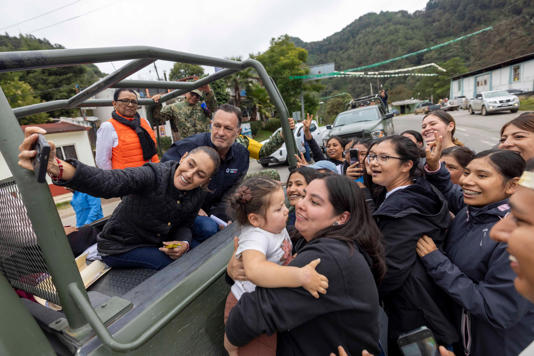
However, the most criticizable are the photographs circulating on social networks and official media: Sheinbaum walking on muddy streets with dirty clothes, surrounded by people from devastated communities in a “maternal” exercise of protection. These images, widely disseminated on platforms like X, aim to project a «people’s» president who is not afraid to get her hands—or shoes—dirty for her people. A viral post from Morena sympathizers praises her for «walking in the mud alongside her people», contrasting with López Obrador’s distancing in past disasters. However, this staging borders on cynicism. Is it genuine empathy or an image wash with mud? In a context where her party, Morena, faces a deep crisis of credibility, these photos seem like a desperate attempt to humanize a regime splattered by scandals. Critics on social networks, like opposition accounts, accuse her of not wanting to «get her feet wet» in initial virtual meetings, only to appear later in calculated and well-taken photos.
This visual maneuver cannot hide the underlying rot. Morena, the party that promised to eradicate corruption, is now sunk in it. In 2025, the «Anuario de la Corrupción» by Mexicans Against Corruption documents 51 cases in Sheinbaum’s first year, from diversions in social programs to ties with organized crime in customs and hydrocarbons. Key figures in the “movement” are wrapped in accusations of excessive luxuries, nepotism, and protection of narcos, according to investigations by The New York Times and El País.
Polls reveal that these scandals have eroded Morena’s electoral support, with disillusioned voters over the gap between the austerity discourse and the reality of an illicitly enriched elite. The president, pressured even by the United States on migration and drug trafficking issues, tries to distance herself, but her silence on these cases makes her complicit. How to believe in a leader who poses in the mud while her “movement” sinks in the swamp of impunity?
This crisis is not just about rains; it is structural. Mexico needs preventive policies, not opportunistic photos. Sheinbaum must prioritize transparency and accountability, not the “redemptive” spectacle. Otherwise, her legacy will be one of drowned promises. In the end, walking among the disaster is equivalent to trying to whitewash corruption with mud.