


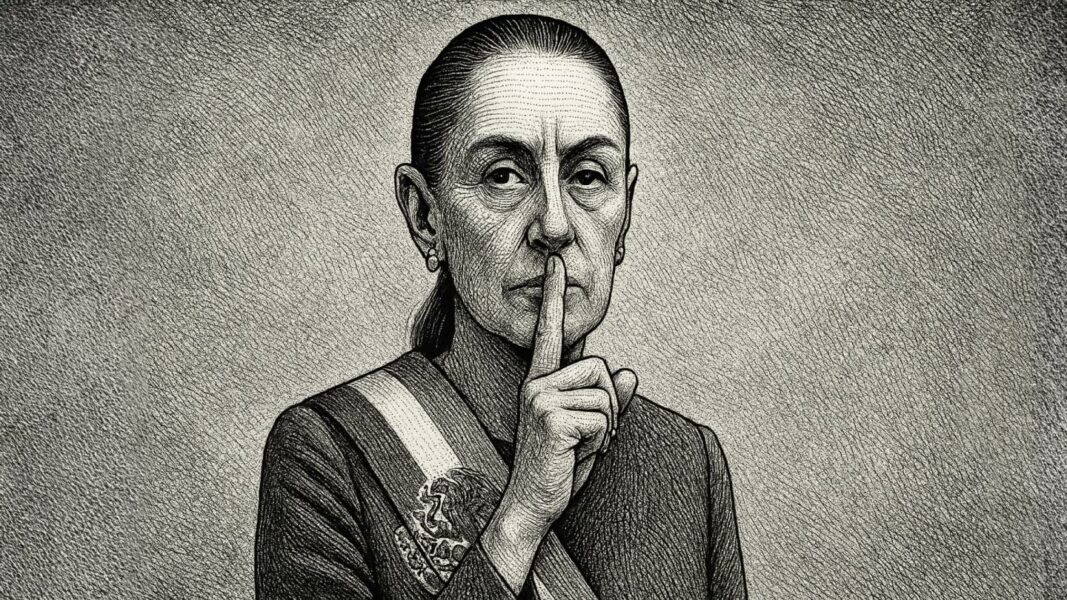
Following the demonstrations of the Generation Z march, President Claudia Sheinbaum, in her morning press conference, gave a statement that mixes challenge and denial. She rejected «falling into provocations» and attributed the unleashed violence to the «Marea Rosa», to the “international right” and to opposition politicians, exonerating the young demonstrators. «No to violence; no one stops the Transformation», she proclaimed, culminating with a worrying and very unfortunate refrain of self-proclaimed invincibility: «I am stronger, stronger. Here we are strong with the people, very strong». She ordered investigations to the Prosecutor’s Office, but her tone, far from inviting dialogue, seems like a wall erected against criticism.
This rhetoric is not harmless. The Z march, which gathered around 17 thousand people in its first edition and saw a waning but symbolic participation on November 20, is not an opposition whim. It is a collective cry for justice, transparency, and security in a Mexico where everyday violence—femicides, disappearances, and corruption—devours hopes.
Sheinbaum invokes Martin Luther King and Nelson Mandela to legitimize her peaceful movement, but she ignores that those icons did not deny social fractures: they embraced them. By blaming «external provocateurs» and boasting of an unbreakable strength, the president not only minimizes the discontent—which demands accountability for the failure in the promised peace—but projects an image of artificial power, built on narratives that the people already question.
This pose of invulnerability evokes Latin American leaders who, drunk on their apparent omnipotence, ended up toppled by reality. The last PRI administration rose on the “strength” of structural reforms that it painted as shielded against corruption while it crumbled under scandals like the White House and Odebrecht, leaving a legacy of impunity that propelled the rise of the 4T.
Beyond borders, Alberto Fujimori in Peru (1990-2000) proclaimed himself «the indispensable savior», dissolving Congress in a self-coup and boasting of an «invincible» economy against terrorism. His initial «fujishock» shone, but corruption and tremendous popular discontent after the “fujimorazo” took advantage to leave the country in 2000, resigning from the presidency from Japan on November 19, 2000; later extradited and convicted. In Venezuela, Hugo Chávez did not fall in life, but his legacy of «eternal revolution»—where «imperialism does not stop us»—has incubated a country that can no longer bear the feigned Bolivarianism that covers the narco-state in the current crisis, with Nicolás Maduro clinging to a power that the people no longer support. These cases illustrate a pattern: the boasting of artificial strengths, fueled by media control and denial of failures, accelerates the fall. Sheinbaum, by hanging her strength on pins, risks the same fate, not from external weakness, but from internal disconnection.
And on this Sunday, November 23, 2025, the Catholic Church celebrates the Solemnity of Christ the King of the Universe, a providential counterpoint to these earthly proclamations. Instituted by Pius XI in 1925 to counter totalitarianism, this feast proclaims Jesus not as a monarch of invincible armies, but as a crucified King, whose power lies in humility, service, and surrender. «My kingdom is not of this world», he said in his trial (Jn 18,36); his crown, of thorns, not of laurels.
In the face of Sheinbaum’s «strength»—an echo of Caesar more than of Christ—, the liturgy invites an authentic royalty: the one that listens to the marginalized, dialogues with the dissident and transforms not by decree, but by justice.
The convulsive transformation that Sheinbaum defends deserves more than raptures feeling like the mother of the people; it demands accountability, real reforms in security, and a government that does not fear criticism, but welcomes it as an ally. Otherwise, her «I am stronger» could become the epitaph of an era. And history is an exceptional teacher. Mexico, wounded but resilient, yearns for leaders who reign by serving, not by presuming. Today, on the feast of Christ the King, it is right to pray for that conversion, from artificial force to the true one, the one that elevates all.