


The start of 2026 will dawn with an ecclesiastical landscape of challenges and not without complications, marked by the urgency of renewal and action. Amid political polarizations and constant tensions with power, the pretensions of a new electoral reform that threatens with an excessive concentration of power in the hands of the official party, the Catholic Church of Mexico faces a crucial year in the midst of a society fractured by violence, inequality, and rampant secularization.
While the country grapples with political and social crises, the ecclesiastical hierarchy also faces a complex year due to its challenges and objectives, such as the strengthening of the National Dialogue for Peace, the evangelizing impetus ahead of the 500th anniversary of the apparitions of the Virgin of Guadalupe, and the formation of new episcopal leaderships.
The National Dialogue for Peace, whose second edition will be held in Guadalajara from January 30 to February 1, 2026, at the Instituto Tecnológico y de Estudios Superiores de Occidente (ITESO), the Jesuit University of the city, is one of those open fronts that has been weaving with fine networks to mend the torn social fabric. Convened by the Conferencia del Episcopado Mexicano (CEM), along with churches, universities, businesses, and civil organizations, this gathering seeks to «stop the pain and barbarity» that afflict the country.
Following the first dialogue, held in previous years with limited echoes, this sequel emphasizes youth participation recognizing the need for fresh voices to counter apathy. However, the Church seems to be preaching in the desert; although it has invested significant resources to promote these initiatives, it faces the skepticism of a society that questions its real influence and proven roots. In a country with more than 100,000 disappeared persons and entire communities under the yoke of crime, dialogue must translate into concrete policies that rebuild what has fallen and unite what has been fractured.
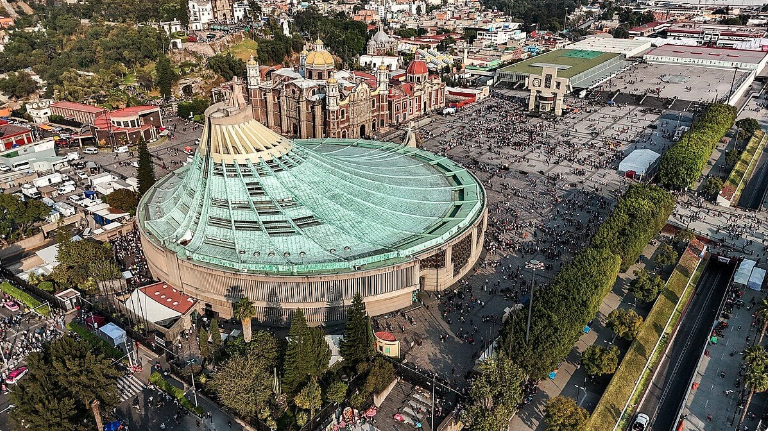
Parallelly, the impetus for evangelization gains relevance ahead of the 500th anniversary of the apparitions of the Virgin of Guadalupe in 2031. Since 2022, the Basílica de Guadalupe has begun preparations with the motto «De tu mano y cobijo celebramos 500 años de signos de tu presencia 1531-2031», including intercontinental novenas and actions to rekindle devotion. The bishops of Mexico have invited the faithful, with quite limited echo, to prepare the Church for the jubilees of 2031-2033 as an opportunity to revitalize faith in a Mexico where Catholicism, though majority, is losing ground to agnosticism, in addition to suffering the lashes that, from officialdom, are supported to prevent bishops from speaking without fear of threats. The Guadalupana, symbol of mestizaje and consolation, united a divided people, but only if evangelization transcends folklore and addresses real injustices, such as poverty and forced migration, and in this, 2026 holds an important message, that of being the year of the “Cristero resistance” which will allude to the centenary of the religious war that left more than 250,000 dead in the post-revolutionary period.
Finally, the formation of new episcopal leaderships emerges as a generational challenge. In 2025, several bishops reached 75 years of age, the canonical age for presenting resignation, leaving sees vacant or in transition. The archdioceses of Mexico, Guadalajara, and Monterrey stand out. In the Mexican Episcopate, a «generational change» could be anticipated with at least six movements between resignations and transfers, immersed in the 2025 Jubilee Year and where a fundamental role will be played by the apostolic nuncio Joseph Spiteri.
This renewal is crucial, but not without criticism. The Mexican Church still appears little formed into a solid bloc with some leaders disconnected from the effects of the «culture of death.» In a 2026 that begins with political crisis and cardinal expectations, the Church must prioritize prophetic bishops to confront violence and promote unity.
Undoubtedly, the new year emerges as a year of opportunities and trials for the Church in Mexico. As the bishops question in the Proyecto Global de Pastoral PGP 2031-2033, “We ask ourselves if Tepeyac and its inhabitants, Mexico and its people, enjoy the consolation of a more just and peaceful society? Even more, we can question whether, as a Church, we are “that little house,” built with social dynamics and humanizing alternative economic actions, foreign to the liberal system of corruption and exploitation of the most impoverished? Mexican faith, rooted in Guadalupe, demands a Church that not only prays, but transforms”. (PGP 2031-2033, No. 10) In the dawns of 2026, these are the challenges where the Catholic Church, “mother and teacher,” is capable of imprinting hope, despite the adversities that plunge us into confusion and deceptions.