


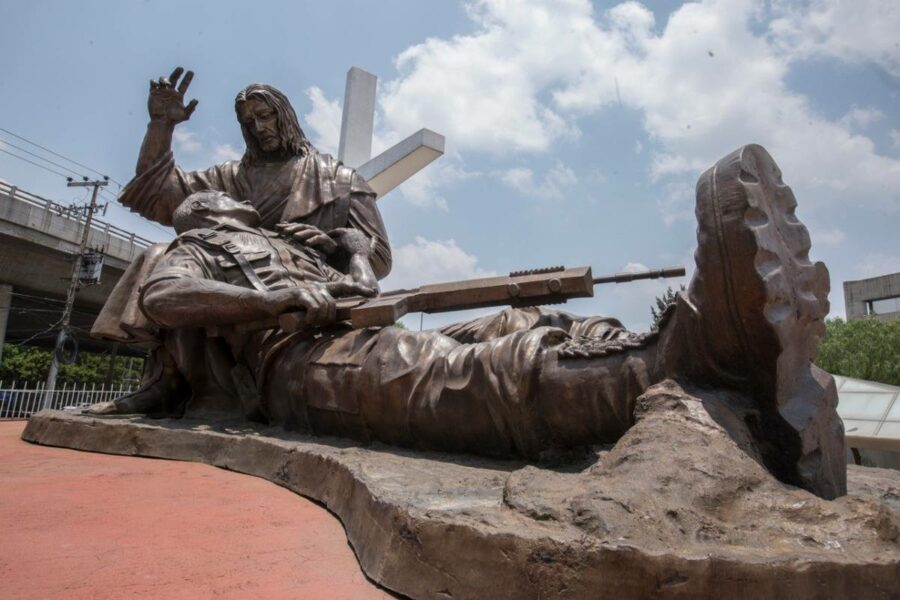
The capture and subsequent death of the leader of the Jalisco New Generation Cartel in a military operation in Tapalpa, Jalisco, unleashed a wave of violence that paralyzed the daily activities of millions in the country with a tragic toll, the death of at least 27 members of the security forces. Among them, 25 members of the National Guard (GN) who perished in ambushes and retaliatory attacks, along with a prison custodian and another public servant from the Jalisco State Prosecutor’s Office. Their passing leaves behind shattered families and a social void that the State and society have not known how to fill.
This tragedy is not isolated. Official figures reveal a hemorrhage in the military ranks. From 2018 to November 2024, according to data from the armed forces, at least 318 members of the army, the armed navy, and the National Guard have fallen in the line of duty during 2,770 confrontations with criminal groups. Of them, 272 belonged to the army, 17 to the armed navy, and 141 to the GN since its creation in 2019.
These numbers are not mere statistics; they represent truncated lives, homes in ruins, and an unpayable social debt. The families of these members face economic and emotional orphanhood; widows and children are left exposed to precariousness, without adequate pensions or comprehensive psychological support. In a country where 60% of GN members are under 30 years old, many enlist due to lack of job options, turning their sacrifice into a cruel reflection of structural inequalities.
But the criticism does not end in the governmental sphere. And that is the spiritual sphere. The military pastoral care that should be an effective mechanism of consolation in faith and accompaniment for the families of the fallen shines by its absence. After the mourning of February 22, as far as is known, there was no authentically pastoral message, not just a simple statement, from the bishops of the Mexican Episcopal Conference (CEM) to console the widows and orphans of those 25 national guardsmen or an initiative of spiritual accompaniment that sustains and alleviates the pain of the families. This omission reveals a neglect toward the armed forces, a sector that, despite its role in national defense, seems forgotten in a country where the armed forces are in a situation of undeclared war.
The person directly in charge of this pastoral care in the Mexican Episcopal Conference, the archbishop of Tlalnepantla and holder of the Episcopal Dimension of the Armed Forces, is responsible for a pastoral care that should have a defined structure and constant renewal in the face of this situation in Mexico.
In the Church in Mexico, even within the limits of the secular State —which does not prohibit humanitarian accompaniment—, military pastoral care is a forgotten dimension. The Gospel is not preached only in temples, but in the trenches of national reality. Ignoring this debt not only perpetuates orphanhood but also deprives members of the armed forces of spiritual and evangelical companionship because, as Pope Benedict XVI affirmed, “the religious dimension also holds a special meaning in the life of a soldier”. (Benedict XVI, Address to the participants of the International Congress of Military Ordinaries, October 22, 2011).