


February 22, 2026, will be etched in Mexico’s memory as a day of unleashed hell. The death of the leader of the Jalisco New Generation Cartel (CJNG), in a federal operation in Tapalpa, Jalisco, not only represented a blow to organized crime, but triggered a wave of violence that paralyzed the country. Road blockades, burned vehicles, attacks on civilians and security forces spread across at least 20 states, leaving a preliminary toll of more than 60 deaths, including National Guard agents.
Schools closed, flights canceled, businesses looted, and a population trapped in fear. Michoacán, the cradle of «El Mencho,» did not escape either. In Aguililla, the streets were filled with charred cars and nights of shootouts that sowed panic. This outburst was the climax of an endless war against drug trafficking that has turned Mexico into a battlefield.
Beyond the death toll and material damages, this violence reveals a comprehensive wear that corrodes the social, moral, and spiritual fabric of the nation. Entire communities displaced, local economies collapsed due to the forced closure of businesses, and hundreds of displaced. Emotionally, the accumulated terror generates a collective syndrome of anxiety and depression; families broken by irreparable losses, children who grow up normalizing death as part of the everyday landscape.
Morally, the erosion is even deeper. Impunity fosters widespread cynicism, corruption permeates from the local police to high-ranking officials, blurring the line between law and crime. Spiritually, the soul of many seems confused, if not shattered.
Faith in one’s neighbor fades in a sea of distrust; the value of human life is devalued amid arbitrary executions and cyclical vendettas. This progressive exhaustion is physical and attacks the spirit, leaving entire generations in an existential void where hope seems like a luxury. Violence not only kills bodies; it assassinates dreams, erodes values, and transforms societies that, once peaceful, are now deserts of resignation.
The «hugs, not bullets» strategy has mutated into reactive operations that, although celebrated as victories, provoke reactions that question their effectiveness. The dependence on foreign intelligence highlights internal weakness and exposes Mexico to foreign agendas, subjecting it to pressures. This criticism is not defeatist, but a call to recognize that violence is not combated only with bullets, but with social justice, education, moral reconstruction, and anti-corruption.
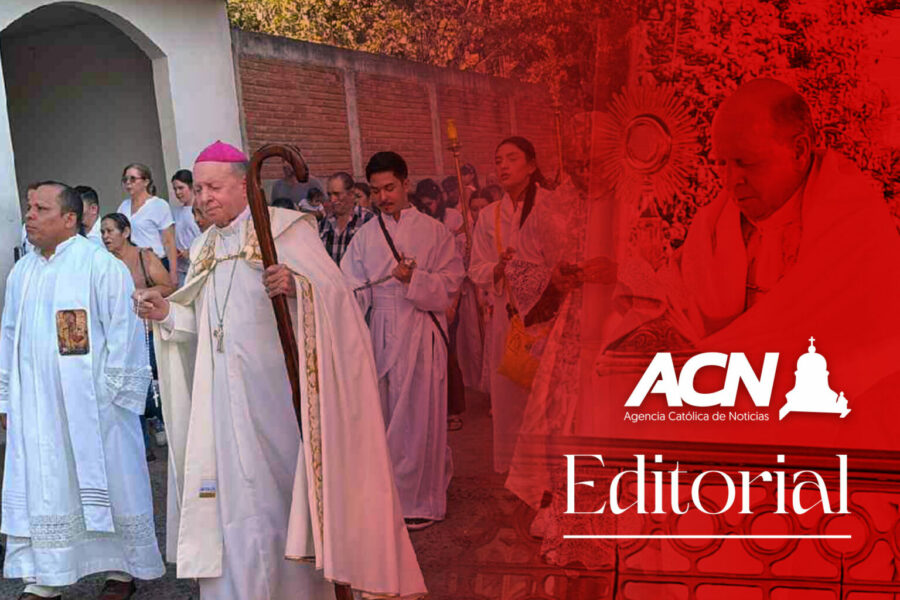
One of those actors that insists on building peace at all costs is the Church. Far from retreating, it has called for reconciliation and forgiveness, reminding that peace is not the absence of conflict and peaceful spiritual resistance. An example was the peace procession on February 27 in Aguililla, led by the bishop of Apatzingán, Cristóbal Ascencio García.
Around 250 faithful, who proved to be a crowd, dressed in white, marched through the main streets with the Blessed Sacrament, accompanied by the priests of the diocese. In the face of recent blockades and shootouts, this walk was not a simple act, but an act of faith and hope. The bishop emphasized that peace begins in the heart: «avoid harm, tolerate the other, not be indifferent to suffering».
Recalling the meaning of Lent, he called to fast from conflicts and vendettas, opting for forgiveness that frees and restores joy. Quoting the Gospel, he urged to uproot the roots of violence such as resentment and ambition, prioritizing reconciliation over empty worship.
The Church walks with the Holy People of God, offering Christ as the path to a homeland of brotherhood, above all, it overcomes fear. In Aguililla marked by isolation and panic, entire families—children, elders—joined in public prayer, affirming that violence does not define the human spirit.
In the end, this violence of February 22 confronts us with a choice, to succumb to the wear or embrace the hope that the Church proposes. Mexico needs more than operations; it requires a regeneration that transforms hearts and structures. And the Aguililla procession inspired that, a spiritual resistance of faith that dispels fear and peace that, though fragile, becomes victory.