


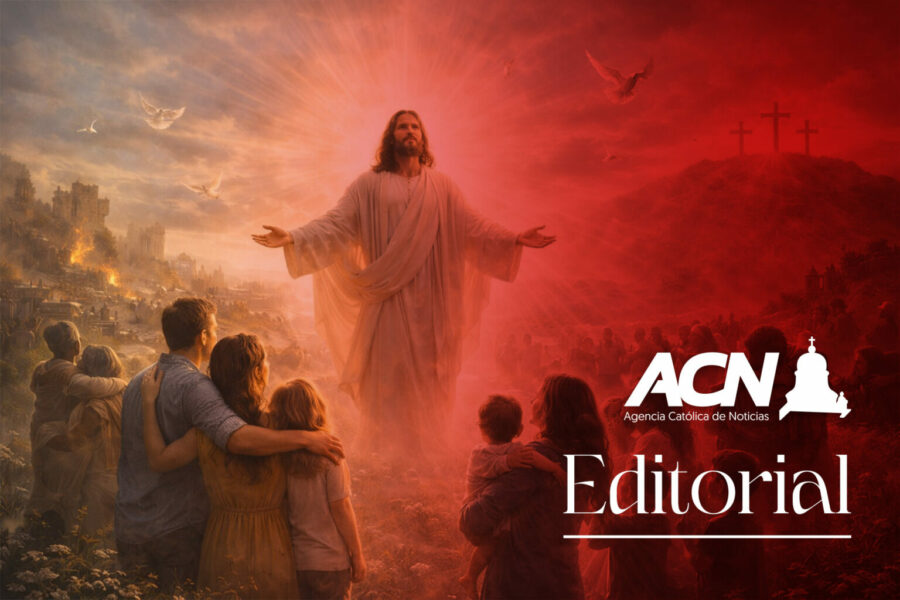
At the end of the days of the Passion, when the silence of the tomb seemed to seal forever the failure of a life given, the announcement bursts in that changes everything: “He has risen!”.
It is not a pious whisper nor a consolation that serves as a placebo for afflicted souls. It is the joyful cry that bursts into human history, precisely in this time of tribulations and wars that darken the planet. In Ukraine and in Gaza, on the African borders and in the streets of our Latin American cities, where violence and uncertainty strike without mercy, the Church proclaims again with a clear and firm voice, Christ lives! And that announcement, far from being an evasion, is the only realistic and radical response to hopelessness.
Especially directed to families, the announcement of the resurrection of the Savior acquires a moving urgency. In the home, where the most intimate anxieties are brewed—unemployment, illness, generational fracture, fear of the future—the resurrection does not arrive as an abstract idea, but as a concrete certainty. The family is the first domestic Church; in it, one learns to believe in the invisible because the real has been touched. When a father or mother rises each morning despite fatigue and uncertainty, when children see in their parents a fidelity that does not surrender, they are living, without knowing it, the paschal mystery, the life that conquers death. That is why Easter is not only for the temples; it is for the family table, for the room where one weeps in silence, for the embrace that rebuilds what is broken.
The paschal time is not just another liturgical season. It is the time of certainty and assurance. In the face of a culture of the liquid and ethereal that relativizes everything, that turns even the sacred into a “narrative” that is negotiable, the Church insists, the resurrection is not a beautiful metaphor nor a polyvalent sign that each one interprets according to their convenience. It is not “the triumph of the spirit over matter” nor “the persistence of Jesus’ message in our hearts”. It is a fact. A historical event that occurred on a specific day, in a specific place, before specific witnesses. Trying to distort it by reducing it to a symbol is, precisely, the most subtle form of modern unbelief, the one that does not deny Christ, but empties him of his power.
Here the paschal message of Benedict XVI in 2014 resonates with special force. The Pope Emeritus, with the theological lucidity that characterized him, expressed it without ambiguity: “It was not a dream, nor illusion or subjective imagination that encounter; it was a true experience, though unexpected and precisely for this reason particularly moving”. The apostles did not see a ghost nor interpret a symbol. They saw the Crucified alive, touched his wounds, ate with him. Thomas, the paradigmatic unbeliever of our time, received the most radical invitation: “Bring your finger here and see my hands; bring your hand and put it in my side; and do not be unbelieving, but believing.” And his response—“My Lord and my God!”—was not the fruit of subjective reflection, but the confession before a real encounter.
Benedict XVI reminded us that every generation is tempted by the same doubt as Thomas. Today that doubt disguises itself as intellectual sophistication: “The resurrection is a foundational myth”, “it is the projection of our desires”, “it is an interior experience”, but the Christian faith is not founded on moods nor on cultural interpretations. It is founded on a fact, the empty tomb and the living Lord who allows himself to be touched. That is the paschal certainty. That is the one that allows today’s families—besieged by ideologies that dissolve life, by economies that precaritize it, by wars that threaten it—to look to the future without cynicism under the certainty of hope.
That is why, in this paschal time, the Church does not invite evasion, but courage. The resurrection does not suppress pain nor eliminate wars; it conquers them from within. It offers the only hope that does not disappoint: that of a love stronger than death. To the families that suffer today, to the nations that bleed today, to the hearts that doubt today, the announcement continues to resound with the same force as two thousand years ago: “Why do you seek the living among the dead? He is not here, he has risen”.
May this paschal certainty illuminate our homes and our nations. May it make us credible witnesses that life always has the last word. Because Christ has risen. Truly he has risen from the dead. And that changes everything.