


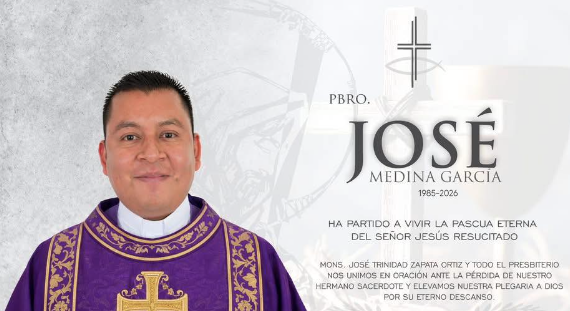
The death of presbyter José Medina García shook the Catholic Church in northern Veracruz and sparked rumors ranging from the initial version that the priest had died due to complications from the cold to the most painful hypothesis, a possible suicide. The official statement issued this Monday by the diocese of Papantla, signed by Bishop José Trinidad Zapata Ortiz, not only contradicts the first information disseminated, but uses such cautious and legalistic language that it has opened the door to interpretations that the diocese itself asks to avoid.
On February 23, in the early hours, the version circulated that the priest, 41 years old and parish priest in Misantla, had died due to a worsening of his health from low temperatures. The explanation seemed logical; however, the diocesan statement reveals a very different reality.
“According to preliminary information, the priest would have ingested a toxic substance, a situation that led to his urgent hospitalization. Despite the medical efforts made, he unfortunately lost his life,” the text states verbatim. It does not speak of “accidental poisoning,” nor of “involuntary ingestion,” nor of “exposure to toxins,” but of a possible action that implies a deliberate action.
More revealing is when the statement asks: “With prudence and respect for his dignity, as well as for the pain of his family,” to avoid “issuing premature judgments and we trust that the competent authorities will be able to fully clarify the facts”. This contrasts with other cases when a priest dies from natural causes, a traffic accident, or even accidental poisoning, dioceses usually provide the information immediately and without reservations. Here, instead, it appeals to “prudence,” explicitly mentions the “competent authorities,” that is, the Prosecutor’s Office, and asks not to jump to conclusions.
Father Medina García was at an age when most priests are in full pastoral activity. No previous chronic illnesses or public health problems are mentioned. The statement also does not mention a sudden malaise or previous symptoms that could have foreseen a fatal outcome from natural causes.
José Trinidad Zapata Ortiz, eighth bishop of Papantla, closes the document by entrusting the priest’s soul to divine mercy and quoting the Gospel of Saint John: “I am the resurrection and the life; he who believes in me, though he die, yet shall he live”. He invites prayer for the eternal rest of the presbyter, for his family, and for the diocesan Church. Details of the exequies will be given later. But the silence on the exact cause of death is deafening.
In the Church, cases of priestly suicide are extremely delicate. When they occur, dioceses usually handle them with the utmost secrecy possible out of respect for the family and to avoid scandal. The Papantla statement follows exactly that pattern: it reports the essentials, avoids details, asks for prudence, and leaves everything in the hands of the civil authorities.
As the investigations progress, the question arises and is inevitable: did Father José Medina García decide to end his life? The official statement does not affirm it, but neither does it deny it. In the meantime, the diocese of Papantla has asked for respect and prayer; the community awaits clear answers that, for now, only the expert opinion of the Prosecutor’s Office will be able to elucidate regarding the death of a young priest, a close and appreciated pastor by his parishioners.
The exequies of “Father Josesito,” as he was known, will be held at the parish of San Miguel Arcángel in Pueblo Viejo and the final funeral honors in his hometown, the town of Adolfo Ruiz Cortines in Coxquihui, Veracruz.
May he rest in peace.