


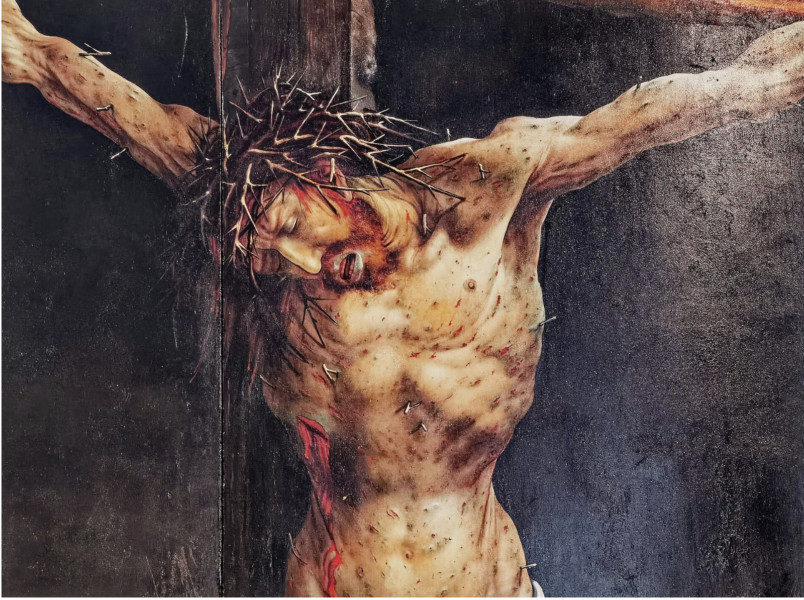
Religious and political envies weighed on Jesus. In the gospel according to Matthew, Mt 26, 3-5, the conspiracy that religious leaders plotted against the Nazarene and his group is explained. The plan reached the spheres of the high priest and, with tricks, they would lead Jesus to death. The gospel says that he would be arrested before the Passover feasts to avoid a kind of agitation or explosive riot, which could indicate the effervescence in the consciousness of a subjugated and submitted nation by the power of an empire that devoured everything.
Among the many trials of criminals and enemies, the one that reaches our times, over the course of two millennia, was that of Christ, an irregular trial, clearly, outside the legality. It would be an error to compare it under our current advanced schemes of law where the recognition of the fundamental prerogatives of people and their guarantees have a well-structured framework for their protection and defense; notwithstanding the passage of centuries, we strive to know what went wrong and how a man who went about doing good, esteemed as a miracle-worker and announcing the kingdom of God, was condemned to such an excessive and cruel penalty without any defense intervening as described in the synoptic sources through which we know the story directly. Why was Christ condemned?
The gospels are not procedural and legal documents; as late accounts of the life of Christ, they were written for later Christian generations. Lc 22, 2 affirms the “fear” of the chief priests and teachers of the Law and, as a solution to their problems, Judas offers himself to them to reveal the plans of the twelve and how the capture of Jesus could be feasible without provoking greater popular agitations, in a quick manner and without compromising the stability of the Passover feasts (Lc 22, 5-6). The arrest was underway, mediated by the betrayal itself and without fair warnings to place any subject at the disposal of the authority.
In the hasty process, Jesus himself takes up the defense of his cause to unload against those who are both judge and party. In one of the interrogations, he affirmed the public character of his teachings in the temple and synagogues where everyone gathers (Jn 18 20-21) and resorts to what seems to be the use of a resource in his favor, that of testimonies (Jn 18, 21). Before such a defense, the action was a slap from the guard protecting the authority; however, Jesus resists with more logical than legal arguments in the face of the loss of common sense. (Jn 18, 23)
An attempt at legal analysis is “The Trial of Christ”, a monograph written by the late jurist and constitutionalist Ignacio Burgoa Orihuela (1918-2005). His hypotheses reveal what the alleged irregularities in the Jewish stage that motivated the condemnation of Christ might have been, and which did not observe elementary resources according to the rules of the sacred books such as: defense of the accused, diurnality of trials (Jesus appeared at dawn before the meeting of priests, as supposed by Lc 22, 61 when, in Peter’s denials, it describes the crowing of the rooster), disclosure of evidence, and the voting on the condemnatory penalty which was overlooked in the famous trial since Mt 26, 65 explicitly indicates the way in which the singular trial concluded, death for blasphemy.
But Judea was a Roman province under the governor of Syria and a delegate who should carry out the Jewish sentence, that was the fifth prefect, Poncio Pilato who would be dismissed three years after the crucifixion of Christ due to the conflicts and agitations of the province.
Judea was subjugated by Rome in 63 B.C. by the military action of the troops of the general Pompeyo Magno, ally of Julio César in the final stretch of the Republic. With the emergence of the empire, the conquered territories retained the status of Provinces governed by imperial or senatorial procurators.
Poncio Pilato was prefect for ten years from 26 A.D. when Tiberio appointed him to the province. Many attempt to make a radiography using as a reference point some apocryphal sources such as the Acts of the trial of Jesus and the Apocryphal Gospel of the death of Pilato. From our perspective, the Procurator reaches us through cinematic interpretations around the life of Christ, impassive governor, stubborn character who confronts the condemned and even the benevolent one who, through all the legal tricks, tries to free the prisoner by passing him through the scourging and dissuading his captors before the brutal beating without causing death, something that would have warranted severe punishments to the executioners for not attending the precise orders of the imperial ambassador.
Pilato interrogates Jesus and the dialogue shows a philosophical and supernatural character more than a legal one (Jn 18, 30-38). Roman criminal law had a typicality in terms of the division of crimes applied anywhere in the empire. From the times of the Republic, infractions could be public, called criminia, and private, delicta. Public crimes endangered the community although later in the empire, the praetors extended this characteristic to private crimes such as the composition of seditious satirical verses.
Consequently, a public crime was prosecuted ex officio by the authorities or by denunciation of any citizen and was punished with humiliating dissuasive penalties: decapitation, hanging, precipice, and perhaps one of the most horrendous, crucifixion, torture adopted by the Romans and inherited from Assyria, Babylon, and Persia. It is said that, to inflict public terror, the suppression of Spartacus’s rebellion (71 B.C.) resulted in the crucifixion of 6 thousand slaves exposed along the Via Appia, from Capua to Rome, that is, a stretch of almost 195 kilometers.
Pilato would go down in history for his political pragmatism. The dialogue with Jesus about the Truth seems to unravel the ultimate meaning to prevent the condemnation to the cross that the authorities of the Sanedrín wanted. In the Acts of Pilato, held as protocols of the trial of Jesus and of which Eusebio de Cesarea (263-339) informs us, the Procurator sought a way to resolve the trial; however, the Jewish accusers refer to Jesus accused of messianism and sedition, public crimes according to the law. The captors of the Nazarene threaten Poncio Pilato with taking the matter to the emperor himself if he does not procure the peace of the province.
The intimidation makes Pilato yield to the point of washing his hands (Mt 27, 24), a symbol foreign to any legal resource and which served to fuel the black legend against the Jews accused of deicide. In any case, the concrete condemnation has as its cause sedition punished with crucifixion.
The trial of Christ has this irregular character that could well be common in our days despite our advances in the system of defense of human rights. However, the destiny of Jesus does not simply have a fatalistic cause that leads to total failure. It is clear that, at that moment, everything was destined for destruction and fear because Jesus’s project would end up hanging on the wood of torment.
Despite the cruelty, Christ died as he had lived; his sacrifice is his own initiative in an attitude of service, setting aside himself, to teach the radical reason for his passage through this world. In the culture of individualism and hedonism, of immediate satisfactions and the cult of personality, of isolation and interconnection, of liquid philosophy and ethereality, the arrest and death of a just man moves us to meditation on this service of the Son of God made man.
His body will be a spoil of blood and pain, but in that mysterious pedagogy we find the deepest meaning of the incomparable sacrifice, that of the envoy of the Most High, that of the representative of God (1Jn 4, 8) and of Love itself who became flesh for us (Rm 8,31). And many see it as madness, as absurdity, in the darkness of the centuries.