


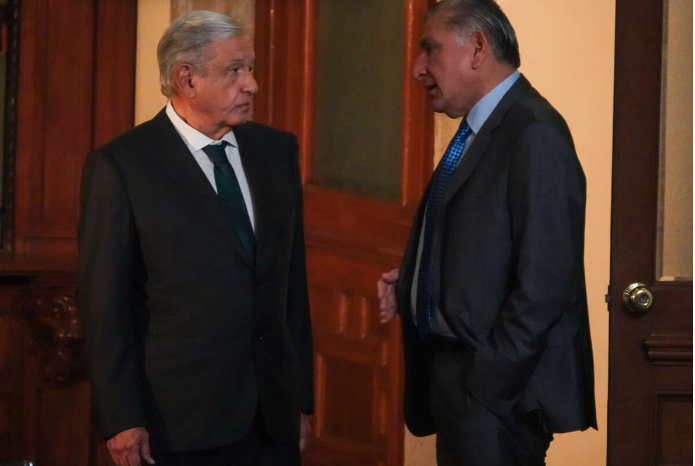
The Catholic Citizenship and Social Analysis Observatory published its bulletin number 43 this Monday, titled “Adán Augusto López Hernández: Politician and Public Servant Useful for Whom?”. The document, twelve pages long, offers a severe diagnosis of the Morenista senator’s trajectory and presents him as the most accomplished prototype of the politician of the Fourth Transformation: ambitious, systematically corrupt, and organically linked to organized crime.
Supported by the discernment criterion of the pastoral constitution Gaudium et spes (n. 43), the text states that the case of Adán Augusto López Hernández transcends the individual and reveals a structural transformation of the Mexican State. According to the Observatory, the country has reached the point where a group of political figures has become an organic part of organized crime, to the degree that both realities—the political and the criminal—constitute today two sides of the same phenomenon.
The report reconstructs in detail the historical “brotherhood” between López Hernández and López Obrador. It traces the link back to 1969, when Adán Augusto’s father, the influential Tabascan lawyer Payambé López Falconi, intervened decisively to free the young Andrés Manuel from jail after the death of his brother José Ramón. That debt of gratitude marked the relationship between both families forever.
During his tenure as governor of Tabasco (2019-2021), Adán Augusto López Hernández promoted or, at least, tolerated the emergence of the criminal group known as “La Barredora”, a cell linked to the Jalisco New Generation Cartel that engaged in huachicol, extortion, and territorial control. The arrest in September 2025 of Hernán Bermúdez Requena, his former Secretary of Public Security and alleged leader of that organization, reactivated all the complaints and once again placed the senator’s political responsibility under scrutiny.
The text also addresses the serious patrimonial inconsistencies detected during his time at the Secretariat of the Interior and the coordination of the Morena parliamentary group in the Senate, as well as his alleged participation—along with Andrés Manuel López Beltrán—in the so-called “fiscal huachicol”, the greatest damage to public finances in recent decades, quantified at around 600 billion pesos.
Despite the gravity of the accusations, López Hernández has enjoyed systematic protection from both former President López Obrador and the current government of Claudia Sheinbaum. Neither the Financial Intelligence Unit, nor the Secretariat of Finance, nor the Anti-Corruption Secretariat have delved into the investigations, which the Observatory interprets as evidence of institutional capture.
The analysis concludes that in Mexico there is no longer a practical difference between a failed state and a narco-state feeding each other mutually. Adán Augusto López Hernández would embody, along with other high-ranking figures of the regime, the clearest synthesis of that decomposition.
The bulletin closes with a direct interpellation to Mexican citizenship: what is the task we have ahead to rescue democracy, restore the honorability of justice, and achieve true pacification of the country? What tools do we have left to raise our voice and redirect the political course of Mexico, so that new generations can live in conditions worthy of education, work, and freedom? And finally: are we still in time to overcome the populism that keeps the population trapped between handouts and false promises?
With this document, the Catholic Observatory not only denounces a particular case, but calls on Catholic and citizen conscience to assume its historical responsibility in the face of the consolidation of what it describes as a de facto narco-state.
The report can be read here.