


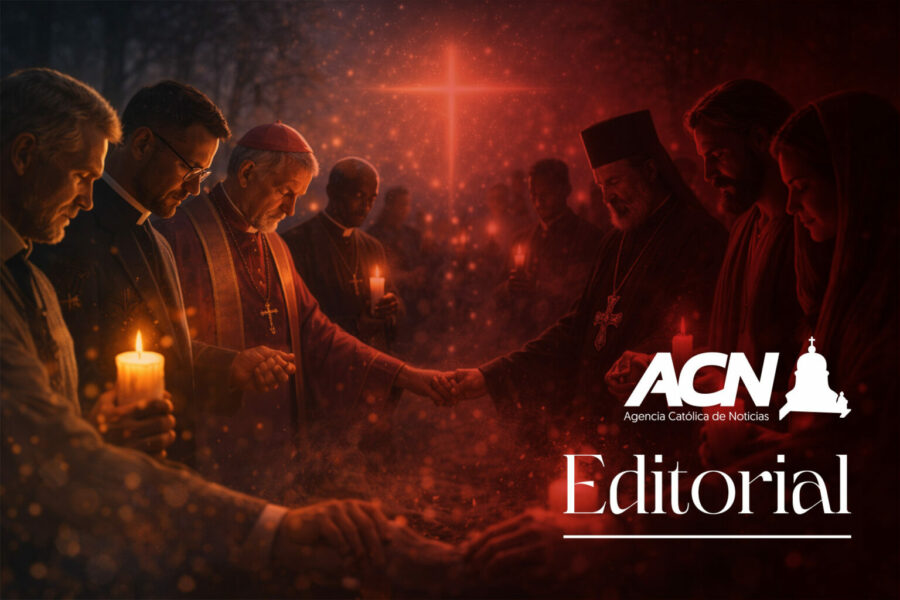
On January 18, 2026, the Christian world begins a journey of deep reflection and prayer: the Week of Prayer for Christian Unity. This tradition, which extends until January 25, coinciding with the feast of the Conversion of Saint Paul, represents a privileged moment for the faithful of various denominations to unite in spirit, remembering Christ’s command: «That they may all be one» (Jn 17:21).
Originating in the early 20th century at the initiative of Reverend Paul Wattson and supported by the Second Vatican Council, this week is not mere ritual, but an urgent call to overcome historical and cultural divisions that have fragmented the Body of Christ. In a world marked by conflicts and polarizations, collective prayer becomes a beacon of hope, inviting Christians to rediscover their common heritage and work toward authentic communion, without diluting the essence of the faith.
The theme for 2026, «There is one body and one Spirit, just as you were called to the one hope of your calling» (Eph 4:4), drawn from the Epistle to the Ephesians, underscores the indivisibility of the Church as the mystical body of Christ. Prepared by the Armenian Apostolic Church in collaboration with the Pontifical Council for Promoting Christian Unity and the World Council of Churches, this motto evokes the light of the Nicene Creed –»Light of light»–, commemorating the 1700th anniversary of its formulation at the Council of Nicaea (325 AD).
Its meaning transcends the symbolic, inviting Christians to deepen their communion with Christ by overcoming barriers to be witnesses of unity in a world that yearns for peace. The Armenian heritage, with its antiquity –Christianity was adopted as the religion of the Roman Empire in 301 AD–, enriches this reflection, incorporating centenary hymns and prayers that emphasize shared spirituality. In essence, this week reminds us that unity is not uniformity, but harmony in diversity, anchored in revealed truth.
Pope Leo XIV’s intentions for this period resonate with particular force. In his message, the Holy Father emphasizes that true peace arises from the search for unity first among Christians, extending then to peoples. For January 2026, his prayer intention is «For prayer with the Word of God,» inviting the faithful to meditate on the Scriptures as a source of spiritual union. Leo XIV, a continuer of the ecumenical tradition of his predecessors, urges persistent prayer that transforms divisions into bridges, reminding us that unity is a gift of the Holy Spirit. His vision integrates the global dimension, promoting dialogues that respect differences but affirm the centrality of Christ as the only Savior.
In Mexico, the Mexican Episcopal Conference (CEM), through its Episcopal Commission for Interreligious Dialogue and Communion (CEDIC), has promoted activities that align with this spirit.
According to what was published by the CEM, materials such as daily biblical reflections, prayers, and guides for Eucharistic celebrations are offered, adapted for parishes and communities. Among the initiatives, vigils stand out where interdenominational services are scheduled with shared testimonies and meditations, such as the program that, starting from January 18, begins at the Basilica of Guadalupe.
In Guadalajara and Monterrey, virtual and in-person encounters are organized with representatives from Orthodox, Protestant, and Evangelical churches, including workshops for youth on interreligious dialogue. These actions, inspired by the motto, seek to foster common prayer and joint witness, especially in a national context marked by social challenges where united faith can be an agent of reconciliation.
However, in this pursuit of unity, it is crucial not to fall into misunderstandings. Gestures of rapprochement should not be confused with superficial irenicism, that false peace that sacrifices doctrinal purity for a vague and empathetic tolerance. As reaffirmed by the declaration Dominus Iesus (2000), approved by Saint John Paul II and drafted by the then Cardinal Joseph Ratzinger, the true Church of Christ «subsists» fully in the Catholic Church, with its apostolic succession and fullness of sacraments.
This document rejects religious relativism, insisting that Jesus Christ is the only Savior and that other Christian communities maintain an imperfect communion. Authentic ecumenism demands doctrinal clarity, not dilution of truth to achieve empathy. In the words of Dominus Iesus, recognizing «glimmers of truth» in other traditions does not equate to equating them, but rather invites dialogue that is respectful without compromising the Catholic faith.