


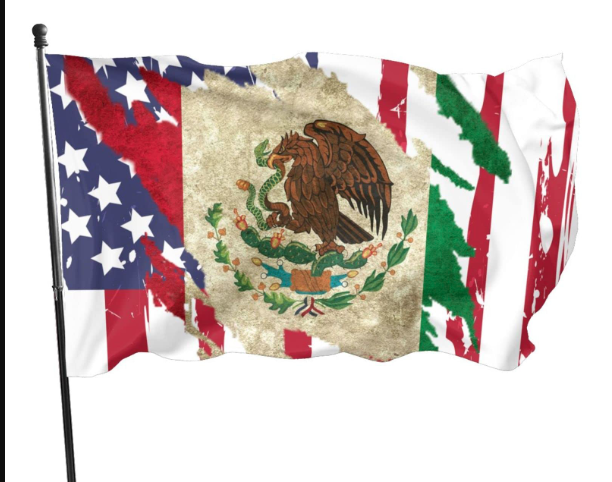
In a world convulsed by the reconfiguration of global power, Mexico finds itself at the epicenter of geopolitical tensions that threaten its sovereignty and internal stability. This is stated in report number 39 of Catholic Citizenship and Social Analysis, titled «Mexico in the Midst of Continental Geopolitics: Elements for Discernment».
This document, inspired by Catholic principles and a call for critical thinking—citing Pope Leo XIV—, analyzes how the resurgence of U.S. hegemony under Donald Trump impacts Mexico, prioritizing the common good and questioning diplomatic priorities: should relations with Cuba and Venezuela be cared for, or with the United States? Does transparency in public information on international affairs prevail?
The report is divided into «Facts» and «Analysis.» In the facts section, a new world order comparable to the wars of the 20th century is described, with the United States facing challenges from emerging powers like China and the BRICS. It details Trump’s «Make America Great Again» (MAGA) strategy, based on five pillars: strengthening the dollar with resources like oil, gold, and lithium from Latin America and Greenland; reordering global alliances, abandoning multilateralism like the UN and NATO; prioritizing military power; controlling Latin America to block Chinese influence; and securing borders against migration and drug trafficking. Mexico, as the main trading partner of the United States via the USMCA (representing 1.5 trillion dollars annually and 55% of Mexico’s GDP), is key in this scheme, dependent energetically (gas) and food-wise on its northern neighbor.
However, it is in the «Analysis» section where the document offers a deep and critical dissection of the Mexican position, highlighting internal and external tensions that could precipitate the collapse of the so-called «Fourth Transformation» (4T). The report underscores a «duality» in power: President Claudia Sheinbaum formally exercises the head of state role, but faces «constant pressure» from former President Andrés Manuel López Obrador (AMLO), who maintains a «political caciquism» through allies in Congress (where Morena dominates), the Supreme Court of Justice (with seven of nine justices aligned, led by Hugo Aguilar), governors, and the party itself, controlled by the Alcalde Luján family and his son Andrés Manuel López Beltrán.
This duality generates «political tensions» in the internal sphere and in diplomacy, subjected to U.S. pressures on trade (tariffs and USMCA), hemispheric security, migration, and combating drug trafficking (especially fentanyl). Mexico, according to the analysis, is «squeezed» in the hegemonic pretensions of the United States, cataloged as a global enemy on the level of China, Russia, and Iran. The report warns that Trump sees Mexico as a gateway for Russian and Chinese influences, linked to populist governments like Cuba and Venezuela, now in crisis. Mexico’s foreign policy, confused and disjointed, responds in a «partial» manner to onslaughts like threats of military interventions against cartels, potentially extended to national territory after actions in Venezuela.
The analysis is contundent. The 4T is built as a «Mexican-style dictatorship», but clashes with Trump’s lethal advance against Latin American populisms. Governments like those of Argentina, Peru, Bolivia, Ecuador, Honduras, and Chile have fallen, leaving Mexico isolated in its regional leadership (Puebla Group-São Paulo Forum). Corruption, ties to organized crime, and lack of international vision accelerate the «shipwreck» of the 4T. Businessmen like Carlos Slim seek alliances with China (telecommunications, oil, trains) to counter U.S. domination, but the report criticizes the absence of professional diplomacy, reduced to defending the sovereignties of Cuba and Venezuela in a context of demolished multilateralism.
The report from the Observatory urges a critical awakening; Mexico must prioritize the common good over corrupt opacities. Without effective diplomacy, the country risks the liquidation of its political model before a U.S. that replaces globalism with bilateral domination. This document not only informs but invites ethical discernment in times of geopolitical crisis.
The full report can be read here.
Catholic Citizenship and Social Analysis 39