


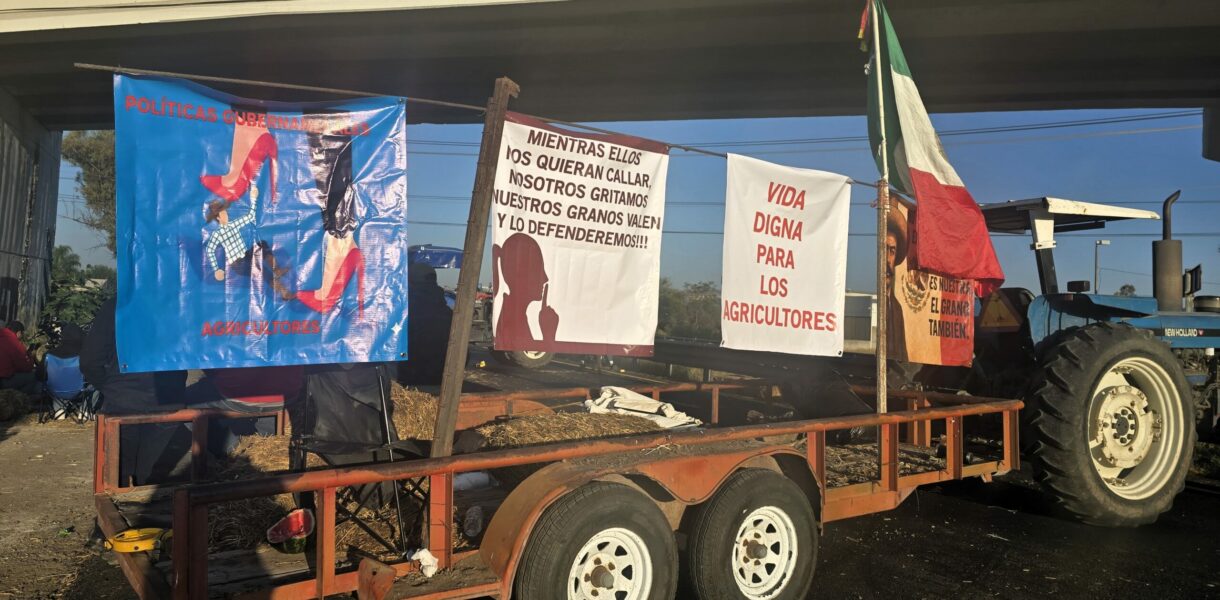
The Mexican Episcopal Conference (CEM) entered the conflict that has been paralyzing roads in Jalisco, Guanajuato, and Michoacán since October 27 with a statement where it recognizes the “desperation” of corn producers, condemns the harm to third parties, and demands from the federal government “fair guarantee prices” and “immediate compensation” for losses. Signed by the Bishop of Cuernavaca, Ramón Castro Castro, and the auxiliary of Mexico, Héctor M. Pérez Villarreal, the text quotes James 3:18 (“Those who work for peace sow in peace, and their fruit is justice”) and warns that, without quick solutions, Mexico risks “an irreversible social breakdown.”
Since October 27, hundreds of producers have blocked roads and toll booths in the west and Bajío regions of the country, which are the main food production areas. In Guanajuato, they blocked the Aguascalientes-León highway and in Michoacán, the main route connecting the West to central Mexico.
On October 28, 42 blockade points were added. The National Chamber of the Industrialized Corn calculated daily losses of 1,200 million pesos in cargo transportation. Through social media, reports emerged of the death of an oncology patient who could not make it to a consultation in Morelia and a truck driver who suffered a heart attack in the 18 km line in Jalisco.
It was on October 29 that the government announced a new dialogue table for November 1, but it does not offer a guarantee price, partial negotiations led to producers lifting partial blockades in Guanajuato after agreements with the Secretariat of Agriculture; however, closures persisted in Jalisco and Michoacán.
The National Chamber of the Transformation Industry reported losses of more than 2,300 million pesos (or 2.3 billion pesos) due to the blockades by farmers that occurred between October 27 and 30, 2025.
The protesters, grouped in the National Union of Agricultural Workers, delivered on October 27 a five-point petition to establish guarantee prices. Their demands varied, but many groups demanded a price of up to $7,200 pesos/ton to cover production costs. The federal government, for its part, announced a guarantee price of $6,050 pesos/ton for white corn in key states like Guanajuato, Jalisco, and Michoacán, which was initially rejected by some producers, in addition to the ban on imports of transgenic corn and a review of the USMCA in agricultural matters.
The message from the bishops of Mexico recognizes that “selling the fruit of labor cheaply” is a “truly desperate situation” and cites the Church’s social doctrine: the universal destination of goods requires that the land serve “especially the most needy.” At the same time, it laments the “millionaire” economic losses and the “incalculable damage to the social fabric”: stranded workers, sick without care, withheld medications. It exhorts producers to “seek paths of dialogue that do not deepen the suffering of other Mexican brothers” and appeals to companies to pay “fair prices, recognizing that behind every harvest there are entire families.”
The harshest call is to the government: “act with vision, diligence, and true negotiation capacity.” It recalls the history of agrarian struggles and warns that ignoring them can lead to “irreversible social breakdown.” The CEM closes by invoking the Virgin of Guadalupe to “find paths of justice and reconciliation.”