


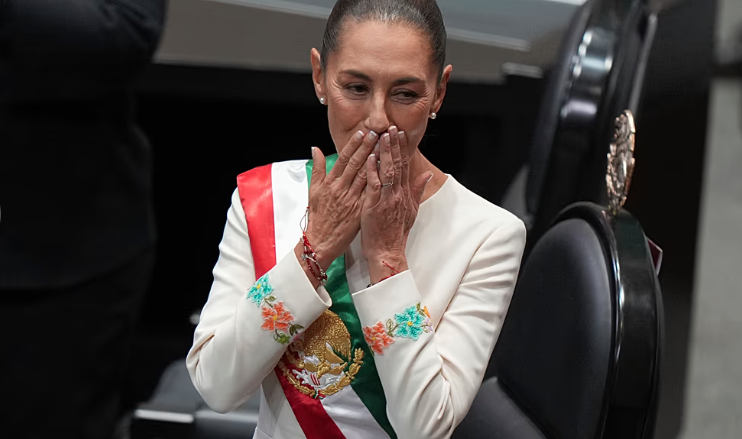
In a message, the Mexican Episcopal Conference (CEM) offered a balanced but critical assessment of the first year of government of Claudia Sheinbaum Pardo. The document titled «Message from the Mexican Bishops on the First Year of the Start of the Mandate of President Dr. Claudia Sheinbaum Pardo» highlights achievements such as progress in gender equality and initial improvements in security, but underscores persistent shortcomings in areas like poverty, corruption, and judicial reform, revealing a contrast between initial optimism and pending realities.
Signed by the Bishop of Cuernavaca, Ramón Castro Castro, president of the CEM, and the auxiliary bishop of Mexico, Héctor M. Pérez Villarreal, general secretary, it recognizes the historic milestone of Sheinbaum’s election as the first woman to assume the Head of the Mexican State. «The people of Mexico have shown that they do not possess the discriminatory spirit that can be observed in other countries«, the bishops affirm, celebrating this «constitutional and cultural advancement» that accredits the country’s democratic maturity. This positive point is presented as a symbol of inclusion, especially in a context where the female mandate has faced «great challenges» both national and international.
In terms of security, the message applauds the initial «fruits» of the strategy proposed by the president, including the disarmament campaign and reforms against organized crime. The bishops note that, although the problem «is far from having been resolved«, there are signs of progress in a country where communities still «suffer the burden of crime». This recognition is framed within their offer of support for national reconciliation, reiterating their commitment to the «National Peace Agenda» and plural dialogue. However, the contrast arises when linking the reduction of violence to the fight against corruption, described as a «social cancer of unimaginable proportions». The bishops predict «greater achievements» in this area, but implicitly point out that the advances are insufficient, even invoking Pope Leo XIV’s invitation to an «unarmed and disarming peace».
The socioeconomic sphere presents another clear contrast. On one hand, there is appreciation for the «significant reduction in the inequality coefficient» despite the «low growth» inherited from previous administrations. The bishops value these achievements, but warn that «the grave historical burden of poverty is still far from the reduction that our people deserve and desire». They criticize the dependence on «government handouts» and advocate for promoting «work and dignified development», offering their contribution to an integral development that encompasses the material and spiritual. This duality highlights partial progress that has not eradicated structural marginalization.
In international relations, the message greets the «diplomatic efforts» that have avoided collisions with trading partners on tariff and common security issues. Nevertheless, it makes an urgent call not to yield in the defense of migrants and disadvantaged groups, emphasizing that their dignity is «our greatest treasure». Here, the positive tone is tempered by an implicit exhortation to intensify actions, recognizing that diplomatic achievements have not resolved cross-border vulnerabilities.
One of the most marked contrasts appears in the democratic and institutional arena. The bishops renew their concern for the preservation of the Rule of Law, federalism, and separation of powers, recalling that the judicial reform «was far from being a clean and democratic process«. Although they value the announcement of discussions on an electoral reform, they express hopes that it will consolidate «pluralism» and «democratic channels», implicitly questioning whether current proposals could erode the republican coexistence established since the end of the last century.
The document also mentions a «respectful and hopeful» meeting with the president last November, where an open dialogue was offered for the common good and a «broad humanistic educational pact» was requested to address challenges in health, education, environment, and marginalization. In this sense, the guarantee of religious freedom is valued and advocacy is made to broaden understanding between secular and religious instances, respecting the secularity of the State. However, the emphasis on «continuing to advance» during the second year of government suggests that these initial efforts have not been sufficient to materialize profound changes.
This message from the CEM, issued on the anniversary of the inauguration, reflects a constructive but vigilant stance. While it celebrates milestones such as gender inclusion and advances in security and equality, it does not hide the shortcomings in poverty, corruption, and institutional reforms, urging greater commitment for a prosperous and peaceful Mexico.
The full message can be read here.