


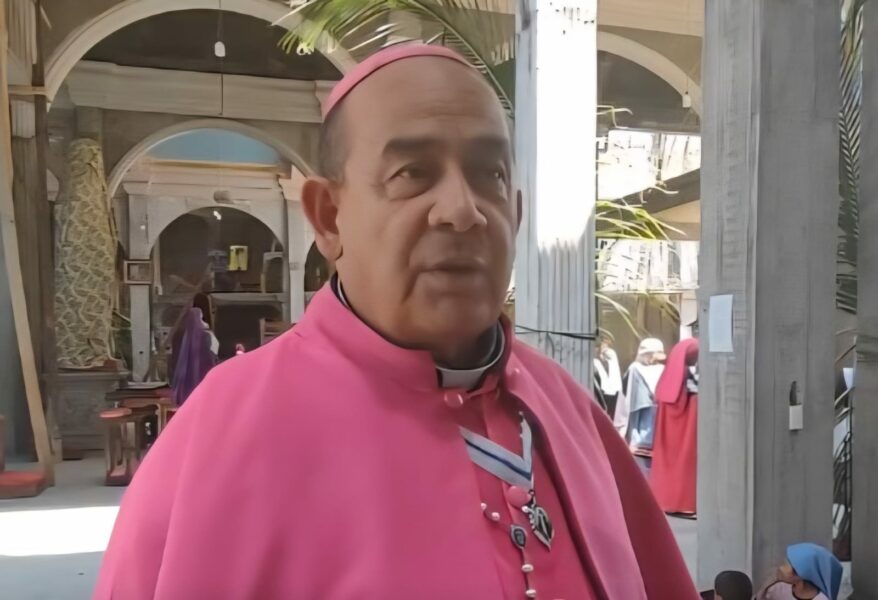
On the early morning of April 1, 2026, Antonio Lara Barajas, the bishop Martín de Tours, passed away, spiritual guide of the apocalyptic sect of the Nueva Jerusalén, also known as La Ermita. The death occurred in the walled enclave of Puruarán, in the Tierra Caliente region of Michoacán, under the veil of secrecy that has characterized the group since its foundation.
The Nueva Jerusalén itself published several videos on social media showing the sect’s estates performing prayers for the bishop in which they called for prayers for their “Papá Martín,” without specifying the causes of death. His departure marks the end of an era of more than two decades at the helm of one of Mexico’s most controversial and isolated religious groups, a model of theocratic control.
Antonio Lara Barajas took over the leadership of the Nueva Jerusalén after the death of the founder, “Papá Nabor,” in 2008, representing the strict continuity of a system built on blind obedience, rejection of modernity, and a lifestyle dictated by supposed divine revelations. During his tenure, the structures of isolation and absolute authority that defined the group from its origins remained intact. His figure was central in the moments of greatest confrontation with state authorities, such as the incidents of 2012, when followers under his guidance demolished public schools arguing that secular education was the work of the devil. Those events exposed the tension between the right to education and the religious fanaticism that has marked the community’s history.
The origins of the Nueva Jerusalén date back to 1973 in Puruarán, an agrarian community in the municipality of Turicato, Michoacán. It all began with the then-parish priest Nabor Cárdenas Mejorada, later known as Papá Nabor, a priest of a surly temperament who had already been suspended from the ministry in Morelia for his radical opposition to any ecclesiastical renewal.
Long before the Second Vatican Council, Cárdenas outright rejected liturgical reforms and administered the sacraments according to Tridentine rites in an improvised hermitage. According to the group’s founding narrative, he received the message from the Virgin of the Rosary through a peasant woman, Gabina Sánchez, widow of Romero, whom the faithful baptized as Mamá Salomé. The Virgin, according to the official account, warned of the imminent end of the world and demanded the creation of a New Jerusalem to save the chosen ones from the apocalypse.
Papá Nabor was excommunicated and proclaimed himself the guide of that new group. Together with Mamá Salomé he built the Hermitage in a place known as El Callejón. The community grew rapidly, attracting dozens of faithful with the millenarian promise that only those who obeyed the leader and the Marian revelations would be saved, while the rest would face eternal torments.
From the beginning, a theocratic and hierarchical structure was established. A stratified society was formed in which clerics and religious occupied the top, and social and productive life revolved exclusively around the hermitage. Papá Nabor became the supreme pontiff whose word was the ultimate and unquestionable norm. All disputes and disagreements were resolved under his absolute power.
The imposed rules were rigorous and exhaustive. Specific clothing was required, long mantles and cloths for women, visible crosses for men. In the beginnings, secular education, media, television, and radio were categorically prohibited; however, in recent times, the leaders have used social media to disseminate internal aspects of the Nueva Jerusalén such as prayers and funerals for Papá Martín and Holy Week celebrations. The Hermitage transformed into a self-sufficient, physically and spiritually walled enclave, where the leader decided marriages, expulsions, distribution of goods, and access by any outsider.
After the death of Mamá Salomé in 1981, the community experienced its first major rupture. Two factions emerged competing for succession. The winning faction imposed as the new visionary a young woman from Monterrey from the group of the “tempranillas”—consecrated maidens—, Arcadia Bautista Arteaga, rebaptized as Mamá María de Jesús. The rival faction, led by a young woman from Ciudad Nezahualcóyotl named Mamá María Margarita, was expelled in September 1982.
Papá Nabor and the new seer maintained iron control. Apocalyptic prophecies followed one after another, the end of the world was announced for 1980, 1983, 1988, and 1999, without any coming true. However, the failures did not weaken the faith; on the contrary, they reinforced isolation and fear as tools of internal cohesion. Papá Nabor embodied a pious rigorism combined with total dominion over the lives of the faithful. His charismatic and manipulative personality allowed the community to consolidate as a town with its own law, sheltered by the impunity and political tolerance of local governments of the time. The hermitage became a world apart where everything—from marriage to property—depended on the leader’s will.
Upon Papá Nabor’s death in 2008, his agony was documented on video and broadcast by local media. Surrounded by consecrated persons, priests, and his monks, as soon as his voice whispered “Martín!” designating his successor, Antonio Barajas Lara, who assumed as Monsignor Martín de Tours. Alongside him continued ruling Mamá Catalina, successor in the line of Marian revelations. Martín de Tours preserved the foundational model intact for more than seventeen years. Under his leadership, the most visible episodes of confrontation with the Mexican State were experienced.
In 2012, obeying supposed divine announcements, the faithful demolished classrooms in public schools. They argued that secular education corrupted children’s souls and harbored the devil. The authorities had to intervene with police and provisional classrooms in neighboring communities, but resistance persisted. Internal education remained controlled by the sect: mandatory dawn masses for boys and girls, rosaries, novenas, and acts of reparation that occupied most of the day.
Isolation was total. The entry of state teachers and any external influence is prohibited. Daily life is regulated down to the smallest detail, worship acts separated by sexes, monitored distribution of goods, and a permanent cult of obedience that equates any dissent with eternal damnation. Indoctrination begins from childhood and is sustained through apocalyptic fear and a surveillance regime where denunciation is considered a virtue. Critics have pointed out that this system constitutes systematic brainwashing, emotional manipulation, denial of personal autonomy, and absolute subordination to the bishop and the visionaries.
Extreme poverty, induced ignorance, and economic dependence on the enclave reinforce control. Despite the scandals, the community has survived thanks to the tolerance of local authorities and the fear instilled by its theocratic structure.
After the death of Martín de Tours, Juan Carlos Téllez Gómez ascended as successor, the late bishop’s secretary and already known as the bishop San Bernardo Abad, who presided over the chrismal rituals on Holy Thursday of the Nueva Jerusalén. His designation seeks to ensure the continuity of the foundational model. Little is known of his previous trajectory, but the history of the Nueva Jerusalén indicates that power is transmitted along with the structures of control. The question that arises now is whether Téllez Gómez will maintain the hard line of isolation or if, in the face of social and legal pressures, he will introduce some minimal opening. The precedents suggest that fanaticism tends to perpetuate itself.
With the death of Martín de Tours, an era initiated by Papá Nabor in 1973 ends, but the model remains. The Nueva Jerusalén continues to be, in the 21st century, an enclave where faith has become an instrument of absolute domination. Dozens of faithful continue to live under a regime of blind obedience, convinced that only behind the walls of La Ermita lies salvation. The Mexican State has had to negotiate time and again to guarantee the right to education, while the Catholic Church maintains its distance and classifies the group as schismatic.
The current challenge is whether the succession will manage to keep united a community that lives in a permanent state of spiritual siege. Time will tell if fanaticism yields to external pressure or if it radicalizes even further. For now, in Puruarán, the bells continue to ring behind the walls and the Marian revelations continue to dictate the destiny of hundreds of souls trapped in an apocalyptic dream and the prophecies that, in 1973, led to the schism provoked by Papá Nabor.