


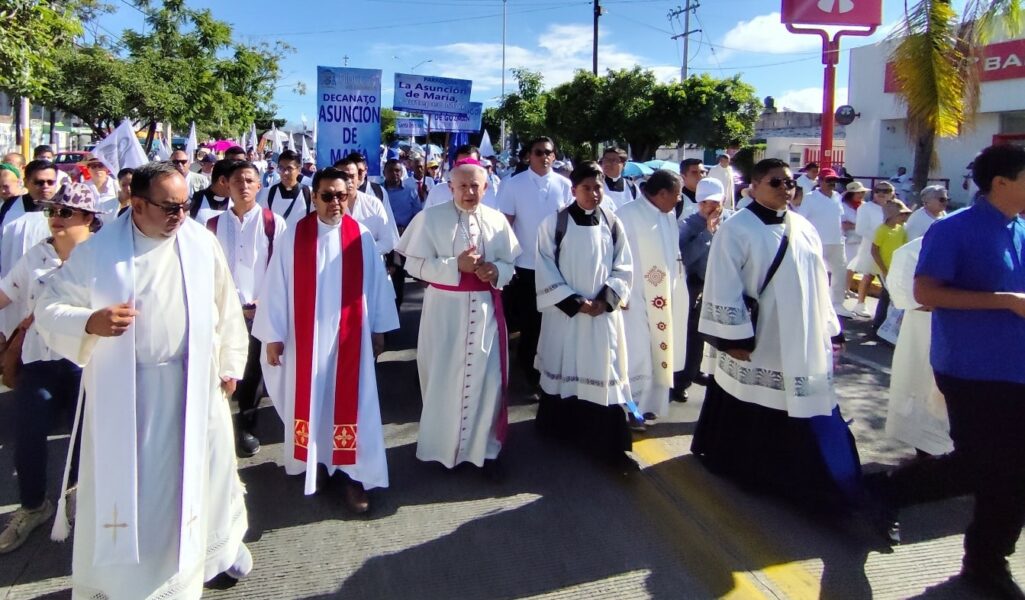
Hundreds of Catholic faithful from the Diocese of Cuernavaca participated this Saturday September 13 in the II Walk for Peace organized by the San Mateo vicariate in Cuautla, Morelos, under the leadership of Bishop Ramón Castro Castro. The event, which brought together local parishes and visitors from other regions of the diocese, sought to make visible the clamor for peace in a state battered by violence, extortion, and impunity.
Bishop Castro Castro, in his central message delivered at the end of the march, structured his reflection around three clear objectives, inspired by the Church's social doctrine method of «see-judge-act»: analyzing the violent reality of Morelos, judging it in the light of the Gospel, and proposing concrete actions for its transformation.
In the first objective, the «see», the prelate presented a forceful denunciation of the situation in the state. «Morelos is wounded», he affirmed, highlighting the «dark figure» of 92% of unreported crimes, the extortion affecting small businesses like tortillerías and hardware stores, and the «floor-right» that forces farmers and ranchers to hand over their harvests to organized crime.
Castro Castro emphasized the coexistence between some public servants and criminal groups, as well as the role of the searching mothers, whom he greeted affectionately for their work against institutional obstacles. «We feel your pain, we live your anguish», he said, based on direct pastoral care with the communities.
The second objective, the «judge», invited an evangelical reflection on peace as a gift from Christ: «My peace I leave with you, my peace I give to you». The bishop rejected violence as a genetic inheritance, attributing it to vitiated family and cultural environments. Quoting Pope Benedict XVI, he emphasized that «the commitment to peace arises from the unconditional respect for life» and John Paul II, who said «there can be no peace without truth». The family emerged as a fundamental pillar: «It is the cradle of life and love, the natural nucleus of society», according to the Universal Declaration of Human Rights, and the primary place to educate in values of peace and justice.
Finally, in the «act», Castro Castro proposed an immediate action plan. He encouraged cultivating «thoughts, gestures, and language of peace», promoting education in legality from childhood, and knowing the new Diocesan Pastoral Plan, whose key verb is «revitalize» –the family, the faith, and the heart of the disciple–. «Do not be afraid!», he exhorted all those present, from children to the elderly, recalling the beatitude: «Blessed are the peacemakers».
A particular emphasis fell on the call to those responsible for the violence. Addressing the organized crime directly, the bishop implored: «Return to the community from which you have strayed! Lay down your arms and do not let the nets of evil suffocate you». He warned about the «dirty money» from extortion and drug trafficking, which «corrupts, generates death, and enslaves», and offered the Church as a refuge: «You will find a mother with open arms». This message of mercy, directed also to authorities and criminals, resonated as a bridge toward reconciliation in a region where unity «is superior to conflict».
The walk, which started from the main church of the vicariate and ended in the civic plaza, had the support of local organizers, whom the bishop thanked publicly. «God allows us to manifest that deep longing for peace», concluded Castro Castro, closing with a collective call: «Let's get to work! Courage! God is with us».
This event is framed within the diocesan efforts to counter insecurity in Morelos, one of the most violent states in Mexico, and seeks to inspire a «new history» of communion and legality. Local authorities did not issue immediate statements, but the bishop's message is already circulating in parish networks, amplifying its echo of hope.
Morelos has faced a significant increase in violence and insecurity in recent years, driven mainly by the presence of organized crime groups. In 2024, more than 1,628 homicides were recorded in total, of which 1,324 were intentional, representing a notable increase compared to previous years. This positions Morelos as one of the most violent states in the country, with a homicide rate that places it in the national top 10. The perception of insecurity among the population is high: in 2024, the economic impact of violence amounted to 147 million pesos, equivalent to about 68,318 pesos per inhabitant. According to the National Survey on Victimization and Perception of Public Security (ENVIPE) 2024, the victim rate per 100,000 inhabitants was 26,995 for men and 24,870 for women.
On the other hand, the Mexico Peace Index 2025 indicates a slight improvement of 0.7% in peace during 2024, marking the fifth consecutive year of moderate advances after periods of deterioration. However, high levels of crimes such as homicides, kidnappings, extortions, and drug retail persist. The May 2025 Crime Semaphore reported alarming figures: 79 homicides, 2 kidnappings, 50 extortions, and 89 cases of drug retail in the state. At the national level, Morelos stands out for its high incidence in violent vehicle theft (first place) and extortion (second place, behind the State of Mexico).
The State is no stranger to territorial disputes due to the expansion of criminal groups, a key factor in the increase in violence. Due to its strategic geographical position near Guerrero and Mexico City, it is a territory disputed by multiple criminal organizations. In 2024, at least 14 groups operating in the state were identified, including independent cells like Los Cahuira and factions linked to major cartels. Among the most prominent are La Familia Michoacana, Los Linos, Los Mayas, Gente Nueva, La Unión, and La Antiunión.
According to the above, these groups have even infiltrated local institutions. In 2025, 17 of 36 mayors are under investigation for alleged ties to organized crime, and it is estimated that 50% of the municipalities are linked or associated with crime. The expansion from neighboring states like Guerrero has exacerbated the problem with disputes over drug retail, human trafficking, and extortion generating deaths and disappearances. In the first eight months of 2025, 650 violent murders were recorded and a 10% increase in feminicides.
Particularly the Cuautla area is one of the municipalities most affected by extortion, known as «floor fee». Between 2022 and 2023, this crime skyrocketed by 229%, according to the Executive Secretariat of the National Public Security System. In 2024-2025, the situation persists: three out of every 10 businesses have closed due to threats, and homicides of those who refuse to pay are reported. The Año de Juárez neighborhood is considered one of the most dangerous, with scenes of shell casings, bullets, and dismembered bodies. Extortion against transporters has intensified; for example, in September 2025, five people were arrested, including the leader of Route 6, for demanding fees from routes 10 and 2, and charging for «protection» for a cartel. Weapons, drugs, and more than 120,000 pesos were seized.
In August 2025, a UNAM study confirmed the increase in extortions, with empty businesses and rising homicides. In January 2024, Gente Nueva forced merchants to record videos thanking them for not extorting them, and in April of that year, a merchants' leader was murdered after reporting collections.
The absence of effective patrols by soldiers and the National Guard aggravates the problem, despite official claims. In 2025, arrests for extortion have been reported, such as a couple linked to crimes against health and extortion in Cuautla. At the state level, extortion has grown in municipalities like Yautepec and Puente de Ixtla, leading companies like Coca-Cola to consider withdrawing.
Morelos faces a security crisis with roots in the proliferation of criminal groups and systematic extortions, particularly in Cuautla, where violence has forced mass closures and generated a climate of fear. Authorities have implemented measures, but indicators suggest the problem persists. Today, the Church takes the initiative to Walk for peace in the hope that, as Bishop Castro Castro affirmed, the evildoers, from criminal groups or politicians, return to the Father's house and rectify the path through the actions that are condemning that State of the country.
Help Infovaticana continue informing