


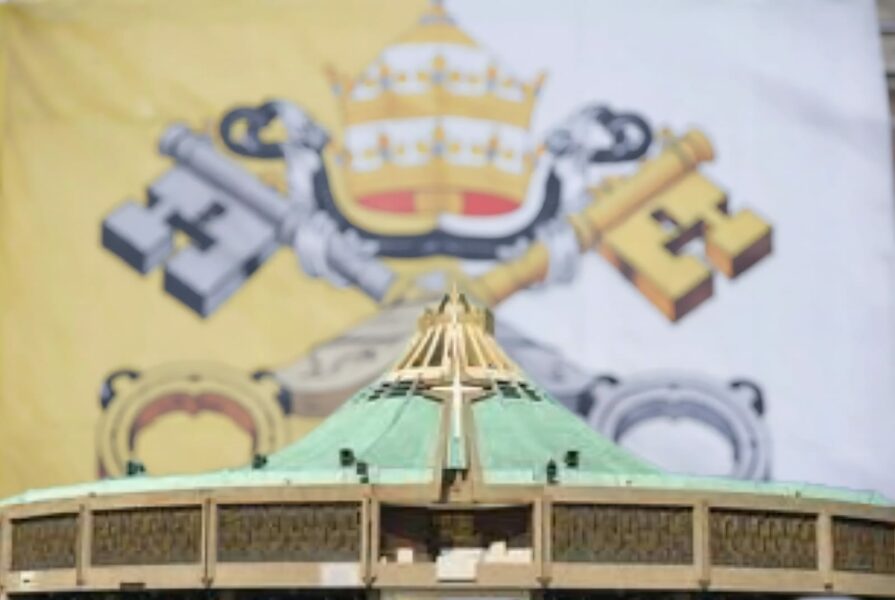
Seasoned observers of the religious phenomenon do not overlook the large number of pilgrims who have arrived at the Basilica of Guadalupe in recent days. Thousands coming from dioceses such as Tenancingo or the archdioceses of Puebla, Toluca, and Morelia, have overcrowded the Marian shrine and soon, that same one will commemorate the fifty years of the New Basilica of Guadalupe—the temple inaugurated in 1976 that since then has welcomed more than thirteen million pilgrims each year and has become the spiritual pulse of the nation—, an unsettling opacity envelops its walls.
This Sunday, March 15, while Auxiliary Bishop Francisco Javier Acero called for seeking justice and urged organized crime to abandon evil, it seems that internally, at home, the outward clamor has little echo inward. The prolonged absence of rector Efraín Hernández Díaz has been documented. Archbishop Carlos Aguiar Retes removed him from the position through decree 817/2025 and opened the preliminary canonical investigation IP 17/2025 on October 3. The chapter of canons had reported serious irregularities in pastoral and administrative management. Today, six months later, the silence is absolute.
It has been concluded that this is not a minor crisis nor is it partialized by keeping the rector in a low profile. It is the most important national Marian shrine on the continent. The rector’s prolonged absence, without a clear and transparent explanation being offered about his whereabouts, raises the first uncomfortable question: why does the Archdiocese of Mexico maintain a silence that contributes to the uncertainty?
Testimonies coincide that Hernández Díaz has not exercised his functions since August 2025. Various versions circulate, from living in a depressive situation to expecting reinstatement, but also more serious denunciations that have not admitted a pertinent explanation, networks of suspicious businesses, patrimonial opacity, and possible misuse of resources.
The chapter, far from remaining passive, fulfilled its canonical duty by presenting the formal complaint that forced Archbishop Aguiar Retes to act. An interim rector was appointed, but there has been no public accountability. There is no accessible financial report, no visible external audit, nor a single statement explaining the real state of the shrine’s finances. The chapter has safeguarded the Basilica, maintained the liturgy, and protected popular devotion, while the national ecclesiastical authorities examine the matter with a possible conclusion that would go against the rector.
What is it that really prevents the Holy See or the CEM from intervening decisively to clarify the affairs of the Basilica? Is the power of Archbishop Aguiar so great that no one can issue a sentence that looks after the interests of the holy people of God, that is, the preservation of true devotion beyond worldly interests?
There are precedents that could be a solution to the Basilica case. In 2019, Pope Francis appointed a pontifical delegate “ad nutum Sanctae Sedis” for the Sanctuary of Lourdes. There was no judicial scandal, but there was the presumed risk of a commercial drift that threatened the spiritual primacy, excessive prices, commercial brand marketing, deficient attention to the sick, secularization of the sanctuary. Antoine Hérouard, auxiliary bishop of Lille, temporarily assumed pastoral care. The result had immediate effects, the commercial aspect was contained, and the spiritual dimension was channeled without destroying the diocesan structure.
The case of the Fabbrica di San Pietro in 2020 is also noteworthy. Pope Francis appointed extraordinary commissioner Archbishop Mario Giordana after a report from the Auditor General that revealed opacity in contracts and fund administration. Giordana updated the statutes, reorganized the entity, and transparency was restored.
If in these cases there was action by the Holy See, why does the Basilica of Guadalupe, a national shrine that far transcends the jurisdiction of a single archdiocese— remain under a local process that, after half a year, has not produced even a public preliminary report? The CEM has been informed. Pope Leo XIV, according to reliable sources, is aware. However, no pontifical delegate has appeared, nor apostolic commissioner, nor audit, and everything seems like it could again be left in the hands of Archbishop Aguiar.
The argument of “diocesan autonomy” no longer convinces when the common good of the faith of an entire people is at stake precisely because this 2026 marks the jubilee of the fifty years of the New Basilica and an intercontinental Guadalupan novena is under development. Millions do not deserve to pilgrimage to a shrine under suspicion.
The solution exists and is viable. Submit a formal petition to the Dicastery for the Clergy or directly to the Holy Father. The Holy See, with the same agility demonstrated in Lourdes and in the Fabbrica di San Pietro, would appoint a Pontifical Delegate or an Extraordinary Apostolic Commissioner with economic-administrative faculties—. This delegate, who could be a Mexican bishop who, with the support of the chapter, could draft new statutes with protocols and annual public accountability, and appoint a new definitive rector modernizing the chapter without dissolving it and not as an imposition, but as an act of episcopal and synodal co-responsibility that has not precisely been the virtue of Archbishop Aguiar. It would not be new for a Mexican bishop to have a mission entrusted by the Holy Father. Ricardo Watty Urquidi, Missionary of the Holy Spirit and bishop of Tepic, was appointed visitor by Pope Benedict XVI in the investigation against Marcial Maciel and the Legionaries of Christ. The precedents, regardless of the cases, exist.
Without a doubt, the Guadalupan heritage does not belong to any particular cleric, nor to any ruler. That heritage of faith is the very identity of the people of Mexico. It cannot become booty of pettiness nor the object of calculated silences. The Mexican Episcopate has the historical duty to recall the words that Leo XIII addressed to the bishops of Mexico in 1895, words that today sound like a precise augury for this hour of crisis in the Basilica of Guadalupe:
«With all the love of our heart, we exhort the Mexican Nation to always look upon and preserve this love for the Divine Mother as the most outstanding glory and the most appreciable source of goods, and above all, with regard to the Catholic faith which is the most precious treasure because it runs the risk of being lost in these times; let all be persuaded and deeply convinced that it will endure among you in all its integrity and firmness as long as that piety worthy of all your ancestors is maintained… Let all strive with the greatest affection to venerate and love her, the benefits of her most present patronage will redound ceaselessly for the common good of all social classes».
Indeed, everything is a sounding box from the National Shrine. And that is what Auxiliary Bishop Francisco Javier Acero Acero wanted to do in the midday Mass on the fourth Sunday of Lent, March 15, who clamored more in the theatricality of his characteristic episcopal paraphernalia: “We will never have peace with a hidden dead man”; paraphrasing, the same can be said of the Basilica situation in a more sincere examination that causes pain within the enclosure: “It will never have peace with a hidden rector”.
And as the same Auxiliary Bishop Acero well said: “How much it behooves us to listen to what we like and also what we do not like”. Perhaps that is his unconscious intention. It is time for those words to stop being dead letter and become concrete action. Because, to the same Auxiliary Acero and his patron in office, Archbishop Aguiar, it weighs on them to hear that which they do not like: Appointing a balanced and neutral pontifical delegate to resolve this shameful situation and which would not be a humiliation for anyone; it would be the greatest act of fidelity to the Virgin and to the people who invoke her as Mother. “How much it costs to listen to each other… even in the Church”, said the auxiliary bishop. And in this case, why is it difficult? Because the truth, in the Basilica of Guadalupe, is also the purest form of devotion that the Lord Himself listens to and in His presence, cries out for justice even to clerics who are also tempted by the ghost of corruption.