


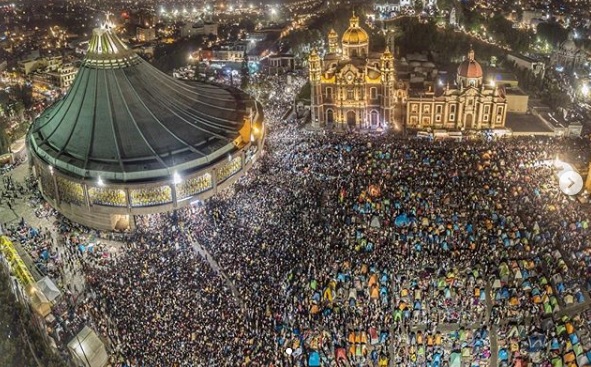
As Holy Week 2026 begins, in the Illustrious and National Basilica of Santa María de Guadalupe, the Marian heart of Mexico and one of the most visited shrines in the world, suspicions and institutional silence prevail. The definitive results of the preliminary investigations into the rector, Canon Efraín Hernández Díaz, episcopal vicar of Guadalupe, remain unseen. While thousands of pilgrims prepare to live the Passion, Death, and Resurrection of the Lord in the place where the Virgin appeared to the Indian Juan Diego, the absence of responses wounds the trust of a people who, generation after generation, have deposited in this shrine their deepest devotion.
This 2026 marks a symbolic anniversary, the 50 years since the inauguration of the new Basilica, on October 12, 1976. That modern work, designed by Pedro Ramírez Vázquez, represented then an act of pastoral and architectural renewal to receive the urban and growing Mexico of the 20th century.
Never before has a Holy Week in the modern Basilica been marked by this level of uncertainty, which not only questions the management of a rector and the duty of an archbishop, but also opens a debate that already has precedents worth bringing to memory.
From the 1950s onward, the bishops of Mexico promoted the creation of new dioceses with an eminently pastoral purpose, responding to the explosive demographic growth of the country. The creation of the modern Mexican Episcopal Conference allowed for a more solidified ecclesiastical organization.
As for the Archdiocese of Mexico, which in another time encompassed an immense territory that included much of the Valley of Mexico and surrounding areas, it has experienced a sustained process of reduction. In the last fifty years, it has been divided and subdivided into various ecclesiastical demarcations, giving rise to dioceses such as Toluca, Tula, Tlalnepantla, Texcoco, Cuautitlán, Atlacomulco, Nezahualcóyotl, and, more recently, Azcapotzalco, Xochimilco, and Iztapalapa.
Mexican bishops have systematically defended this fragmentation under the argument of “pastoral maturity”: a territory that reaches a certain level of ecclesial development, with trained clergy, consolidated parish structures, and capacity to self-manage, deserves to become an independent diocese. This logic has been applied in dozens of cases throughout the country.
Precisely as part of that history of dismemberment of the Archdiocese of Mexico, in 1984 and 1989 formal proposals for subdivision were presented, including letters addressed to the Holy Father requesting the creation of new circumscriptions.
In that context, a special situation arose regarding the Basilica of Guadalupe. There are documented precedents in the Mexican Episcopate according to which the National Shrine could become the episcopal seat of a convenient pastoral demarcation. It was even proposed that objective conditions of maturity existed for Tepeyac to cease being an abbey or dependent vicariate and assume greater autonomy, in keeping with its national and international dimension.
However, in 1990 the bishops opted to maintain the unity of the Basilica with the Archdiocese of Mexico. On August 11 of that year, the then secretary of the CEM, Archbishop of Tlalnepantla, Manuel Pérez Gil, publicly declared that an eventual modification of the primatial archdiocese “would come to modify the conditions of the national Shrine of the Basilica of Guadalupe”.
That statement from the CEM during the 1990s implicitly recognized that the shrine was not just another temple; its legal personality as a National Shrine placed it in a singular category, with obligations and rights that transcend mere territorial dependence.
Today, toward the 50 years since the inauguration of the new Basilica, it is evident that the 1990 decision did not resolve the core of the problem. The Basilica of Guadalupe is not an ordinary parish nor should it be just another vicariate. Millions of faithful from across the country and the continent consider it “their home.” It therefore demands special treatment as part of the “pastoral evolution” that the shrine itself calls for. Keeping it subsumed under the structure of the Archdiocese of Mexico, without governance adapted to its unique reality, amounts to ignoring the maturity that the bishops themselves had recognized in the precinct at moments in its history.
The current opacity surrounding the rector is not an isolated incident. It is the visible symptom of a structure that has not evolved at the pace that history and the faith of the people demand. While the results of the investigations are still not made public, the credibility of the shrine erodes.
Reaffirming those from the 1990s, it is worth questioning with severity and peculiar bluntness: how is it possible that, in these 50 years of the modern Basilica, a Holy Week has never been lived with this degree of suspicions and situations that injure and wound the faith, trust, and credibility of Mexican Catholics? The Archbishop of Mexico, in his role as principal custodian of the shrine, has failed to place truth as the first commitment that demonstrates his adherence to the Gospel. Instead of that, he has privileged opacity, lies, and discredit, which are nothing but works of the father of lies.
Paraphrasing the famous words of Paul VI, the smoke of Satan has entered the Basilica of Guadalupe. The pastoral firmness of the Chapter has been translated into the pastoral courage that the moment demands, but the smoke keeps seeping in. Holy Week 2026 not only recalls the Passion of Christ; it also reveals, painfully, the passion of a Church that, in its most beloved shrine, deserves to live facing the Truth.