


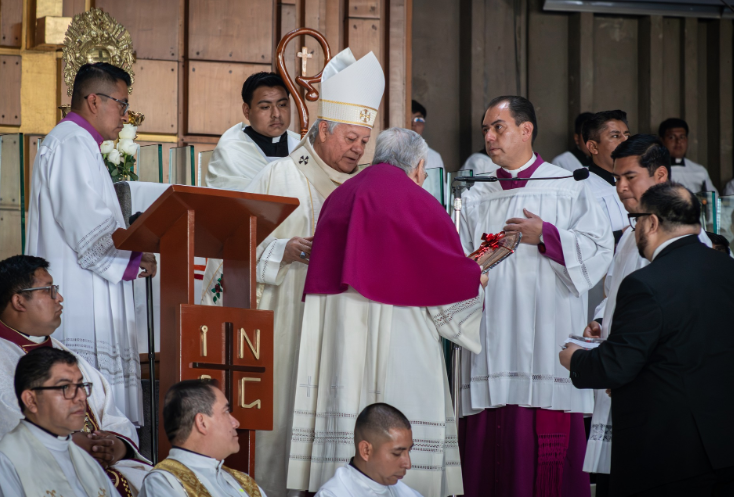
Every year, on February 12, the streets surrounding the Basilica of Guadalupe turn into a living stream of faith. This Thursday, however, the annual pilgrimage of the Archdiocese of Puebla had a special tone, that of the archbishop awaiting his succession who, upon turning 75, has reached the canonical age limit and is preparing to hand over his episcopal ministry. With the serenity of one who knows that his stage as the principal pastor of the Angelopolitan Church is coming to an end, Monsignor Sánchez Espinosa presided over the Eucharist in the most visited Marian shrine in the world and delivered a homily that is, at the same time, a thanksgiving, a spiritual testament, and a cry for Mexico.
The tradition of these pilgrimages dates back to 1887, when Father Ramón Ibarra González—later the first archbishop of Puebla—began the journey to the Tepeyac hill. One hundred thirty-five years later, Puebla remains the diocese that brings the most pilgrims to the Morenita. As Canon Pedro Tapia recalled, “Puebla is no longer only present on December 12 or February 12; it is present in December, January, February, March, and in other events as well.” Thousands of faithful arrived on foot, by bicycle, by motorcycle, and, above all, in the emblematic cavalcade from the Sierra Norte, which departed from Zacatlán and Texcoco, uniting parishes and municipalities in a beautiful image of popular devotion.
The archbishop led the pilgrimage to Tepeyac with the humility that has characterized him during his 17 years at the helm of the archdiocese and his nearly 50 years of priestly ministry. In his homily, he focused on the pastoral work dedicated to the Virgin. He wove together the day’s readings—the Book of Sirach, the Gospel of the Visitation, and the letter to the Galatians—to remind that Mary is “the mother of love, of knowledge, and of holy hope”. He quoted with emotion the wisdom text: “I am like a vine with fragrant leaves… Come to me, you who love me, feed on my fruits, because my words are sweeter than honey.”
He highlighted Mary’s haste in going up to the mountains of Judea to serve her cousin Elizabeth. “Mary set out in haste,” he repeated, and recalled that Elizabeth’s greeting became the Hail Mary that we pray every day. Then, the Magnificat burst from his lips with force: “My soul glorifies the Lord and my spirit rejoices in God my savior, for he has looked upon the lowliness of his handmaid.” From that same humility, the archbishop presented the intentions of the entire Church of Puebla before the Guadalupana.
He thanked, first of all, the synodal unity that has marked these years, recalling with affection the fruits of the Synod on Synodality and the words of Pope Francis of happy memory, who invited the Church to walk together. He presented the eight new presbyters ordained just the previous Monday as a living offering before the altar of the Virgin. He blessed the pastoral works carried out in the six zones of the archdiocese—north, south, east, west, center, and episcopal city—, in the deaneries and in the nearly 400 parishes, promoting the Diocesan Pastoral Plan and celebrating the creation of new communities.
With the evangelical pain of one who cannot remain indifferent, he implored the gift of peace for Mexico, for Puebla, and for the entire world. “We are living in difficult times, social conflict in Mexico and in the world… Our Church of Puebla cannot remain indifferent to these situations. We have to do something for them,” he said, referring to the poor who cry out for justice amid violence and inequality. He also recalled the great spiritual itinerary that the universal Church is experiencing: the 500 years of the Guadalupan Event in 2031 and the 2,000 years of the Redemption in 2033, inviting to live it “with a true Guadalupan spirit,” as Pope Francis requested.
He also asked that faith grow and that the homeland advance along paths of justice and peace. Finally, he entrusted to the Virgin the physical and spiritual health of all, the unity of the Church, and the strength to persevere in the faith. “Most Holy Mother of Guadalupe, you more than anyone know the sufferings we are currently going through because of violence, insecurity, that we suffer from the contempt that many have for life, for the family, which are sacred gifts from God,” he prayed with a firm voice.
At the end, Monsignor Sánchez Espinosa left a phrase that summarizes his ministry and that of the entire Church of Puebla: “I wholeheartedly desire that our pilgrimage be a sign of our people’s trust in the words of Saint Mary of Guadalupe: ‘Am I not here, who am your mother?’”
As the Eucharist reached its climax and thousands of faithful received communion under the tender gaze of the Morenita, many understood that this was not just another pilgrimage. It was that of a pastor who, upon reaching the twilight of his episcopal service, continues to place his Church in the hands of the Mother. Puebla, once again, said “thank you” to its archbishop in the most eloquent language it knows: that of faith on the move.