


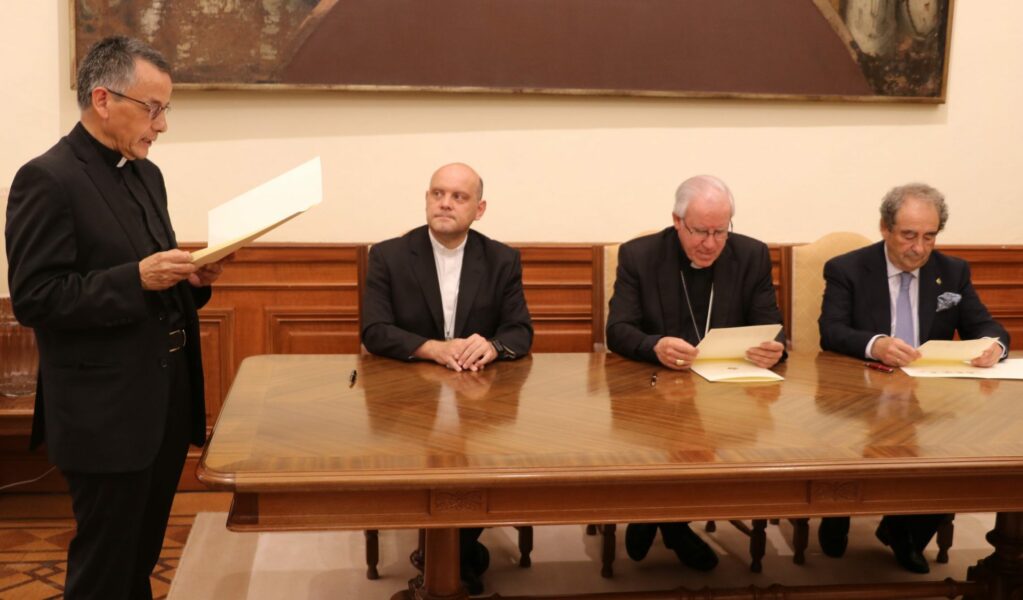
In an act held in the archbishopric of Seville, the Basilica of the Hope Macarena has sealed a twinning with the Basilica of Our Lady of Guadalupe, in Mexico, which aims to unite two of the most important Marian advocations in Hispanic America, fostering the exchange of worship, prayers, and traditions among devotees from both continents.
The document that formalizes this spiritual bond was signed by the Archbishop of Seville, José Ángel Saiz Meneses, the auxiliary bishop of Mexico, Francisco Javier Acero, and the brother mayor of the Brotherhood of the Hope Macarena, José Antonio Fernández Cabrero. As honorary witnesses, the rectors of both temples were present: José María Losada, for the Sevillian basilica, and Efraín Hernández, rector of the Basilica of Guadalupe.
The twinning establishes a shared liturgical calendar that strengthens ties between the two nations. From now on, the feast of Our Lady of Hope will be celebrated with special solemnity every December 18 in the Basilica of Guadalupe. In a reciprocal manner, the Basilica of the Hope Macarena will host, on December 12, the celebration of the Virgin of Guadalupe, patroness of Mexico and the Americas.
This reciprocity extends to the venerated images. In Seville, a reproduction of the tilma of San Juan Diego will receive worship in the Macarena basilica. Both locations will raise prayers for the Spanish and Mexican peoples, promoting the dissemination of these devotions to «strengthen the bonds between the devotees of the Hope Macarena and of Guadalupe,» as stated in the agreement.
The event, which brought together ecclesiastical representatives and brotherhood members, underscores the role of the Macarena as a symbol of hope in times of global uncertainty. «This twinning is not just an institutional bond, but a living commitment to prayer and universal fraternity,» declared Saiz Meneses during the ceremony.
The Virgin of the Hope Macarena, popularly known as «La Macarena», is one of the most emblematic Marian images in Seville and throughout Spain. Her history dates back to the 17th century, wrapped in a legend that fuses divine providence and human chance.
According to tradition, the carving—an anonymous work attributed to Genoese or Andalusian sculptors from the Baroque period, such as Pedro Roldán or the circle of Juan de Mesa—arrived in Seville in 1650 in the hands of an Italian merchant named Pedro de Vargas. The man, who was traveling to the Indies with the image destined for America, fell gravely ill in the city. On his deathbed, he left the Virgin as collateral in the watchmaker’s shop of a humble artisan on Calle Alfalfa, in exchange for care and lodging. Upon dying without heirs or payment, the image remained in the watchmaker’s possession, who installed it in a niche in his workshop. There, under the title of «Hope,» it began to be venerated by the neighborhood residents, who attributed miracles to her intercession.
In 1680, the Brotherhood of the Bakers—predecessor of the current Brotherhood of the Hope Macarena, founded in 1595—acquired the carving for 36 reales, a legendary barter that is said to have included a clock as part of the payment, giving rise to the nickname «Macarena» (possibly from the Macarena neighborhood where its chapel was located). The image, 1.75 meters tall, with a serene face and slanted eyes that convey a profound hopeful sorrow, became the center of a popular devotion that grew during the War of Independence (1808-1814), when thousands of Sevillians entrusted themselves to her in the face of the Napoleonic threat.
The 20th century marked decisive milestones: in 1913, the brotherhood settled in the Basilica of the Macarena, erected in 1949 and elevated to minor basilica in 1964, coinciding with the canonical coronation of the Virgin that same year—the second sorrowful image in Seville to receive this honor, after the Virgin of Bitterness. The Macarena is the patroness of the Real Maestranza de Caballería de Sevilla and a symbol of Andalusian Holy Week, with her penitential station on Palm Sunday attracting hundreds of thousands of faithful.
The feast of the Virgin of the Hope Macarena is celebrated on December 18, coinciding with the Solemnity of the Expectation of the Birth of the Most Holy Virgin Mary, also known as the «Feast of the O» (from the Antiphon O Adonai Emmanuel). This liturgy, of medieval origin and revived in the 20th century, evokes the imminent arrival of the Messiah and hope amid Advent. For Macarena devotees, it is a day of massive hand-kissing: since 1925, thousands of Sevillians flock to the basilica to kiss the Virgin’s hand, in a spontaneous procession that turns the neighborhood into a sea of candles and saetas.
In the brotherhood, the day includes a solemn function at 8:00 p.m., with a floral offering and exposition of the image. This date, now extended to the Basilica of Guadalupe thanks to the twinning, symbolizes the universality of Marian hope: in Seville, of faith before Christmas; in Mexico, with Guadalupan devotion, reminding us that Mary, as the Hope of the needy, is present throughout Hispanic America.