


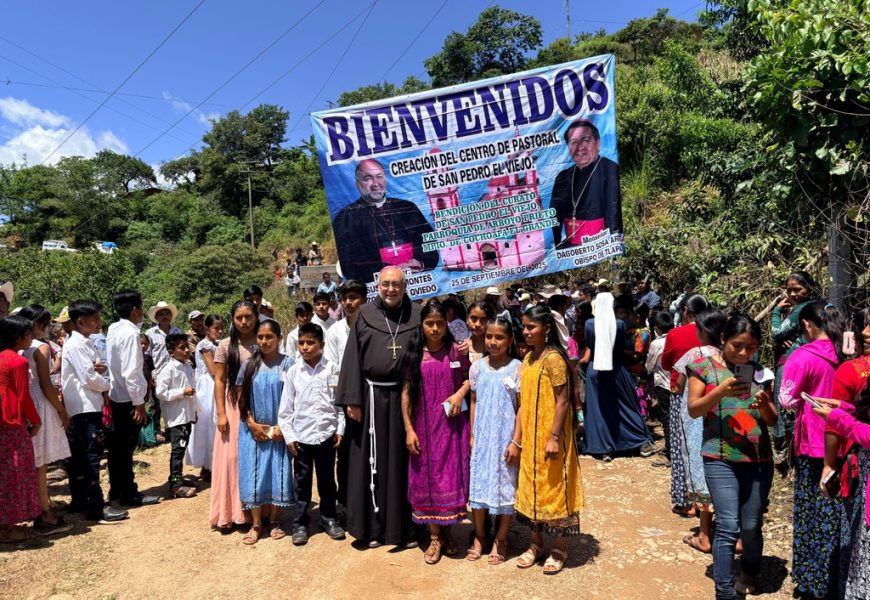
In an episode that underscores the inherent dangers of missionary work in conflict-ridden regions, the Archbishop of Oviedo, Franciscan Jesús Sanz Montes (1955), faced armed hooded men during his recent visit to the Mountain region, in the municipality of Tlapa, state of Guerrero, Mexico. The incident, which he considered of minor significance, was recounted by the prelate himself in an interview with the Archdiocese of Oviedo, published on its official website. Although the event did not escalate to greater consequences, it highlights the chronic insecurity plaguing this area, marked by tribal vendettas and the influence of drug trafficking.
Sanz Montes’ visit to Mexico was not casual. As he details in the interview titled “If we lose the missionary zeal, we lose our identity as Christians”, published on October 10, 2025, the archbishop traveled at the end of September 2025 to accompany the opening of a mission of the Unión Lumen Dei and the start of the pastoral course in the diocese of Tlapa. It was not his first foray into the area; the previous year, two former seminary classmates invited him to explore this «mission territory,» a mountainous and forested landscape dotted with small indigenous communities, many of them mired in extreme poverty. «I have two old friends from the Seminary there who invited me last year to get to know all that terrain, which is indeed a mission territory,» explained Sanz Montes in the conversation.
Currently, two priests and a deacon from Lumen Dei serve about 45 scattered parishes, facing logistical challenges such as impassable roads that require 4×4 vehicles. Their work goes beyond the sacraments: it includes a human and fraternal presence to support communities that have preserved the faith through generations, despite the historically scarce priestly attention. «The older people or the elderly are enormously respectful; in them remains the imprint of that first evangelization, centuries ago, which took place through the presence of my Franciscan brothers,» noted the archbishop, highlighting the hope represented by the children and youth in these villages.
However, the idyllic setting contrasts with a grim reality. Guerrero, particularly the Mountain region in Tlapa, is one of Mexico’s most violent states, according to reports from organizations like Amnesty International and the federal government itself. The area is part of drug trafficking corridors, where cartels like Guerreros Unidos or factions of the Jalisco New Generation Cartel vie for territories. To this are added ancestral «tribal» conflicts, such as family vendettas that perpetuate cycles of primitive violence. «It is an area that, in addition to the simplicity and poverty of these communities, in the state of Guerrero is ‘proverbial’ for violence; it may be one of the most violent areas in Mexico,» affirmed Sanz Montes.
The incident involving the archbishop occurred during a routine journey. Accompanied by a local priest, they were heading to celebrate Mass in a small community. «On one of the curves, three hooded men with machine guns appeared. They stopped us in the vehicle and asked who we were and where we were going», he recounted. Upon identifying themselves as «missionary fathers,» the assailants responded: «Don’t worry, keep going.» Although the episode resolved without violence, the archbishop admitted the emotional impact: «It’s impressive to see people pointing guns at you whose faces you can’t see, but beyond that understandable fright, on the other hand, it had no greater consequence.» He emphasized that missionaries are generally respected in the area, which likely prevented a worse outcome.
This event is not isolated. In Guerrero, attacks on clergy and missionaries have increased in recent years. According to data from the Centro Católico Multimedial, at least 10 priests have been murdered in Mexico since 2018, many in regions like this, where the Church acts as a mediator in local conflicts. The evangelizing work, which includes promoting peace and forgiveness, clashes directly with dynamics of revenge. «To proclaim in those places where people live with this primitive essentiality, the Christian peace and to announce the forgiveness we owe one another, is one of the tasks we have in this evangelization,» emphasized Sanz Montes.
Back in Spain, the archbishop contextualized the incident within a global landscape of violence. In the interview, he alluded to conflicts like the war in Gaza—started two years ago with the Hamas attack—and the Russian invasion of Ukraine, as well as dozens of forgotten wars that serve to «dispose of obsolete weaponry.» In the Spanish national context, he criticized the «political polarization» that generates divisions. As a Christian, he advocated being «instruments of peace» in the everyday: «So that we can dream of a world in peace, my little world has to be pacified.» Quoting Saint Francis of Assisi, he urged avoiding «wars» in families, friendships, and parish communities.
The interview also addresses diocesan challenges in Oviedo, such as the increase in vocations—with 12 new seminarians and 44 in total—and the priority on youth, families, and education. Sanz Montes praised the new Pope Leo XIV, whose exhortation Dilexi Te emphasizes love for the poor, describing it as a «breath of fresh air» that promotes unity and peace, inspired by Saint Augustine.
This incident in Tlapa will not deter the mission. On the contrary, it reinforces the central message of the interview: «Losing this missionary zeal is losing our identity as Christians.» The Archdiocese of Oviedo, through this publication on October 10, not only reports on the trip but invites reflection on the evangelizing commitment in adverse contexts. In a world where violence lurks even for messengers of peace, Sanz Montes’ experience reminds us that faith is forged in adversity, and that the Church, missionary by essence, persists in bringing hope to the corners where violence does not have the last word.