


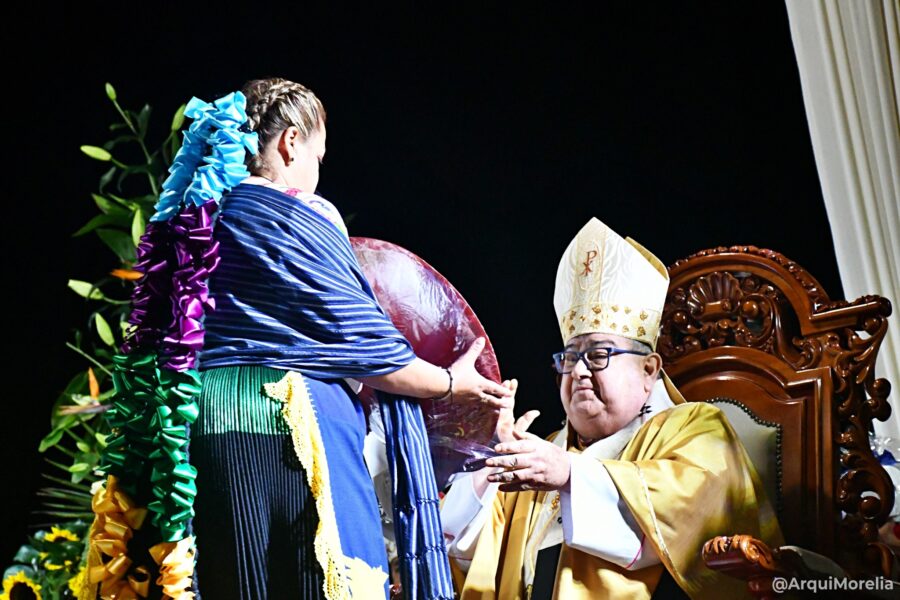
In an emotional ceremony that united faith, history, and hope, the Archdiocese of Morelia commemorated on October 17, 2025, the 500 years of the arrival of the Gospel in Michoacán lands. Presided over by Archbishop Carlos Garfias Merlos, the Eucharist celebrated in Pátzcuaro brought together bishops, priests, religious, laity, and civil authorities to give thanks for the evangelizing legacy begun by the Franciscans in 1525.
This celebration highlights not only the perseverance of faith in the region but also the profound cultural and social impact of the Franciscan missionaries, who «planted the Gospel» in the heart of the Purépecha people.
The Mass, celebrated in the historic Basilica dating back to the 16th century, was attended by Armando Álvarez Cano, coadjutor archbishop of Morelia, and representatives of Franciscan and Augustinian congregations, as well as civil authorities such as the presidents of the municipalities surrounding Lake Pátzcuaro. Archbishop Garfias Merlos, in his homily, emphasized gratitude for «the blessings and abundance of divine graces that God has had in these lands.» He recalled the commitment of missionaries and laity who facilitated the inculturation of the Gospel, extending throughout the entire Archdiocese of Morelia and beyond. «We have gathered at the Lord’s altar to give thanks to God who 500 years ago began the evangelization in our lands of Michoacán,» expressed the prelate, uniting local joy with the universal jubilee of Christian hope.
It is essential to go back to the historical origins of evangelization in Michoacán, led by the Franciscans, to understand the importance of this celebration. According to historical documents compiled by the Franciscan Provincial Commission for the Fifth Centenary, the arrival of Fray Martín de la Coruña in 1525 marked the beginning of a presence that transformed the spiritual and cultural landscape of the region. Sent by the general minister of the Order, Fray Francisco de los Ángeles Quiñones in 1523, Fray Martín and his twelve companions—inspired by Christ’s apostles and Saint Francis of Assisi—arrived in New Spain with the mission of «planting the Gospel in the hearts of those infidels.»
The expedition departed from Spain with clear instructions: to imitate Franciscan poverty and humility. In a letter from Quiñones dated October 4, 1523, it reads: “And thus at present I am not sending more than one prelate with twelve companions, because this was the number that Christ took in his company to make the conversion of the world. And St. Francis our father did the same for the publication of the evangelical life”. Upon arriving in Tzintzuntzan, the capital of the Purépecha kingdom, the friars settled among the indigenous people, learning the local language to dialogue and practice «fraternal love.» «And upon arriving in Tzintzuntzan they wanted to learn the local language and managed to dialogue with the people,» details the Franciscan document, highlighting how this respectful approach facilitated conversion without impositions.
The Franciscans founded churches and schools, prioritizing catechesis. In Tzintzuntzan and Pátzcuaro, they established missions that extended to the Bajío and the West, covering a «vast territory to be evangelized.» Their focus on «minority»—living with the poor and simple—resonated with Purépecha culture. «Upon opening our eyes we contemplate lakes and mountains. From that moment we shared our life with an ancestral culture; we learned their language and they embraced our faith,» describes the jubilee prayer composed by Enrique Muñoz. This cultural exchange resulted in an inculturated faith: Christ and the Virgin integrated into indigenous life, symbolized in the anniversary logo with Fray Martín planting his staff in Lake Pátzcuaro, alluding to the «fishers of men» from Matthew 4:18-20.
Over the centuries, the Franciscan Province of San Pedro y San Pablo of Michoacán, canonically erected in 1565 but with roots in 1525, faced trials such as secularizations and conflicts, but endured «five hundred years,» «increasing the faith of men who allowed themselves to be molded by God.» Its cultural impact includes the promotion of education, justice, and respect for creation, themes that resonate in current pastoral care. Historical sources, such as the song «Apostles of Michoacán» by Fr. Orlando Herrera Téllez, celebrate these pioneers: «Apostles of Michoacán who, practicing minority, came to these lands to teach the example that Christ gives us.»
That is why Archbishop Garfias Merlos’ homily linked this historical legacy to the present, quoting Pope Francis on Christian hope that «does not deceive or disappoint.» He recalled the words of Saint Paul in Romans 8: «Neither death nor life… can ever separate us from the love of God manifested in Christ Jesus.» He invited the faithful to renew their evangelizing commitment: «Let us continue with this evangelizing commitment with great joy and hope.»
Referring to the Gospel of Luke (10:1-12), the prelate emphasized the sending of disciples to announce the Kingdom of God: «Set out on your way… The Church is marked by Jesus’ sending.» He criticized ecclesial temptations such as isolation and urged to «heal the sick» and offer peace: «When you enter a house, say first, peace to this house.» Garfias Merlos specifically thanked the Franciscans for their «effort and dedication so that the Gospel reaches all corners,» mentioning figures like Fray Martín de la Coruña, Saint Barnabas of Jesus Méndez Montoya, martyr, and the venerable Vasco de Quiroga.
The archbishop also recalled his 50 years of priesthood, asking for the intercession of the Virgin of Health: «May she be the star that continues to guide us as she has for 500 years.» This invocation highlights the Marian role in Michoacán evangelization, with devotions like Our Lady of Health rooted in Franciscan work.
This celebration is not only retrospective; it is an impetus for contemporary mission. In a Michoacán marked by social challenges, the jubilee promotes «hope that does not decline,» fostering confidence in the Church and society. Activities such as pilgrimages to Pátzcuaro, historical colloquia, and Franciscan congresses—detailed in the centenary planning—seek to revitalize faith.
Experts from the Universidad Vasco de Quiroga, who organized conferences in June 2025, reflect on this «early evangelization,» highlighting its role in the humanization of indigenous life. Documentaries like «500 Years of Devotion» illustrate how Franciscan faith shaped local identities, from Tzintzuntzan to Morelia.
Upon closing the Jubilee Year in October, the archdiocese looks ahead: «Let us feel like the new ones sent by Jesus Christ to continue preaching his Gospel of peace, love, and divine tenderness,» exhorted Garfias Merlos. In a fragmented world, the Franciscan legacy—of dialogue, humility, and service—offers an enduring model. As the jubilee prayer states: «Thanks for Fr. Martín de Jesús and his companions who preceded us… Do not abandon, Lord, the work of our fathers.»