


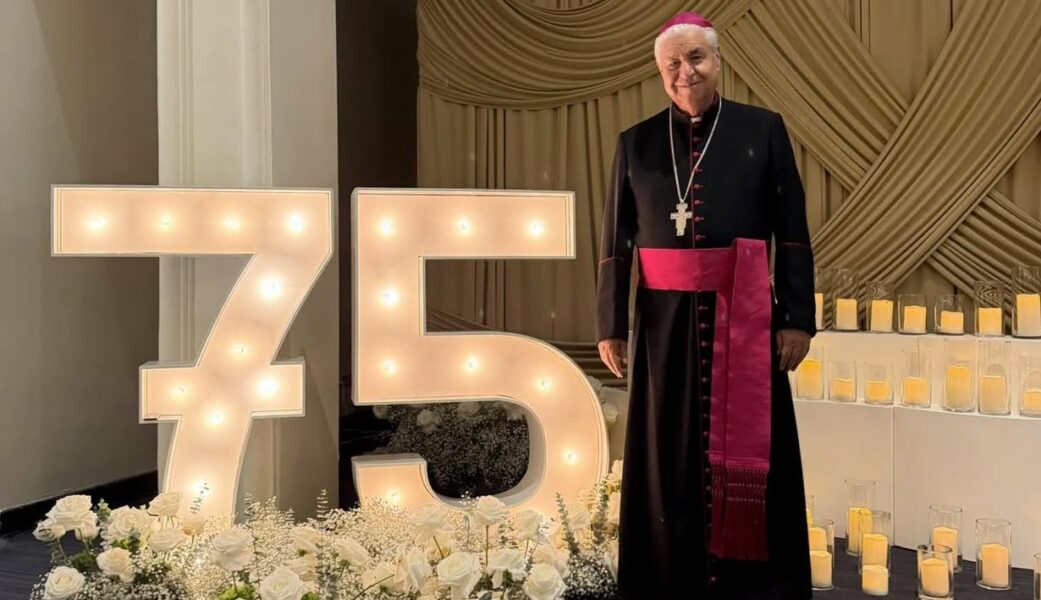
In an act of “obedience,” the Archbishop of Monterrey, Rogelio Cabrera López, presented his resignation from the pastoral office on January 24, coinciding with his 75th birthday. This regulation marks a significant personal moment for the prelate and highlights a period of transition in the Mexican ecclesial structure where six of the 19 ecclesiastical provinces have seen their archbishops reach retirement age, adding to a vacancy due to the death of the Archbishop of Tijuana, leaving seven provinces awaiting new pastors, representing approximately 36.84% of the total.
The presentation of the resignation, previously announced in a Sunday message on social media on January 18, was framed in celebrations filled with gratitude and spiritual reflection. Cabrera López, who has led the Archdiocese of Monterrey since 2012, emphasized that this step is taken «with peace, obedience, and interior freedom,» recalling that the episcopal ministry is a temporary service to the people of God. According to canon 401 of the Code of Canon Law, bishops must offer their resignation to the Pope upon turning 75, although acceptance depends exclusively on the decision of the Supreme Pontiff. The archbishop clarified that he will continue at the helm of the archdiocese until otherwise determined, assuming his role «with responsibility and always in communion with the Church and with the Roman Pontiff.»
Cabrera López held a thanksgiving service in the Metropolitan Cathedral of Monterrey on the afternoon of January 23, on the eve of his birthday. In an atmosphere of fraternal closeness, the archbishop presided over the Eucharist surrounded by bishops, priests, religious, and family members where he had previously exercised ministries. He particularly thanked the presence of priests with whom he collaborated in Tapachula and Tuxtla Gutiérrez, as well as his close family, permanent deacons, and religious sisters. He highlighted the participation of Luis Carlos Lerma Martínez, Bishop of Nuevo Laredo, and his elected auxiliary bishop, José Eugenio Ramos Delgado, symbolizing the continuity of the episcopal ministry.
In his homily, he reflected on the day’s biblical readings, focusing on the story of Saul and David from the Old Testament. He emphasized human fragility and the greatness of forgiveness, stating: «The forgiveness is always an act of nobility; you are more human when you forgive and less human when you hate and are vengeful.» Commenting on the Gospel of Saint Mark, he emphasized the sense of Christian vocation: «Jesus called those he wanted,» recalling that every call is an act of gratuitous divine love. In this context, he shared his own episcopal journey, nearing 30 years as a bishop, humbly recognizing successes and errors, and expressing a desire for ongoing conversion.
The celebration continued on January 24 with a commemorative breakfast that brought together family members, priests, seminarians, bishops, and civil authorities. From early in the morning, the archbishop personally greeted the attendees, reflecting his close pastoral style, described as «with the smell of sheep and also with the smell of the city.» Father David Jasso, on behalf of the local Church, offered an emotional message highlighting the 47 years of priestly ministry and nearly 30 as a bishop of Cabrera López. He highlighted his perseverance, generous service, and commitment to the peripheries, parish missions, and synodality, both in the Mexican Episcopal Conference (CEM) and in CELAM and pontifical assignments.
Subsequently, the chancellor secretary read a writing from the archbishop himself, where he communicated the presentation of his resignation and shared three key feelings: a profound debt to God and the people served; a sincere request for forgiveness for errors and limitations; and deep gratitude for the accompaniment of laypeople, priests, consecrated persons, deacons, seminarians, and bishops. In his own words, Cabrera López thanked everyone’s presence and recalled his trajectory, marked by obedience from his appointment as Bishop of Tacámbaro in 1996, passing through Tapachula and Tuxtla Gutiérrez. «I never sought these services, but assumed them trusting in the grace of God,» he expressed with simplicity.
The archbishop also valued the role of his family in his formation and the support of collaborators, emphasizing that the ecclesial mission is a shared work. He recognized the importance of collaboration with civil authorities for the common good, in the face of current social challenges. He encouraged prayer for vocations, citing the Gospel: «Ask the owner of the harvest to send more workers,» trusting that God guides the Church beyond human limitations.
This personal event is inserted into a broader context of renewal in the Mexican Church. Of the 19 ecclesiastical provinces in the country, six archbishops have presented their resignation upon reaching 75 years: Cardinal José Francisco Robles Ortega of Guadalajara; Rogelio Cabrera López of Monterrey; Víctor Sánchez Espinosa of Puebla; Pedro Vázquez Villalobos of Oaxaca; Leopoldo González González of Acapulco, and Cardinal Carlos Aguiar Retes of Mexico. To this is added the vacancy in the Archdiocese of Tijuana, following the death of Francisco Moreno Barrón in November 2025, which raises to seven the number of provinces awaiting a new archbishop.
Of the total of 19 provinces, these seven sees amount to approximately 36.84%. This percentage underscores a significant moment of transition, where the Holy See must discern successors who continue the pastoral work in a country with more than 90 million Catholics, facing challenges such as secularization, violence, and the promotion of synodality promoted by Pope Francis and continued by Leo XIV.
Recently, the resignation of Carlos Garfias Merlos, Archbishop of Morelia, was accepted on January 19, just ten days after its presentation on January 9, with José Armando Álvarez Cano immediately assuming as successor, already designated as coadjutor. Álvarez Cano will receive the archiepiscopal pallium from Pope Leo XIV on June 29, on the feast of Saints Peter and Paul, resuming a ceremony centralized in the Vatican.
The resignation of Cabrera López does not imply an immediate cessation, but a confident wait. As he himself expressed, «the Church belongs to the Lord» and his legacy of closeness and service will endure. The Archdiocese of Monterrey, with its more than 6 million faithful, looks to the future with hope, while the Mexican Church navigates this phase of generational handover, strengthening its universal communion.