


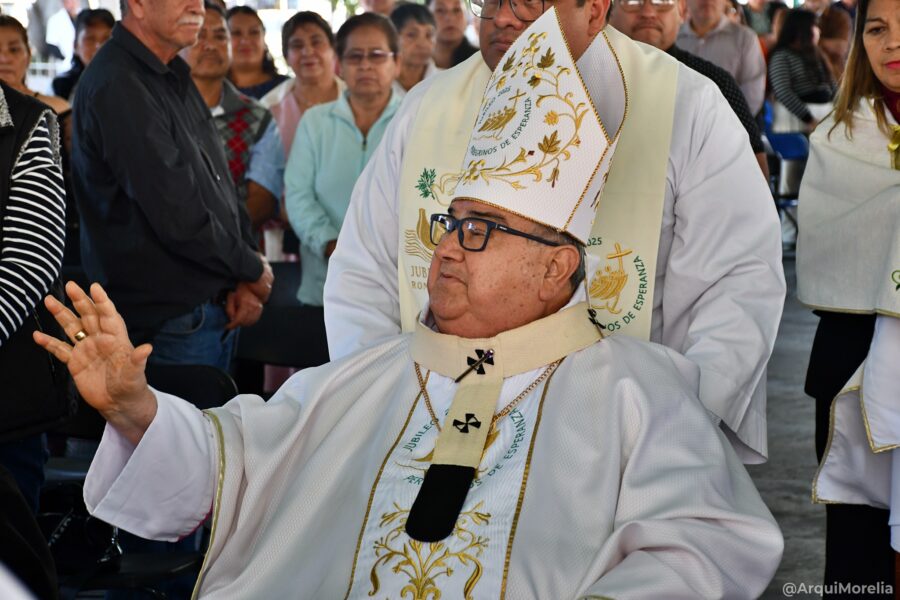
In a moving ceremony that combined nostalgia, gratitude, and a call for unity, Archbishop of Morelia, Carlos Garfías Merlos, celebrated the 50th anniversary of his priestly ordination on December 27, 2025, in his hometown of Tuxpan, Michoacán.
The event took place in the parish of Santiago Apóstol, the same temple where he celebrated his «cantamisa» exactly half a century earlier, accompanied by the faithful, fellow clerics, family, and friends. Many more joined virtually through social media and live broadcasts, highlighting the archbishop’s influence in Mexican Catholic circles.
The celebration occurred days before Garfías Merlos’ 75th birthday on January 1, 2026, adding a layer of personal reflection to the milestone. Born in Tuxpan on January 1, 1951, Garfías Merlos has risen through the ranks of the Catholic Church in Mexico, serving in some of the country’s most challenging dioceses amid social unrest and violence. His career began with studies in teaching -education- humanities, philosophy, and theology at the Morelia Seminary, followed by advanced degrees in psychotherapy and spirituality at the Intercontinental University of Mexico City.
Ordained a priest on November 23, 1975, for the Archdiocese of Morelia, he initially aspired to be ordained on the feast of St. John the Evangelist, December 27—a date he later chose for his first Mass despite his companions’ group ordination amid the post-Vatican II conciliar reforms.
Garfías Merlos’ episcopal career has been marked by service in conflict-plagued regions. Appointed Bishop of Ciudad Altamirano in 1996 by Pope John Paul II, he served there until 2003, when he was transferred to the diocese of Nezahualcóyotl. In 2010, Pope Benedict XVI appointed him Archbishop of Acapulco, a position he held until Pope Francis designated him for Morelia in 2016, where he took possession in 2017. Throughout his tenure, he has held key roles in the Mexican Episcopal Conference (CEM), including vice president in 2018 and leadership in commissions on youth, family, and social pastoral care.
In the golden jubilee priestly Mass, preaching the homily to the congregation, Garfías Merlos expressed profound joy at returning to Tuxpan, where he rooted his vocational dream. «I am very happy today to celebrate this Eucharist here in the parish of Santiago Apóstol, in my birthplace,» he said, recalling the illusions of his youth and the circumstances that led to his ordination date. He thanked those present, including companions ordained by Archbishop Estanislao Alcaraz, Fathers Severo, Zavalita, Jesús, Aurelio, Basurto, Armando Ríos, and others who have shared his 50-year journey, as well as the Archbishop of Acapulco, Leopoldo González.
Two characteristics were defining of his priesthood, which Garfías Merlos highlighted with gratitude to God. The first: an identity rooted in friendship, modeled on St. John the Evangelist, whom he described as Christ’s intimate friend: «To be a friend, to learn to be attentive to the needs of others and to seek ways to help them,» he emphasized, extending this to his relationships with priests, family, and communities across the presbyteries of Altamirano, Nezahualcóyotl, Acapulco, and Morelia. He invoked the synodal theme of «walking together» in Morelia, urging intergenerational solidarity among priests—from veterans like himself to the newly ordained. This call resonates amid the Church’s global synodal process, fostering unity in an era of division.
The second pillar, his role as a promoter and builder of peace, a theme that has defined his ministry, especially in the last two decades as a bishop and archbishop. Garfías Merlos referenced a book about his life, “Carlos Garfias Merlos, obispo, promotor y constructor de paz”, which narrates this commitment. «To be a promoter and builder of peace, to be an impeller of peace, nothing simple and nothing easy in these times when there is so much conflict,» he noted, alluding to the prevalent discrimination, competition, and aggression in society. Drawing from Isaiah—»blessed are the feet of the messenger who announces peace»—and from Ephesians—»Christ is our peace,» his episcopal motto—he detailed initiatives such as promoting prayer for peace, education for a culture of peace, and collaboration with civil authorities, society, other confessions, and fellow bishops.
In Michoacán and Guerrero, regions marked by cartel violence and social unrest, Garfías Merlos has been a vocal advocate for dialogue and reconciliation. He mentioned collectives such as the Red Juntos por Michoacán (which unites university rectors), the Colectivo Michoacán Humanitario (helping those facing adversities), the Interreligious Council of Michoacán, the Michoacán Council for the Construction of Peace and Reconciliation, and the Economic and Social Council of Michoacán. These efforts align with Pope Francis’ call to be «artisans and builders of peace,» a message he repeated.
The archbishop’s peace work has not been without controversy. In recent years, he has publicly supported negotiation with organized crime to curb violence, stating in interviews that dialogue is essential for pacification. This stance, amid Mexico’s security crisis, positions him as a bridge-builder in a polarized landscape, though it has drawn criticism from some ecclesial sectors that reject direct engagement with cartels.
At the end of the homily, Garfías Merlos invoked the intercession of the Virgin of Health, St. Barnabas of Jesus Méndez Montoya, and the Venerable Vasco de Quiroga, urging continued friendship with Christ and commitment to peace. Attendees described the event as inspiring, a testament to a life dedicated to service amid adversity.
This golden jubilee not only honors Garfías Merlos’ personal milestones but also highlights the Church’s role in fostering hope in turbulent times. As Mexico grapples with violence and inequality, his message of friendship and peace-building offers a model for community healing. With more than 50 years of priesthood, the archbishop’s legacy continues to unfold in Morelia and beyond.