


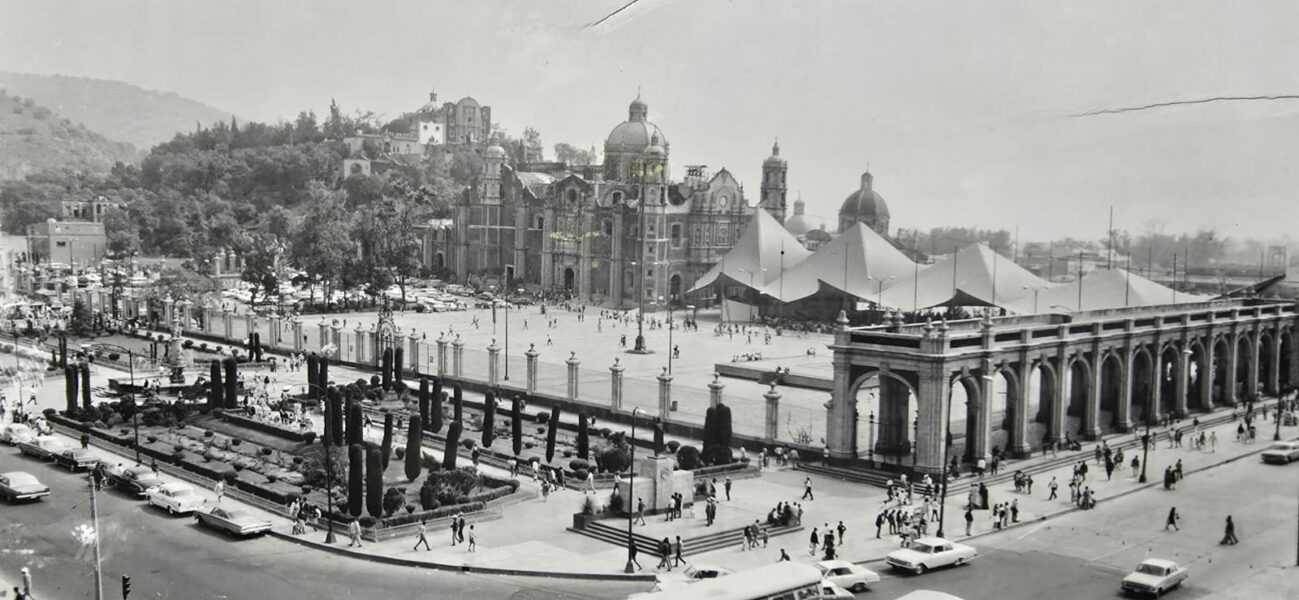
October 12, 1970, the Basilica of Guadalupe marks a milestone in its history that, currently, few remember. That day, the Archdiocese of Mexico held a grand celebration in honor of the Mother of Heaven. That moment was the 75th anniversary of the pontifical coronation of the image by the will of Pope Leo XIII.
In the chronicles of that distant 1895 –the 130th anniversary this October 12- splendid and grand religious events are recorded, gathering the sacred and the profane. It was the Archbishops of Mexico, Próspero María Alarcón and of Michoacán, José Ignacio Árciga Ruiz de Chávez who, representing the Church of Mexico, imposed the crown on the image of the Virgin of Guadalupe before the faithful and 36 bishops who heard the oath of fidelity from the newly appointed abbot, José Antonio Plancarte y Labastida, perpetuating himself in the memory of Catholic and Guadalupan Mexico.
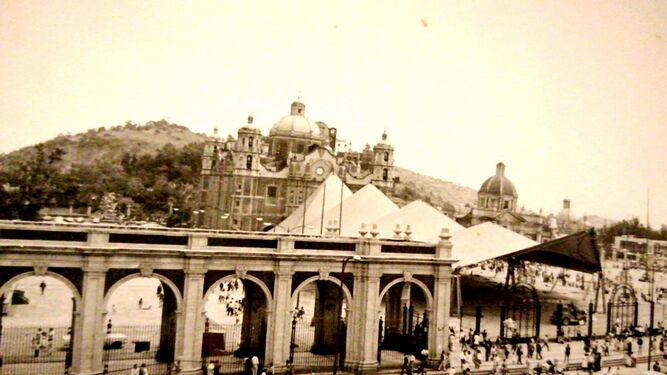
- Villa de Guadalupe
In 1970, it should be remembered with equal solemnity and joy. And it is special because it is one of the few occasions when the Virgin of Guadalupe left her altar to be close to the Catholic people, six years before her transfer to the modern Basilica.
Old Basilica was a silent witness to the respect, love, and devotion of thousands of people when that unprecedented event was perpetuated in memory: Seeing the image of the Guadalupana up close. At the beginning of that decade, the building of the so-called Collegiate Church was succumbing to the passage of time and was practically insufficient to receive thousands of pilgrims.
During the archbishopric of Cardinal Miguel Darío Miranda and Abbot Guillermo Schulenburg Prado, appointed by John XXIII in May 1963, the 75th anniversary of the coronation should be of such impact and magnitude as that of 1895.
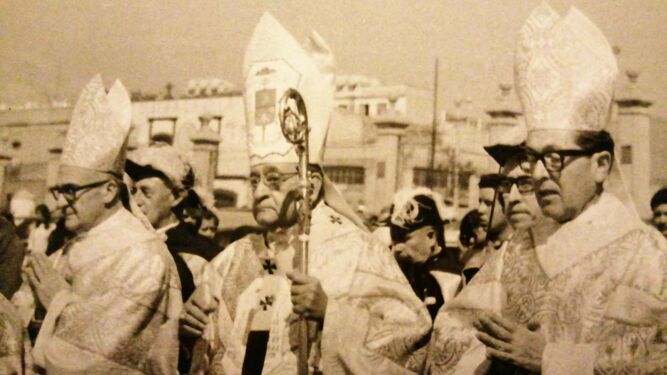
Cardinal Miranda and Abbot Schulenburg. Grand Eucharist.
According to the memoirs of Abbot Schulenburg published in 2003 by the publishing house Miguel Ángel Porrúa, the first 12 days of October 1970 were organized with liturgical celebrations in a space that was the embryo of the current building where the blessed image is today. It was called the “Ephemeral Basilica”, as the last abbot of Guadalupe recalled:
“The worthy setting for the liturgical and paraliturgical celebrations of the first 12 days of the month of October 1970 was, without a doubt, the so-called «Ephemeral Basilica» which in reality adequately resolved the various problems of hygiene, capacity, visibility, participation of the people of God, and dignified celebration of the Holy Sacrifice of the Mass”.
The Ephemeral Basilica had a pink canvas as its roof mounted right in front of the old Collegiate Church. Designed by the architects Fr. Gabriel Chávez de la Mora, Juan Planas, and Héctor García Olvera, it was mounted by Casa Planas and would house the thousands who would be at the celebration presided over by Cardinal Miguel Darío Miranda.
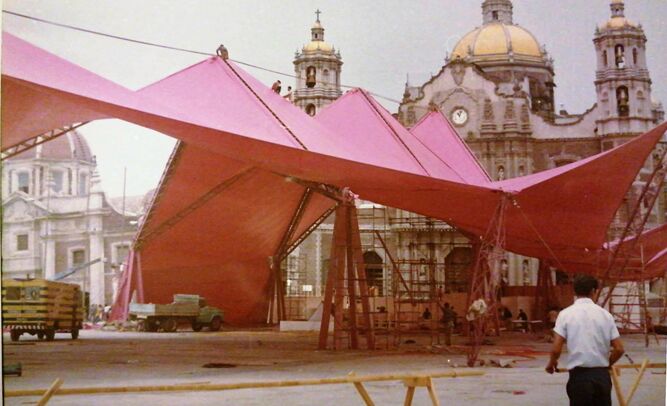
Ephemeral Basilica. Embryo of the modern enclosure.
Photos from the era immortalized the moments where workers used cranes and machinery to assemble the roof where the altar would be that would receive the Guadalupana flanked by a large cross. Just the night of October 11, 1970, Saint Mary of Guadalupe left the shelter of the old building to give dignity to the Ephemeral Basilica that was ready for the grand Eucharistic celebration of the 75 years of Leo XIII’s coronation.
One of the few witnesses to that extraordinary event was attorney Fernando Chiquini Barrios. Educated from primary school through high school by the Benedictine fathers of Tepeyac College in the Lindavista neighborhood.
Chiquini had an active apostolate in the convent of the Salesian Sisters operating the dispensary for the most needy from 1964 to 1970. Thanks to these activities, he met Father José Cenobio Ramírez who collaborated with Abbot Schulenburg in the Collegiate Church.
In 2020, Chiquini shared with this blog his memories of that special moment of having the precious image of the Mexican people just one meter away. That October 1970 remained in the memory of the one who, in that same year, graduated as a bachelor in administration from UNAM.
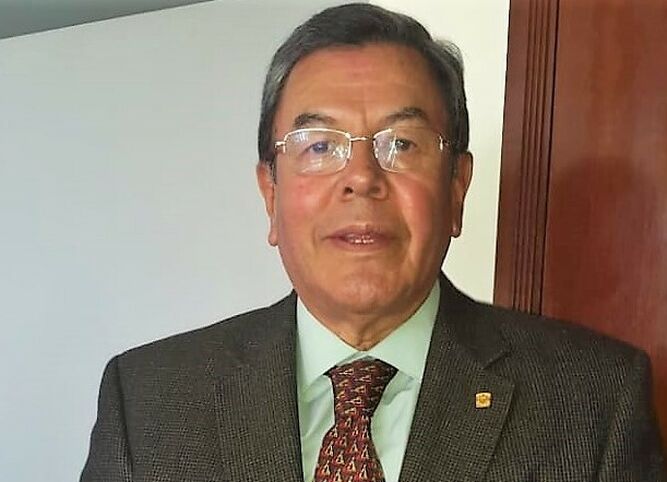
Chiquini Barrios. Witness
What memories do you have of that Ephemeral Basilica, how was its installation?
-I learned about the construction of the Ephemeral Basilica from its planning because Abbot Guillermo Schulenburg invited Friar Gabriel Chávez de la Mora to support him in the design and construction of the project. I had known Chávez de la Mora for several years before since he was a Benedictine friar. Towards the end of September, there was a lot of enthusiasm for this celebration and a lot of activity to finish the Ephemeral Basilica, which was at the same time a preliminary design of the New Basilica.
In fact, you were one of the few to have the honor of seeing the image of the Virgin of Guadalupe up close and witnessing the transfer to the altar of the Ephemeral Basilica, how was that moment?
-Father Cenobio invited me to attend the transfer of the Virgin the night before, that is, October 11. Due to the security measures implemented, I entered at 11 p.m. through the back part through the economo’s office. The work to lower the Virgin began at 1 a.m., I remember there were between 80 and 100 guests. Once down, they positioned her with great care on the ground on a base where she was held vertically. They invited us to come see her up close, one meter away, in pairs. My partner was the Benedictine Father Hildebrando Garza, my teacher at Tepeyac. While we were in line, a tense atmosphere full of complete silence was felt. When it was our turn to be in front of Her, it was a beautiful and great emotion that brought me to the point of tears. Father Hildebrando explained the tilma to me in detail. It was 5 minutes, for me an eternity. At 5 a.m., the tilma was placed in the Ephemeral Basilica.

Dawn of October 12, 1970
This October 12 marks 50 years of the Ephemeral Basilica, half a century since the Virgin of Guadalupe came down from her altar to be close to her children, what feeling do you hold after the passage of that time?
-Indeed, 50 years have passed and I always carry that memory with me. When I talked about it with my family, they were also very moved and told me it was the work of my mother who had passed away 4 years earlier. For many years, I have carried a medal with the image of the Guadalupana with me. I can only say that I feel like a blessed man, faithfully believing. That is why, periodically, I attend Mass at the Benedictine monastery of Ahuatepec, Morelos, which was also designed and built by Friar Gabriel Chávez de la Mora.
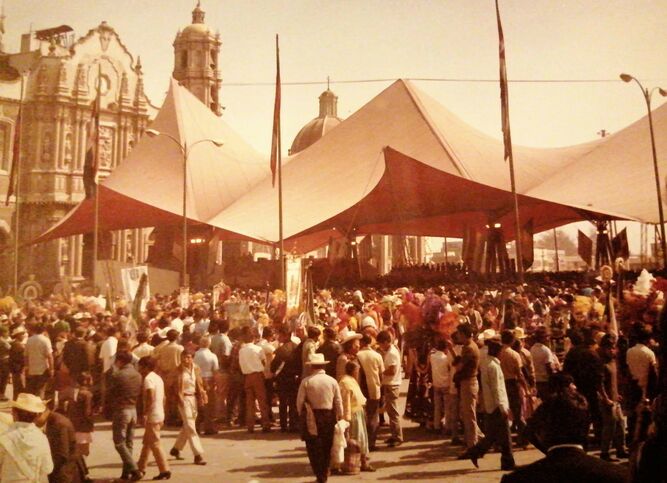
1970. Celebration for the 75 years of the coronation
That Ephemeral Basilica was the seed of the new Basilica built under no small tensions, approaches, negotiations, and agreements with the power. A new home that, as Abbot Schulenburg recalls, was “a vital necessity for the people of our country”.
That Monday, October 12, 1970, Paul VI directed an emotional radio message to the people of Mexico. Words that seem to update themselves when, in these particularly difficult times, Saint Mary of Guadalupe accompanies her children. On that occasion, these words arrived in a radio message and still seem to address our most pressing and urgent problems: “Beloved Mexicans, today we want to echo before you so many sorrows and anxieties that overwhelm the world, which cannot leave us indifferent if we truly want to be faithful to the Gospel message. A Christian cannot feel at peace while there is a man who suffers, who is treated unjustly, who does not have what is necessary to live. A Christian cannot do less than demonstrate his solidarity and give the best of himself, to solve the situation of those to whom the bread of culture or the opportunity for honorable and justly paid work has not yet arrived; he cannot remain insensitive while the new generations do not find the channel to make their legitimate aspirations a reality, and while a part of humanity continues to be marginalized from the advantages of civilization and progress”.
For Paul VI, the best crown that the Virgin of Guadalupe could wear was that of “fidelity to the Gospel of which She knew how to be the eminent example”. 55 years after the Ephemeral Basilica, it may be necessary to open our ears to the prophetic words of the saintly Pope.