


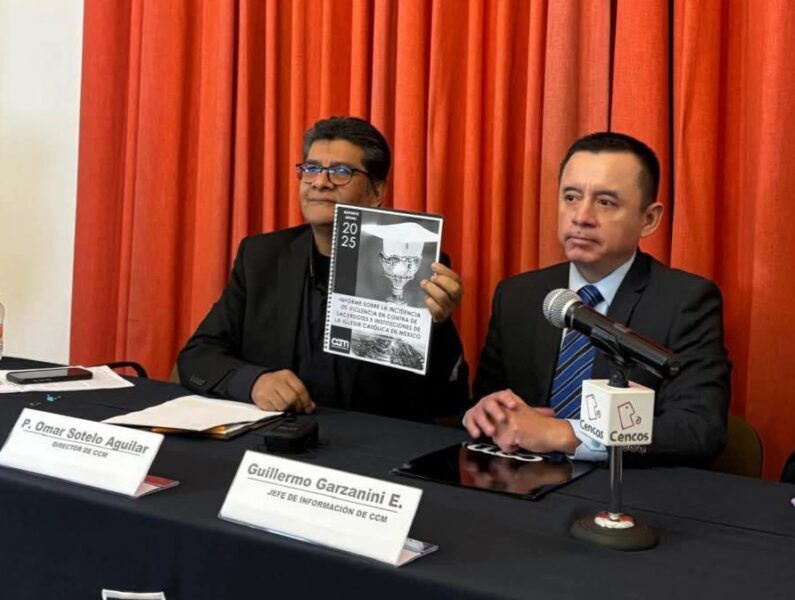
In a press conference held yesterday at the National Center for Social Communication (CENCOS), Father Omar Sotelo Aguilar, SSP, director of the Catholic Multimedia Center (CCM), and Guillermo Gazanini Espinoza, head of information, presented the «Annual Report 2025: Report on the incidence of violence against priests and institutions of the Catholic Church in Mexico». The document, prepared by the CCM’s Special Investigations Unit, reveals a worrying mutation in the violence: although the murders of priests have decreased, attacks against laypeople linked to pastoral activities have escalated, affecting entire communities and eroding the social fabric.
The report, which covers the periods of the six-year terms of Andrés Manuel López Obrador (2018-2024) and the beginning of Claudia Sheinbaum (2024-2025), documents 13 priests murdered in total: 10 in the previous administration and three in the current one. Sotelo Aguilar emphasized that this numerical reduction does not imply an improvement in security, but rather a change in the targets of organized crime. «The violence has not ceased; it has transformed. Now, laypeople who exercise community or pastoral leadership are direct victims, which reflects a strategy to destabilize the Church as a factor of social cohesion,» the director declared during the presentation.
One of the most alarming aspects highlighted is the violence against laypeople. The report records 23 murders of people close to ecclesiastical tasks in the last seven years, many of them for resisting organized crime or for their activism in human rights. Examples include the case of a family in Chicomuselo, Chiapas, where on May 13, 2024, 11 people were massacred, including Ignacio, a candidate for permanent diaconate, and Teresita de Jesús, a catechist. «They died for refusing to join criminal gangs,» the report explains, citing journalistic sources.
Other incidents underscore this trend: on March 16, 2025, eight young people were executed on a field adjacent to the San José de Mendoza parish in Salamanca, Guanajuato, while preparing for Holy Week. Just one month later, on May 10, seven young people—including minors—were massacred in San Bartolo de Berrios, Guanajuato, during a parish celebration for Mother’s Day. Gazanini Espinoza pointed out that these are not isolated incidents: «They are symptoms of a loss of values and the relativization of the sacred, aggravated by impunity and corruption.» The document also mentions the murder of catechist Florinda Orozco Calderón in Colima, on December 3, 2024, and of Inocencia Prudencio Gómez in Acapulco, on March 15, 2024, both for their community commitment.
In the historical context, the CCM counts, since 1990, one cardinal, 62 priests, one deacon, four religious, and 23 laypeople murdered, plus three missing priests. Guerrero emerges as the most affected state, with 10 events since 1990 and eight priests killed since 2009, including the recent case of Father Bertoldo Pantaleón Estrada, murdered in October 2025. The bishop of Chilpancingo-Chilapa, José de Jesús González Hernández, has denounced the forced displacement of another clerical activist, Father Filiberto Velázquez, due to threats.
The conclusions of the report are forceful: the violence has mutated, but not due to direct religious persecution, but because priests act as «social stabilizers» that hinder the control of organized crime. More than 80% of cases remain in impunity, which fosters a culture of silence, forced recruitment, and «narco-governments» in vulnerable territories. «There is no evidence of collusion between clerics and criminals; their interactions are for community survival,» the document states. Additionally, it criticizes political polarization, with media attacks from those in power accusing the clergy of interference, exacerbating tensions.
In the face of this crisis, the report proposes eight final recommendations for a proactive and unified response:
- Establish a Special Ecclesiastical Security Commission in the Mexican Episcopal Conference (CEM) for protocols with technology such as anonymous reporting apps.
- Strengthen international alliances for training in preventive intelligence and drills with authorities.
- Update security protocols with emphasis on rural areas and annual audits.
- Create a National Observatory of Violence against Ecclesiastical Heritage, collaborating with the INAH for censuses and preventive measures.
- Promote digitized inventories of sacred art using AI to combat illicit trafficking.
- Develop comprehensive accompaniment programs for victims’ families, with psychological and legal support.
- Foster ecumenical dialogues for coalitions against violence and joint documentation.
- Institute a National Day of Memory and Prevention, with events to raise awareness and pressure for justice.
With 1,300 temples attacked annually—84% common robberies, 10% high-impact, and 6% sacrileges—the Church positions itself as collateral victims of a war that touches everyone, Sotelo Aguilar closed the presentation invoking Christ as a source of peace: «Sensible actions are urgently needed so that Mexico has a dignified life. The faith of a people is a right that must be protected before violence profanes even the divine.» The report, available on the CCM website, calls on society and authorities to act decisively to prevent this crisis from becoming normalized, recalling the assassination of Cardinal Juan Jesús Posadas Ocampo in 1993 as a warning, the CCM director expressed.
The report can be read here:
Annual CCM report on violence against priests