


Vamos empezando semana y el Papa León XIV está en su Apartamento y es como si una respiración profunda después de trece años inundara los Sacros Palacios. These decisions, whether we like it or not, very media-driven, make the pontificate of Pope Francis appear as a parenthesis. It is fair and necessary that Pope Leo be the one who speaks most about Pope Francis, but the facts are the facts and it does not seem that he likes some of the choices of the late predecessor much, something is something.
Pope Leo XIV in the palace.
On Saturday afternoon, Leo XIV returned to live in the Third Loggia of the Apostolic Palace, which, to be a secondary issue, is causing rivers of ink to flow. As soon as he was elected, Francis announced to the other guests at Casa Santa Marta that he would remain there, apologizing for his somewhat uncomfortable presence. «I don’t go there for psychiatric reasons. I need to live among the people», he replied a few months later to a girl who asked him the reason for that decision. More than a decade of incredible abandonment followed huntil this Saturday. Late Saturday afternoon, the Swiss Guards and gendarmes abandoned the post they had occupied for the last ten months in the Palazzo del Sant’Uffizio: a sign that the Pope had moved to the Apostolic Palace. He left the third-floor apartment «inherited» from the German cardinal Paul Josef Cordes.
It took months and months of work, the biggest problems were caused by leaks on the northeast side of the Palace, which had severely damaged the walls and interior, as had happened several times during the years of Benedict XVI. His personal secretary, Monsignor Edgard Ivan Rimaycuna Inga, and his second secretary, Don Marco Billeri, also moved with him . Other central figures in the Pope’s daily life remain the chamber assistants: Piergiorgio Zanetti, confirmed, and the newcomer, Anton Kappler, who works at his side. Leo also wanted a faithful collaborator from his time in the Dicastery for Bishops, the former usher Cristiano Raimondi, to be close to him in the Pontifical Household. The predominant feeling in the Vatican is one of joy at knowing that the successor of Peter is returning to the Third Loggia apartment, inhabited by his predecessors from Pius X to Benedict XVI. And, above all, at knowing that Mass will once again be celebrated in the Papal Apartment after thirteen years of desecration.
The Pope on pastoral visit to Ponte Mammolo.
Yesterday Leo XIV spent the afternoon in the parish of the Sacred Heart of Jesus in Ponte Mammolo, on the eastern outskirts of Rome. He followed the pastoral routine that has characterized all his visits to Roman parishes in recent weeks: he arrived around 4:00 p.m., met with children, young people, and families; then met with the elderly, the sick, the poor, and the homeless, whom the parish supports; after that, Mass at 5:00 p.m.; and finally, a meeting with the Pastoral Council and priests, before returning to the Vatican.
In his homily during Holy Mass, Leo XIV expanded his gaze from the Roman periphery to the entire world. Starting from the fourth Sunday of Lent, Laetare Sunday: «God cannot be manipulated by darkness.» Then he developed the Gospel of the man born blind, explaining that seeing with God’s eyes means, above all, overcoming prejudices against those who suffer. Jesus, he observed, does not treat the wounded as a problem to avoid, but as a person to love. Hence also his criticism of a religiosity trapped in formalism: no observance can justify indifference, because «there is no «Sabbath» that can prevent an act of love».
He also evoked the proximity of Rebibbia prison, reminding us that even for those who have made mistakes, the path to conversion remains open. The central point, once again, was this: we need people capable of accompanying, of «extending a hand», of making God’s love visible in a difficult neighborhood. His final comment: «I hope it won’t be another 40 years until the next visit!».
Audience with the Pontifical Commission for the Protection of Minors.
Highly recommended reading of Pope Leo’s brief speech to the THE PONTIFICAL COMMISSION FOR THE PROTECTION OF MINORS gathered for their Plenary Assembly. «I thank (…) your service to the Church in protecting children, adolescents, and people in situations of vulnerability. It is a demanding service, sometimes silent and often burdensome, but essential for the life of the Church and for building an authentic culture of care.» «Prevention is never merely a set of protocols or procedures. It is about helping to form, throughout the Church, a culture of care, in which the protection of minors and people in situations of vulnerability is not seen as an obligation imposed from outside, but as a natural expression of faith. Therefore, it requires a process of conversion in which the sufferings of others are heard and move us to act. In this sense, the experiences of victims and survivors are essential points of reference. Although they are certainly painful and difficult to listen to, these experiences powerfully bring to light the truth and teach us humility as we strive to help victims and survivors. At the same time, it is precisely through the acknowledgment of the pain that has been caused that a credible path of hope and renewal opens up.»
«The Annual Report of the Commission is a tool of great importance. It represents an exercise of truth and responsibility, as well as of hope and prudence, which must go hand in hand for the good of the Church. Hope prevents us from falling into discouragement; prudence preserves us from improvisation and superficiality in addressing abuse prevention.» «Supporting local churches, especially where resources or experience are lacking, means giving concrete expression to ecclesial solidarity. I look forward to receiving additional information in your third Annual Report on the encouraging progress already made, as well as on the areas that still require further development.» There will be malicious ones who do nothing but weigh that the case of abuses in Chiclayo, which personally and directly affects Pope Leo, remains unresolved. We already know that «one thing is to preach, and another is to give wheat», it is easier to give advice than to practice what is advised; or something more local: «The squire of Guadalajara, what he promises at night is nothing in the morning. Those from Peñaranda, what they say at night they do not fulfill in the morning.»
The ‘clumsy mistake’ of Cardinal Ouellet.
And that’s not the worst that nests in the Roman Curia. Ouellet, 81 years old, former prefect of the Vatican’s Dicastery for Bishops and considered in 2013 as a possible papabile, is currently immersed in a civil process before the Superior Court of Quebec in Montreal, in a lawsuit against Paméla Groleau. From the beginning of the trial, the cardinal has stated that the accusations made by Groleau in 2022 have gravely damaged his honor and reputation. He requests compensation of 100,000 Canadian dollars. The process does not constitute a criminal trial and no criminal charges have ever been filed against the Canadian prelate. Instead, the court has been asked to determine whether Groleau defamed him by including him in a class-action lawsuit for alleged misconduct within the Archdiocese of Quebec.
Groleau alleges that Cardinal Ouellet touched her without her consent on three occasions between 2008 and 2010, while she worked or trained as a lay pastoral agent. During her testimony in the trial, she stated that in an incident that occurred in 2010, the cardinal ran his hand down her back to the top of her buttocks. During cross-examination, she indicated that this last incident was the only one she considered to constitute sexual assault. Cardinal Ouellet has categorically denied all accusations. The center of the headlines is that the cardinal acknowledges the ‘clumsy mistake’ of having inserted 50 dollars into the front of the lady’s sweater, well, what was he thinking. Two more women have appeared as witnesses for Groleau’s legal team, offering testimonies about what they describe as inappropriate behavior by the cardinal in previous decades. We recommend to His Eminence to read the immortal Quixote: “It seems to me, Sancho, that you are very afraid.” Sorry “that now more than ever you smell, and not of amber.” And the wise response: “Worse is to shake it, my friend Sancho”
The Priestly Fraternity of St. Charles Borromeo.
It is today at the center of a growing number of testimonies denouncing abuse of conscience, distorted formation processes, control over individuals, and an internal life management that, according to several priests who still belong to the organization or have left it, has caused deep wounds. This is a climate that is currently very widespread within Communion and Liberation. It is surprising, therefore, that in the face of this accumulation of accounts, this exodus of priests, and these insistent reports, no apostolic visitation has ever been commissioned to the Fraternity of St. Charles. In other cases, the Holy See has deemed it necessary to verify, listen, investigate, and send visitors. However, in this case, despite the growing gravity of the situation, no adequate means of investigation seems to have been established. Leo XIV will meet with the superiors of the Fraternity of St. Charles. It is an appointment that, in light of what is emerging within the CL movement, cannot go unnoticed.
«What is behind the Pope’s resignation?».
We take it from an interesting article in Panorama, we understand that it may be a dense topic for those far from the complicated issue of Vatican finances. To understand it, we must start from the beginning. On September 29, Leo XIV issued the motu proprio Coniuncta cura, «excommunicating» the financial monopoly of the IOR, imposed by Pope Francis. Through an apostolic recommendation, Pope Leo XIV revoked the exclusive investment authority of the Vatican Bank. Two weeks later he sent Cardinal Giuseppe Petrocchi, member of the Council for the Economy and of the Dicastery for the Clergy, to the financial Institute as his «supervisor», in the role of new president of the Cardinalitial Commission of the Vatican Bank. What purpose do these actions pursue and what do they foreshadow? Without a doubt, to make the Vatican’s investment decision-making process more «democratic» and to control the bank’s decisions. The bank over the decades—from the Marcinkus-Roberto Calvi case—has become the legendary repository of the Holy See’s most unspeakable secrets.
The current topic is that the IOR is being examined again because it is one of the key points of the Epstein Archives: perhaps the most emblematic chapter of the horrible saga of the pedophile financier. Leo XIV knew how important reputation is in economics, and that’s why he secured the management of funds through «collegiality», focusing on maximum transparency by dividing investments and responsibilities. Of the 3.5 million «documents» linked to «The devil dressed as Jeffrey», a significant part is dedicated to the Vatican and describes various areas of interest for the Holy See, depending on whether those handling them is Epstein, who financed the Democrats and maintained close ties with Bill and Hillary Clinton, who took every opportunity to enrich himself, or finally, Epstein, who used Steve Bannon.
Jeffrey Epstein’s obsession with controlling the Church It is surprising that, while Bannon sent him an email in June 2019—few days before his arrest—with the imperative order to «overthrow Francis», Epstein was communicating with Joichi Ito, director of the MIT Media Lab, founded by Nicholas Negroponte, the guru of the future of technology, whom the Democrats consider one of their main financial sponsors. The pedophile financier wanted the Japanese man, an expert in Wall Street bets, to tell him everything about the summits that the executives of the big American tech companies, «friends» of Epstein, held in the Vatican with the blessing and interest of Pope Francis and the very active organization of the Dominican Eric Salobir.
It is a double-edged game that Jeffrey has been playing with the Church for at least thirty years. Those who strive to present him as a defender of the global right recall that Epstein, along with his partner and accomplice Ghislaine Maxwell, received the blessing of Karol Wojtyla and kept the photo waving in the sky of his New York bunker. But few examine the Epstein Archives in depth, which reveal his obsession with the Church. This translates into a desire to attack the Russian Orthodox Church and use it for his own ends, involving circles within the Obama administration.
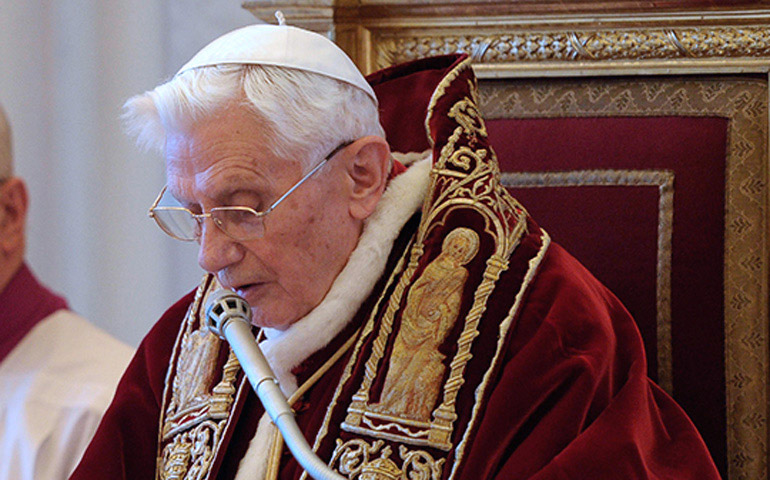
And we arrive at Ratzinger’s resignation and the change in the direction of the IOR. The most controversial email is February 21, 2013, in response to his question: «What is behind the Pope’s resignation?». In fact, just two weeks earlier, Ratzinger had pronounced the historic words: «perveni vires meas in gravescente aetate non iam aptas esse ad munus Petrinum» (I have come to the conviction that my strength, due to my advanced age, is no longer adequate for the Petrine ministry), and Epstein wanted to know more. He received a response that opened up a world of possibilities for him. «The most important change in the Vatican may not be the sudden resignation of Pope Benedict XVI, but the change in the direction of the Institute for Religious Works.» He added that, since the Vatican Bank is an expression of a sovereign state and is outside Italian jurisdiction, it is not subject to European transparency standards, allowing those who work there «to transfer money with total anonymity and without any kind of supervision.»
This was music to Jeffrey’s ears, who paid little attention to the subsequent email explaining why Ettore Gotti Tedeschi was being removed from the presidency of the Institute. Epstein understood that the Vatican Bank was in trouble and that there were business opportunities. But he does not act alone; he is turning to the Democratic Party’s chief economist: Larry Summers. He was Secretary of the Treasury with Bill Clinton, economic advisor to Barack Obama, the man capable of anything at Harvard, and he resigned on February 26 after the publication of the infamous report.
On February 22, 2013, Epstein forwarded to Summers the email he had received. The email also summarizes the «case» of Gotti Tedeschi’s dismissal, which occurred due to one of the many Vatican intrigues from which the banker came out harmed. After the September 11, 2001 attack on the Twin Towers, the United States obtained authorization to exclude the IOR from the Swift system (the banking system through which all payments are processed; exclusion from Swift was the first sanction against Vladimir Putin’s Russia after the invasion of Ukraine). And they would do the same with the IOR: just before Benedict XVI’s resignation and immediately after the Gotti Tedeschi case, the Vatican institution was formally disconnected from the Swift system.
It was January 1, 2013. It was precisely at that moment that JP Morgan, the major American bank that had always financed Epstein, withdrew the pedophile financier’s accounts. It transferred them to Deutsche Bank (the accounts remained active until a few days before Epstein was found dead in a New York prison on August 10, 2019), which is the bank that manages the Holy See’s payments. And as if by magic, on February 12, 2013, the Vatican, which had ceded the management of ATMs and credit cards to the Swiss company Aduno, was readmitted to the Swift network.
What happened in those six weeks? One thing is certain: the Obama administration received dozens of emails announcing a radical change in Rome. Shortly after, on March 13, 2013, Jorge Mario Bergoglio was elected Pope. And it is very likely that Epstein tried to infiltrate the IOR and profit from the information he had gathered on the Vatican institution by investing, through Deutsche Bank, in securities favored by the Pope’s bank. From there begins another story about the attentions he lavished on the Holy See. Reviewing Epstein’s files, one appreciates his interest in the pedophilia scandal shaking the American Church, even involving Pope Francis, accused of tolerating the abuses of Cardinal Theodore McCarrick, who would later be dismissed by the Pope.
From that moment on, Epstein began to donate large sums to Catholic institutions and sought access to the Holy See’s hierarchy and the IOR’s investments. Steve Bannon would transform the Vatican into Epstein’s promised land through a strategy of bribes and blackmail. It could be said that it was his modus operandi. The proof is that in 2018, the American cardinal Raymond Burke, initially attracted by Bannon, broke off all relations with him. Leo XIV knew this story very well. Leo XIV does not trust the IOR, the Vatican Bank, and that’s why it is no longer the only one handling the finances.
«The Bible as God commands».
And we end with an interesting article by Viganò in which he recommends the essay «The Bible as God commands». Translated or betrayed the Sacred Scriptures? The author has undertaken a rigorous and courageous investigation, exposing the distortions introduced in the official translations of the Sacred Scripture approved by the Italian Episcopal Conference, particularly those of 1974 and 2008. These versions, influenced by a distorted concept of ecumenism and a Protestant-based theology that silences or adulterates Catholic Truth, constitute evidence of a deliberate plan to obscure the divinity of Christ, minimize original sin, depersonalize the devil, and reduce the salvific role of the Most Holy Virgin Mary.
We cannot ignore that the manipulations of biblical texts in current translations are not accidental. They are part of a broader plan, orchestrated by that deep church which, in alliance with the secular powers of the deep state and, in general, with relativistic thought, seeks to transform faith into a vague humanism, devoid of its supernatural force and, above all, centered on man proclaiming himself god in opposition to the incarnate God. Modern translations, with their horizontal and «inclusive» language, manipulate the sacred text to adapt it to contemporary sensibilities, eliminating inconvenient verses and altering fundamental theological meanings. This work, based on textual evidence and comparisons with the original Hebrew and Greek texts, as well as with traditional versions like St. Jerome’s Vulgate, offers the faithful an essential tool to discern truth from its falsification.