


- O Adonai, et Dux domus Israel,
- qui Moysi in igne flammae rubi apparuisti,
- et ei in Sina legem dedisti:
- veni ad redimendum nos in brachio extento.
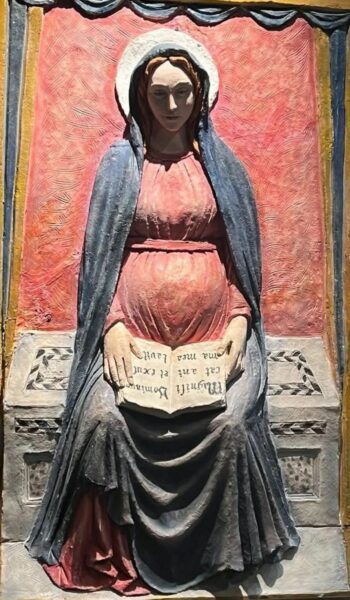
It’s already December 18th and today we celebrate the Virgin of Hope, the one of the ‘O’ and we begin by praying today’s antiphon. It is impossible to prepare for Christmas without contemplating the ineffable hopeful joy that possessed Saint Mary for the imminent future of her childbirth. That is what is meant by «The Expectation of the Birth,» or «The Day of Saint Mary» as it was also called in another time, or «Our Lady of the O» as it is also popularly known. The cold is being felt in Rome and in yesterday’s audience the Pope Leo, before heading to St. Peter’s Square stopped in the Paul VI Hall for a close encounter with the sick and the most vulnerable who are not up to spending the morning in the square. The Pontiff explained the practical and pastoral meaning of the decision: «to protect oneself a little from the elements, especially the cold «, allowing those present to follow the audience «on the screen» or, for those who wished, to go out and head to the square.
Yesterday, Pope Leo XIV received a phone call from Isaac Herzog, president of the State of Israel, on the occasion of the upcoming Christmas holidays and the Jewish festival of Hanukkah. During the conversation, following the recent terrorist attack in Sydney, the Pontiff reiterated the firm condemnation of the Catholic Church to all forms of antisemitism, which continue to sow fear in Jewish communities and in the world society. The Pope renewed his call for perseverance in the ongoing peace processes in the region, also emphasizing the urgency of intensifying and continuing efforts in humanitarian aid.
As is customary, the Pope spends one day a week in Castelgandolfo and every Tuesday afternoon, when Leo XIV departs for the Vatican he stops to chat with the press. The format resembles an «informal meeting» or «press conference,» something common among politicians or celebrities when interacting with the media. For a pope this is a novelty and no supreme pontiff, not even Pope Francis, who liked to be interviewed as pope, has stopped to speak with the press in such impromptu way. Papal press conferences on board, initiated by Saint John Paul II, are similar, but they are infrequent and more controlled. We do not know the motives of Pope Leo XIII for adopting this media strategy. In his favor is the fact that they can help the Pope appear less distant, accessible, more human and responsible before the faithful in this democratic era, of accountability and with an uninterrupted news cycle. They attend to the insatiable contemporary demand for transparency in all areas, which has sharpened especially in the Vatican after the scandals of clerical sexual abuses, bad financial practices and disastrous governance decisions. He can also take advantage of this opportunity to teach, reach more people who otherwise could not see his other pre-scripted messages and apply his teaching to hot topics of the present.
The same qualities of this practice also generate new risks. Since the Pope began granting these house interviews that has generated considerable unwanted controversy and, according to some, avoidable. We all remember the Cupich award to the pro-abortion Democratic senator Durbin, from Illinois. Leo has intervened in U.S. immigration policy and has criticized U.S. foreign policy, urging President Trump not to launch a military invasion of Venezuela . More recently, he said that he would prefer not to comment on a U.S. peace plan to end the war between Russia and Ukraine, since he had not read it in its entirety, but media interpreted his comments as an unusual papal reprimand to a sitting U.S. president.
Is it prudent and necessary for a Pope to participate in these exchanges? A pope is not a politician or a supragovernmental technocrat, but the vicar of Christ, anointed as his principal representative to guide souls to heaven. Therefore, his statements not only demand careful foresight and reflection, but also a focus on transcendent and eternal realities. His priority is to form consciences, affirm the faith and preserve unity, rather than offering detailed guidance on politics and temporal matters, which can be used for partisan purposes. Some will also confuse these statements in the interview with magisterial ones, although this is reserved for formal papal pronouncements. Saint John Paul II and Popes Benedict XVI, and especially Pius XII, understood this well. The latter was extremely cautious, avoiding media confrontations that could be interpreted as openly partisan.
Except for journalists seeking a story, no one demands that Pope Leo give his opinion on a domestic policy issue with such detail, nor on any other current news. The Holy Father does not have to answer to an electorate; his only judge is God. He has the freedom to ‘pontificate’ at his whim when and how he sees fit, and he has many opportunities to do so, whether in homilies, messages or magisterial documents. These spontaneous “house” interviews are done on others’ terms and demand an immediate and unreflective response, making him vulnerable to entering controversies and committing doctrinal errors that will likely be interpreted as magisterial. In view of the scant benefits they bring, many simply ask to suspend them altogether, perhaps along with the on-board press conferences. Silence is golden. And in this restless, volatile and complaining era of social networks, more than ever.
On December 13, the French Church beatified 50 martyrs, priests, laity, seminarians and religious who gave brave testimony in the Nazi extermination camps. That same day, the Spanish Church beatified 124 martyrs of the Civil War, «witnesses to love of truth and justice». In Jaén, Andalusia, a beatification Mass was celebrated for 124 priests, religious and laity, victims of the civil war (1936-1939) at the hands of the communists. «Not heroes or fighters for an ideology, but witnesses to true courage, contained in the capacity to suffer for truth and justice». The last beatified are 110 priests, one religious sister and 13 laity, divided into two groups: the first, led by Father Manuel Izquierdo Izquierdo and 58 companions; the second, by Father Antonio Montañés Chiquero and 64 companions.
Italian politics always has a special place in the Vatican. The papal state needs its environment to survive and yesterday we had a meeting of Parolin, in the Sistine Chapel with Italian Catholic parliamentarians, their families and colleagues on the occasion of Christmas. To the meeting formally attended the presidents of the Senate, Ignazio La Russa, and of the Chamber of Deputies, Lorenzo Fontana. «Rediscover the true meaning of fraternity and the supreme good of peace». And a small Christmas joke: «Some have defined it (the Sistine Chapel) as the most beautiful voting center in the world, the most artistic voting booth». It is not strange that the comments about the chosen stage focus on Parolin’s desire to be Pope for at least one day.
We’re going with some news coming to us from the increasingly close America. The Permanent Committee of the Chilean Episcopal Conference, in a letter to the Catholic elected president José Antonio Kast on Sunday, congratulated him on his decisive electoral victory, but did not mention his strong pro-life and pro-family stance, but rather emphasized immigration. In the letter of December 14, the bishops highlighted Kast’s landslide victory and encouraged him to use his office to promote the common good, while highlighting their concern for the supposed denigration of migrants and other people. Kast is a Catholic father of nine children, has been the most well-known political opponent to the legalization of abortion and the redefinition of marriage in Chile, centered his presidential campaign on stopping illegal immigration and securing the country’s borders. Kast defeated his communist opponent, Jeannette Jara, by a margin of 58 percent against 42 percent of the votes in the December 14 elections. Kast promised to build secure border walls, deport all illegal immigrants and even deploy military in areas with high crime rates.
The cardinal archbishop of New York turned 75 in February. In office since 2009, he is the last survivor of the paradigm shift that Pope Francis imposed on the cardinals who head the U.S. dioceses. Dolan who lasted fifteen years under three successors of Peter, is coming to an end, and rumors are circulating (which must be taken with a grain of salt, but not dismissed outright) about the imminent appointment of the next archbishop of New York. The changing of the guard in New York will happen soon, rumors or not and everything points to Ronald Hicks, 58 years old, current bishop of Joliet ( The Pillar labels it as «confirmed»). The expected changing of the guard will also offer a significant glimpse into the future direction of the Leonine pontificate, as well as the Prevost-Iannone collaboration, since the newly appointed Prefect of Bishops has been in office for two months. The chosen one will be the first archbishop of New York chosen by the first American Pope.
Pope Leo XIV has appointed an auxiliary bishop of San Diego who celebrated a Pride Mass with LGBT theme “All Are Welcome” – during which a drag queen activist was allowed to speak – as the new bishop of Monterey, California. Bishop Ramón Bejarano was the celebrant of the Sunday Mass of July 13, which was organized by St. John’s “LGBTQ Ministry” and had the full backing of the Diocese of San Diego under the command of Bishop Michael Pham , one of the first episcopal appointments of Pope Leo XIV. Bejarano was also among the 68 U.S. bishops who in 2021 signed a letter asking the U.S. Conference of Catholic Bishops (USCCB) to end discussions on prohibiting then-President Joe Biden and other pro-abortion Catholic politicians from receiving Holy Communion. The drag queen “Nicole” Murray-Ramirez , former member of the board of the powerful LGBTQ+ lobby giant Human Rights Campaign, thanked Bishop Bejarano for his work “defending” the “LGBTQ community”.
A recent poll conducted by EWTN News in collaboration with RealClear Opinion Research sheds light on a worrying and growing gap within American Catholicism. The poll, conducted between November 9 and 11, to 1,000 Catholic voters, revealed that 55% support the death penalty for a person convicted of murder. Only 20% oppose it, while 25% are not sure. Among those who attend Mass weekly, 52% support the death penalty, while 26% oppose it and 22% are not sure. Catholics are at odds with the hierarchy: the study also found that 58 percent of Catholics who attend Mass weekly support “the large-scale detention and deportation of unauthorized immigrants”.
They do not seem to agree much with Pope Francis’s change in the catechism on the subject, as already professors Edward Feser and Joseph Bessette in a June 2017 article for Catholic World Report titled “ Why the Church Cannot Reverse Past Teaching on Capital Punishment ”on the teachings presented previously by theologians and popes in the Church’s past. Saint Thomas Aquinas, for example, stated that “if a man is dangerous and infectious to the community, because of some sin, it is praiseworthy and advantageous that he be killed in order to safeguard the common good”. Pope Pius XII also defended in 1955 the authority of the State to apply the death penalty because “the coercive power of legitimate human authority” is based on “the sources of revelation and traditional doctrine”. In 2018 Pope Francis revised the Catechism to withdraw its support for this practice. “The death penalty is inadmissible because it attacks the inviolability and dignity of the person,” it now says. Previously, the Catechism explicitly taught that the Church “does not exclude recourse to the death penalty, if this is the only possible way of effectively defending human life against the unjust aggressor”. The EWTN poll is useful because it reveals the growing disconnect between American Catholics and their pastors. Faithful Catholics simply want orthodoxy to be maintained.
United Airlines has reached a settlement in a lawsuit filed by a Catholic flight attendant who alleged that he was fired for expressing Church teachings on marriage and sexuality. Rubén Sánchez, a United employee with 28 years of experience and resident in Alaska, previously explained: “After 28 years, my employer, United Airlines, fired me for being a practicing Roman Catholic. I had a private conversation with a colleague about Catholic doctrine and theology. Specifically, as it was May 31, I told him that, as Catholics, we should not affirm, celebrate or commemorate Pride Month, something that United Airlines observes and takes very seriously». “You know, as Catholics, we’re really not supposed to celebrate Pride”. “The Church will never believe that men give birth, that women have penises or that the Church should bless same-sex marriages because marriage is a sacrament and is not intended for two men or two women or three people or whatever”. Sánchez said that the airline’s investigation found no violation on social media, but fired him anyway. The curious thing is that the same Sánchez identifies as gay, but “clings to the teachings of the Catholic Church” on issues of marriage and sexuality.
On December 13 it was reported that far-left commentator Rachel Maddow had publicly announced her supposed return to the Catholic faith. The audio of Maddow’s statements, published by MS NOW, confirms the news. This fact is surprising given Maddow’s long-standing public opposition to Catholic moral teaching, the question that now must be asked is: to which “Church” has Maddow returned? It seems she continues to defend her positions against life and defend the indefensible. All this means that there is a de facto parallel structure within the institutional Church that allows someone like Maddow to forge a comfortable «Catholic» identity without having to abandon her leftist ideas or her non-Catholic personal life. This structure is reinforced by pro-LGBT parishes, ideologized priests, heterodox websites and media, and bishops who promote gender ideology under the pretext of «accompanying» people «on their journey of faith».
U.S. Caritas is not at its best. Border humanitarian organizations reacted with concern to the recent action by the Trump administration against Catholic Charities of the Rio Grande Valley (CCRGV) and others that help refugees and asylum seekers. Just a year ago, the shelter was receiving incessant buses of asylum seekers. Today, the center’s corner is eerily quiet, as the number of arrivals at the border has plummeted. The Department of Homeland Security (DHS) accuses this humanitarian organization, among other things, of keeping incomplete and inaccurate records and mismanaging the federal funds it received to help asylum seekers. The federal government has suspended Catholic Charities and other organizations from receiving federal funds for six years. The accusations have fallen on the executive director herself, Sister Norma Pimentel, considered the favorite nun of the late Pope Francis. The organization and the shelter she founded are part of U.S. Catholic Charities, which was also the subject of the federal investigation and subsequent funding freeze.
The Vatican is part of the Roman DNA and they announce for these days “ATTACK ON THE VATICAN”, a hilarious comedy that arrives at the Teatro de’ Servi stage, a brazen and irreverent story. The plot is as simple as it is brilliant. A group of four unlikely criminals has an idea. They want to carry out the heist of the century. Their target? Kidnap the Pope himself. A feat that seems completely impossible. However, they are determined to carry it out. The gang has spent years meticulously preparing the heist. Every move has been planned down to the last detail. Finally, the critical moment has arrived. Everything seems ready for action. But just when everything is unfolding, the unexpected happens. A shocking news falls like a bucket of cold water. The Pope has died. Their carefully planned scheme seems to collapse. And now? What will our antiheroes do? Has the heist really been thwarted forever?
And we’re wrapping up. We find it hard to rejoice in others’ good, spiritual jealousy exists and we have to learn that the good that happens to others is not a threat to my identity, it is a reason for gratitude. Benedict XVI offers a decisive passage: prayer as a «school of hope» is also a place for the purification of intentions. In prayer man must learn that he cannot pray against the other; he must purify desires and hopes. It is a ray of light: religious envy, even before being treated on social networks or in comments, is treated on one’s knees, because there the claim of innocence fades and the root is seen: sadness for others’ good that we don’t even want to confess to ourselves. Recognizing that God can open doors where we only see «categories», that he can attract hearts with roundabout paths. The older son in the parable was not an atheist: he was a believer without celebrations. The parable does not say that he was wrong about everything; it says that he had lost the most Christian thing: joy. The Gospel does not ask us to extinguish reason; it asks us to extinguish resentment. Faith is not a possession to defend, but a gift to receive and, when we see it happen in another, to celebrate.
Oh Adonai, Shepherd of the house of Israel,
who appeared to Moses in the burning bush
and on Sinai gave him your law:
come to free us with the power of your arm.
«Behold, the virgin shall conceive and bear a son…»
Good reading.