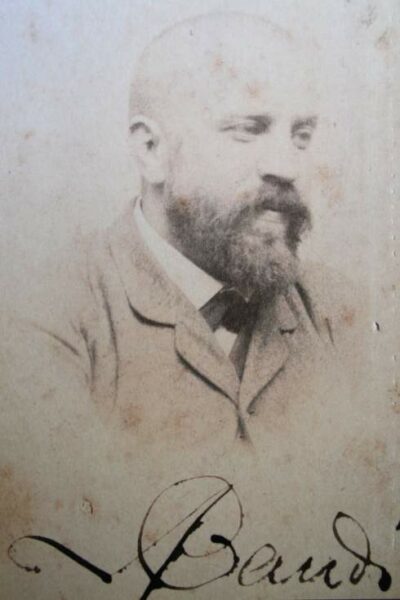
"The Ecumenical Synodality of Saint Paul?", Leo XIV uses the ‘rationale‘, Gaudí in National Geographic, audience with the Roman Rota, "the trip to Spain postponed ‘sine die’?", the ‘refuge boxes’ for babies, Buruaga deceased, the Vatican and the Catholics of Greenland.
by SPECOLA |
The pace of Leo XIV makes Monday afternoons and Tuesday mornings quiet; it’s retreat time in Castelgandolfo. The abandoned papal villas come back to life, and it’s common to see the Pope on horseback in the gardens; one day we might be able to offer his image despite all the precautions being taken. This absence from the Vatican on Tuesdays makes Monday mornings very busy with audiences. Yesterday we had in the Sacred Palaces Luis Alberto Barrera Pacheco, bishop of Callao (Peru); the members of the Presidency of the National Conference of Bishops of Brazil; Bernhard Scholz, president of the Foundation of the «Meeting for Friendship Among Peoples»; Paolo Garonna, president of the Centesimus Annus Pro Pontifice Foundation; Cardinal Turkson, chancellor of the Pontifical Academy of Sciences and of the Pontifical Academy of Social Sciences; Alejandro Arellano Cedillo, dean of the Tribunal of the Roman Rota; the Prelate Auditors of the Tribunal of the Roman Rota; the prelates of the Roman Rota on the occasion of the inauguration of the Judicial Year; and Barham Salih, United Nations High Commissioner for Refugees (UNHCR). We start another day full of news.
Ecumenical synodality of Saint Paul?
On the solemnity of the Conversion of Saint Paul, the Church should speak as Paul did. It should recall his uproar, the clear distinction between before and after, and his hardness toward error. Paul converts by being struck down, blinded, stripped, and totally recreated. Paul does not walk toward unity, he does not enter a bigger tent, he does not discover common points, he does not negotiate at a synodal table; he declares war on the gods of the world and wins by losing everything.
In the homily of Leo XIV at Saint Paul Outside the Walls, we assume it was very cooked up by a dicastery full of ‘borderline’ elements, Paul’s conversion is transformed into something completely different; it borrows Paul’s vocabulary but empties it of content. The conversion becomes a metaphor for a «transformative encounter,» and the central phrase expresses the kind of confidence that only modern ecumenism can generate: «We are one. We already are.» If «we already are» one, evidently the division is reduced to a superficial misunderstanding that can be healed through committees, dialogue tables, and shared prayers. Paul’s conversion is the opposite. It declares that the previous structure of worship was false and that its substitutes cannot be legitimized. Paul does not say: ‘We already share the same faith in one baptism; let’s recognize it and make it visible.’ Paul says: ‘Everything I defended was rubbish, everything I guarded was dung, everything I built was rubble compared to Christ’.
The homily’s main objective is to validate the current ecumenical assumptions, and something grotesque happens. The feast becomes a stage for post-conciliar religion, an occasion for self-celebration. Paul is used as a mascot for what he supposedly opposed: the normalization of doctrinal borders as a form of violence. A Church that can tolerate contradictory confessions as long as they cooperate in witness, a Christianity whose unity can be defined as already real, even if there is disagreement on the nature of the Mass, confession, priesthood, papal authority, justification, and the sacramental economy itself. It’s no longer about ending error. It’s about staging unity. The pre-Vatican II Church also desired unity, but it did not have the modern fanciful idea that unity can be achieved by pretending that the doctrinal rupture had never been decisive.
Pius XI addressed the ecumenical movement of his time with language that, expressed today, seems almost illegal. He called the «panchristian» project dangerous precisely because it was based on the idea of finding a «common basis» for spiritual life among rival confessions. He stated that Catholics could not approve these attempts, based on the false belief that religions were «more or less good and praiseworthy.» Then he got to the heart of the matter. Christian unity could only be achieved by promoting the return of those who had separated from the one true Church of Christ, that is, the Catholic Church. These words do not fit into the post-conciliar liturgy of goodness, unity is conversion.
One faith in what sense, when Luther denies the sacrifice of the Mass and Trent anathematizes that denial? One baptism in what sense, when baptism is not a magical sign that automatically confers ecclesial unity, regardless of what is confessed afterward? One Lord in what sense, when rival communions deny what He instituted, reject what He commanded, and subvert what He taught? Leo says: ‘My beloved predecessor, Pope Francis, observed that the synodal path of the Catholic Church «is and must be ecumenical, just as the ecumenical path is synodal.»‘ Can we imagine anything further from Paul and his conversion?
The ‘rationale’.
Another small recovery by Pope Leo XIV today at Saint Paul Outside the Walls: the «rationale» has returned: The rationale is an ornamental brooch or plaque used to join the front edges of the cope on the chest, typical of liturgical jewelry for bishops, cardinals, and popes. Often decorated with gems or sacred images, it serves as a functional and artistic complement, distinguished from the simpler brooch, sometimes also known as a «shield.» It serves to close the cope. Benedict XVI used it frequently throughout his pontificate.
Gaudí in National Geographic.
Leo XIV received in audience the Prelate Auditors of the Apostolic Tribunal of the Roman Rota for the inauguration of the Judicial Year . This was his first speech before the Rota, those who daily exercise the function of administering ecclesial justice in the name of the Pope. On November 21, he received the participants of the juridical-pastoral training course. Leo XIV began his speech by thanking the Auditors for a service he described as «precious» for the universal judicial function linked to the Petrine ministry, recalling the Pauline formula «Veritatem facientes in caritate» as an operational criterion .
The Roman Rota is a tribunal of the Holy See that, in ordinary practice, functions as an appellate court : it intervenes when a case is challenged and a new trial is requested. The cases are examined by panels composed of three Auditors (the judges of the Rota). Its origins date back to the Apostolic Chancellery , where the figures in charge of instructing cases operated. With Innocent III, the power to pronounce sentence was also recognized; with Innocent IV and the Council of Lyon (1245), the form of a stable tribunal was consolidated. In 1331 , with the Constitution Ratio iuris , the institution was organically regulated. The name «Rota» probably derives from the original arrangement of the Auditors in a circular enclosure during the examination of cases. Over time, the structure was further defined: Sixto IV fixed the number of chaplain auditors at twelve (1472) and Benedict XIV , with the Constitution Iustitiae et Pacis (1747), specified the tribunal’s jurisdiction. As for jurisdiction, the Rota mainly judges in second instance the cases resolved in first instance by ecclesiastical tribunals and presented on appeal to the Holy See; and in third (or further) instance the cases already appealed. It is also designated as the appellate tribunal of the Ecclesiastical Tribunal of the State of the Vatican City .
Leo XIV has cited the shorter process for matrimonial nullity before the diocesan bishop: the manifest evidence of the cause of nullity, which enables this path, requires thorough scrutiny, and the process must still confirm the nullity or refer the case to the ordinary rite. Hence the invitation to study and apply canon matrimonial law with scientific seriousness and fidelity to the Magisterium, in accordance with the jurisprudence of the Roman Rota. In his homily at the Mass inaugurating the Judicial Year of the Roman Rota in the Pauline Chapel of the Apostolic Palace, the substitute Edgar, Parolin is in Denmark and Greenland, invited to act with a charity «that makes us attentive to people’s experiences» and a closeness «that accompanies those going through difficult times.»
The trip to Spain postponed ‘sine die’?
Possibilities have been discussed, but up to now, no date has been set for a possible trip by Pope Leo XIV to Spain. There have been many years of absence of a pontiff on Spanish soil, and due to the legacy of Pope Francis, his presence or absence does not create special enthusiasms. In Spain we have a tense ecclesial context, marked by serious internal divisions.
In Madrid, Cardinal Cobo does not quite fit in, and the more time passes, the more the error of his appointment in a diocese that, like it or not, is a reference for the rest of Spain becomes evident. One of his latest and solemn blunders is the one regarding the thorny issue of the Valley of the Fallen. This trip was announced in unusual circumstances: a few weeks ago, Pope Leo XIV personally informed Cardinal José Cobo, Archbishop of Madrid, of his intention to visit Spain at the end of this year. This decision was a surprise: traditionally, a papal visit is prepared after a long diplomatic and pastoral process. In this case, the Pope expressed his wishes even before the official invitation was formally extended. But, according to Spanish protocol, said invitation must be signed by the King and the President of the Government. It seems that the King gave his approval quickly, but the President of the Government, Pedro Sánchez, took time to do so, which explains why the travel dates have not yet been confirmed.
At the epicenter of the tensions is the Valley of the Fallen, located near Madrid. It is not merely a historical monument, but above all a consecrated Catholic basilica, carved into the rock and under the direct authority of the Holy See. It is crowned by a monumental cross and historically entrusted to a Benedictine community. The place houses the remains of more than 33,000 victims of the Spanish Civil War and was conceived as a place of prayer and national reconciliation, although this intention is now questioned and exploited in the contemporary political debate. For several years, the Spanish government has sought to transform the meaning of the Valley of the Fallen. The stated objective is to turn it into a place of civic memory marginalizing the religious dimension of the place.
This development poses a serious canonical problem: as a papal basilica, the place is not under the exclusive authority of civil powers or the local archbishop. Any substantial modification should require the approval of the Holy See.
What is curious is that Cardinal José Cobo, despite alleging in the recent press conference of Saint Francis de Sales before friendly media that he had nothing to do with the issue, accepted and signed agreements that fit the government’s demands, despite lacking the necessary authority to do so. This decision is perceived by many faithful and priests as a grave concession, even a symbolic profanation, of the sacred nature of the place and the enormous number of relics of canonized and beatified individuals found in the basilica’s crypts. Even Parolin is following the issue very closely and recently had a discreet meeting with the abbot of Solesmes and the one of Leire on the thorny issue of the Valley.
This matter is part of a deeper malaise surrounding Cardinal Cobo. His appointment as head of the Archdiocese of Madrid has been questioned from the beginning: he was not among the locally proposed candidates, and his arrival is widely perceived as an imposition from Rome, under the pontificate of the late Pope Francis. This fragile legitimacy sheds light on his subsequent behavior: nervousness in the face of criticism, obsession with image, and resort to communication strategies designed to show support that hardly manifests spontaneously.
Internal tensions and controversial episcopal appointments are part of a broader framework of the beginning of the pontificate of Leo XIV that in Spain has not yet begun. In recent weeks, the Pope has made important decisions outside Spain that are being scrutinized, particularly the dismissal, without public explanation, of the Indonesian cardinal Paskalis Bruno Syukur as bishop of Bogor. He received in private audience Óscar Sarlinga, emeritus bishop, who was removed in 2015, a decision that has raised numerous doubts in the Argentine episcopate. These actions are interpreted as signals of the willingness to reexamine certain «sensitive cases» left unresolved by the late Pope Francis, especially since Leo XIV personally knew these matters as Prefect of the Dicastery for Bishops and not all his proposals were followed. The attempts by Cobo, Omella, and Satue to meet with Leo XIV to talk about «our thing,» and they found that the doors would not open. This trip, if it materializes, which remains to be seen, is considered a crucial moment for the Spanish Church, called to clarify its position, its relationship with civil authorities, and the effective protection of its sacred places so trampled upon. It seems clear that Leo XIV will have the opportunity to assert his pastoral and institutional authority in a context marked by tensions and very questionable episcopal decisions by priests and faithful that are causing general disaffection, very noticeable in Madrid where Cobo and his entourage do not quite fit in.
The ‘safe haven’ boxes for babies.
An Idaho hospital encourages mothers to safely leave their newborns with medical staff in a new Baby Safe Haven Box. The hospital is located near the border with Oregon, a pro-abortion state, and chooses to support life instead of encouraging women to kill their babies. The Weiser Memorial Hospital has secured funding for the baby box, which «is anonymous and will have resources available for those mothers who use this life-saving tool to make the right decision for their baby’s health.» “If we save one baby, it’s all worth it.” “The hospital will be the first in the area to install a box of this type, providing moms with a life-affirming option in a region that Planned Parenthood has targeted for abortion tourism.” “The boxes are designed to immediately alert staff so that surrendered babies can be retrieved and cared for quickly.” “Hundreds of baby boxes have been installed in safe locations in more than 20 states in the country.” There have been numerous success stories with the boxes, even in Wisconsin , Kentucky e Indiana .
Just a few months ago, the state of Oregon granted Planned Parenthood, the abortion giant, 7.5 million dollars so it could continue killing innocent babies in the state. Oregon has also established a «task force» with Planned Parenthood to preserve «access» to abortion under President Donald Trump; it is one of seven states that have committed to cover all or part of Planned Parenthood’s lost funds with state tax dollars. Oregon requires all insurance plans to pay for abortions, there are no limits on when a baby can be killed, and state officials have promised to protect their abortionists from criminal prosecution from other states.
Deceased Spanish Ambassador.
Eduardo Gutiérrez Sáenz de Buruaga who died last Saturday in Madrid, after a relentless and fulminant illness. In 2012 he was appointed ambassador to the Holy See during the transition period between Pope Benedict XVI and Pope Francis. During his time, he had to deal with the Vatileaks case that affected a Spanish prelate and in which he tried not to intervene, leaving the management in the hands of Antonio Pelayo, today well-known and not precisely for his brilliant management. In 2017 he was assigned as ambassador to Lisbon, from where, a year later and without being able to complete his mission in Portugal, he was dismissed with the change of government.
Catholics in Greenland.
The Pope follows closely the events in his native Church and has also had to recognize the division within the American episcopate regarding Greenland. The critical comments of Cardinals Blase Cupich, Robert McElroy, and Joseph Tobin against the «polarization and destructive policies» fostered, according to them, by the current Republican administration. The three cardinals, all very liberal, have forced the hand of the body supposedly responsible for advising on this matter. However, the majority of American bishops are conservative and prefer to avoid open confrontation with Trump. Catholics on the world’s largest island are not just American soldiers, and outside the bases, the canonical territory belongs to the Diocese of Copenhagen. There is a community of 300 people and a parish priest in Nuuk who constantly travels to Denmark, where he has another parish. The faithful living far from the capital are deprived of Mass and organize with the Liturgy of the Word in their homes. Bishop Czeslaw Kozon of Copenhagen expressed his closeness to the faithful of Nuuk in a letter. «Among them there is unanimity in the Danish stance: Greenland is part of the Kingdom of Denmark and must remain so.» Today concludes a three-day visit to Denmark by the Cardinal Secretary of State, Pietro Parolin. It is easy to imagine that the Greenland issue will be addressed during today’s meeting with the Foreign Minister, Lars Lokke Rasmussen. The Holy See follows the matter closely, in part because it would directly face the consequences of a hypothetical annexation. If it happens, the Vatican would have to decide whether to transfer or not the ecclesiastical territory of the island from the diocese of Copenhagen to an American diocese.
«…whoever does the will of God, that one is my brother and my sister and my mother».