


Se nota la vuelta a la normalidad después de las fechas navideñas más relajadas. El generoso periodo de gracia concedido a León XIV apunta a su fin y la tónica de las noticias de cada día nos da una visión de ‘vuelta al frente’. Todos somos consciente de que no lo tiene fácil, y todos esperamos el rumbo que irá tomando en sus decisiones. Serán analizadas al milímetro, el Papa es consciente de que la histórica confianza que siempre han concedido los fieles a las decisiones pontificias se ha perdido, es más, se reciben con prevención e indiferencia. La confianza se ha perdido y no será fácil recuperarla, por ahora, las palabras suenan bien, lo que vemos gusta más que lo anterior, pero los hechos es lo que cuenta y en, términos generales, o no se han producido o son contradictorios.
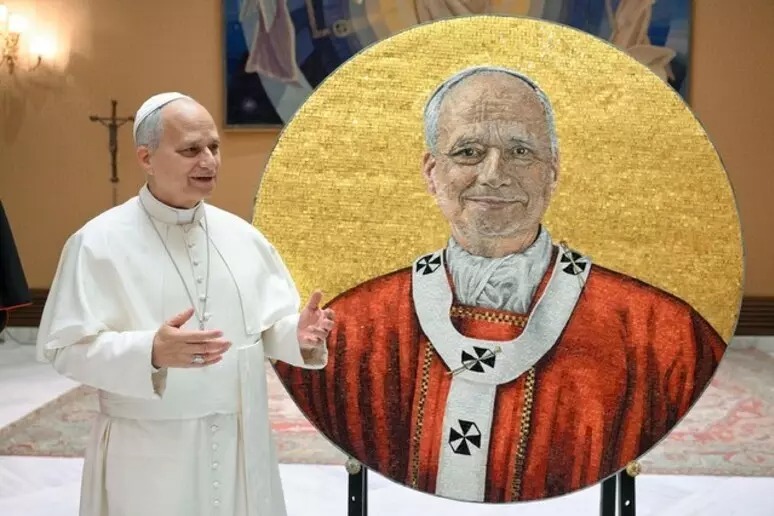
The tondo of Leon XIV.
Pope Leon XIV was able to see the mosaic tondo created by the Vatican Mosaic Studio of St. Peter’s Factory, a work that, according to tradition, is carried out after the election of each Pontiff. The tondo, called clipeus, is destined for the Basilica of St. Paul Outside the Walls and will be placed in the right nave, in the space next to the portrait of his predecessor, at an approximate height of 13 meters. With a diameter of 137 centimeters, the mosaic was created with glass enamels and gold on a metal structure: the approximately 15,000 pieces, cut using the ancient cut mosaic technique, were fixed with oil stucco from the Vatican tradition. In the midst of a too informal atmosphere, while Mauro Gambetti laughed and made jokes to impress the Pope, Leon XIV fell silent and called everyone to prayer, ensuring that the mosaic would be blessed in the basilica after its installation. At the same time, he invited everyone to pray at that moment and then imparted the apostolic blessing. The scaffolding to place the tondo in St. Paul will be used to place the date of ‘end of pontificate’ in this case by death, of Pope Francis.
Prince Albert II of Monaco will be received in audience by Pope Leon XIV on the morning of January 17, 2026, as announced by the Holy See. The Catholic monarch, who has frequently visited the Vatican in recent years, is making his first official visit since the election of Pope Leon XIV. He attended the funeral of Pope Francis and the Inaugural Mass of the pontificate of Leon XIV.
Bishop Dr. Rudolf Voderholzer of Regensburg met with Pope Leon XIV during a private audience in the Vatican and presented to the Pope the work of the Pope Benedict XVI Institute (Institut Papst Benedikt XVI) and its latest publications. The Pope Benedict XVI Institute is a theological studies center dedicated to Joseph Ratzinger, directed by Bishop Rudolf Voderholzer, who was appointed its director after being appointed bishop of Regensburg by Benedict XVI himself in 2012. Recently he opposed the publication of the ritual of the German bishops stating that they had not counted on him at all and that he did not think the issue was right.
Cardinal Aguiar sends a letter recalling his meeting with Pope Leon XIV and reiterates the invitation to Mexico.
The holy doors walled up.
The Holy Doors of the papal basilicas will be sealed with a private ceremony, according to the Holy See Press Office. On Tuesday, January 13, the Holy Door of St. Mary Major was sealed. Yesterday the Basilica of St. John Lateran; this morning, January 15, the Basilica of St. Paul Outside the Walls; and, finally, the afternoon of Friday, January 16, the Holy Door of St. Peter in the Vatican. During the rite, a bronze cap is placed inside the walls containing the act of closing the Holy Door, the key to the Holy Door, some papal medals from the last closing of the Holy Door (from 2016, Extraordinary Holy Year of Mercy) to the present and, where provided, a commemorative medal of the basilica.
Sunset Boulevard and Vatican II.
There was a time when Hollywood made real movies, I mean. Serious novels that explored the depths of the human condition, with its dizzying ups and downs. A time when formidable creativity was put at the service of truth and beauty. Today’s Hollywood is more like a dump of progressive ideology and degenerate carnality. Sunset Boulevard is one of those Hollywood jewels. Billy Wilder’s 1950 classic is a deeply disturbing exploration of the arrogance that leads to madness. Sophocles would have approved. The film centers on Norma Desmond, a Hollywood legend who still believes that today is yesterday. Her tragic delusion is reflected in her face: covered in thick layers of makeup, it looks like a cemetery of broken dreams and frustrated aspirations.
Vatican II is like that: not exactly Vatican II, but its self-proclaimed interpreters. These experts did not intend to transmit to the Church the letter of the Second Vatican Council, but to promulgate its spirit. With that good faith, they invented something new and shiny, with no resemblance to the Church of the apostles. They adopted a 1960s vision of reality, unlinked from the past. When Rome tried to curb this self-destruction in some way, it was only a whisper received with firm defiance. After decades of incessant catastrophes for the universal Church, numerous prominent Catholic figures began to suggest that much of the blame lay on that much-vaunted Council.
Without denying its validity, but rather its interpretation, in its most discreet form, they argued that there was a certain vagueness in the drafting of some documents, a naivety that hovered over much of the written texts, a marked departure from a more muscular form of doctrinal expression and a general lack of dogmatic weight that had characterized all previous councils. Many of the experts of the Council had been burdened by a dangerous theological thought, censored by previous pontiffs. The same experts who led the anti-traditionalist offensive managed to create a division between two factions: the Rahner/Küng party of the avant-garde theological journal Concilium and the Ratzinger/DeLubac party (both former enthusiasts of the left-wing ideology that had taken root around the experts of the Council) of the journal Communio. The latter defended the immutable teachings of the Church; the former, its permanent elasticity.
The pontificates of John Paul II and Benedict XVI were an exercise in re-establishing the old conception of the Church as normative. Pope John Paul II, along with his brilliant doctrinal representative, Cardinal Joseph Ratzinger, soon promulgated revolutionary documents and encyclicals that amounted to nothing less than a declaration of war against the modernist interpretation of Vatican II. This vision had dominated the theological landscape of most dioceses, seminaries, and Catholic higher education institutions, causing unprecedented damage.
Pope Benedict XVI continued with determination the doctrinal and moral program of his predecessor. However, this brilliant Pope gave the project a slightly different turn. He understood his task in the resacralization of the liturgy, which was in ruins worldwide. As he himself stated, «the Church stands or falls with the liturgy.» He infused new life into the ancient theological axiom «lex orandi, lex credendi,» which reached its peak in Summorum Pontificum. In it, he corrected the grave error of Pope Paul VI in suppressing the traditional Latin Mass and freed it from previous prohibitions. Pope Benedict XVI well understood the ruin that the Church had suffered due to a distorted interpretation of Vatican II. He did not violate the validity of Vatican II, but downplayed it in light of the last twenty councils.
Even after these two crucial pontificates, the delirium of the Second Vatican Council persisted in an increasingly irrelevant episcopal gerontocracy. Those who still felt euphoric about the Second Vatican Council were left behind, like a scattered line of octogenarian cheerleaders: irrelevant and embarrassing. They are the Norma Desmonds of the Catholic world, clinging to a failed dream instead of embracing a flourishing present. Is there no limit to the myopia of Catholic intellectuals? Animated parishes? The few that thrive attribute their dynamism to a sacred liturgy that transports them to Heaven, often the traditional Mass. The second attraction is the teaching of the Catechism. Neither of these two has much to do with the Second Vatican Council. Reformed seminaries? The few that remain are wind-whipped houses, with their empty hallways invaded by waving brambles of faded dreams. Increase in the number of new converts? Yes, there are. But only where they are nourished by the pages of the Catechism and intoxicated by the splendor of a Holy Mass properly celebrated. There is a bright Catholic future to embrace.
Vatican diplomacy and the ‘extraction’ of Maduro.
The earthquake provoked by the ‘extraction’ of Maduro makes the global diplomatic landscape continue to be unstable. The prospect of new U.S. interventions in countries like Greenland and Cuba has provoked a global rethinking about effective diplomacy and the possibility of other previously unthinkable events. The Holy See was involved in last-minute negotiations about Maduro’s fate; could the emerging new normal bring with it renewed influence for Vatican diplomacy? Could the Holy See, led by an American Pope, emerge as a newly credible actor, especially in the geopolitics of the Western Hemisphere, and if so, what could that mean for local Churches? The suddenness of Maduro’s ousting did not mean it was a complete surprise to everyone, Parolin, and it is assumed that Leon XIV, told the ambassador that Russia was willing to receive Maduro in exile and asked for time to persuade him to step aside and leave Venezuela voluntarily, thus avoiding bloodshed and instability. Maduro did not choose to resign, despite apparently urgent recommendations to the contrary, and instead was captured in a military raid, which caused several dozen casualties among his protection force.
The Vatican seems to have proven to be more attentive to the urgency of Maduro’s stance than he himself was. And the Holy See had enough diplomatic influence to have confirmed, apparently, a place of exile for Maduro in Russia and to have been aware of the U.S. plans for direct intervention in time to present the case for delay to U.S. diplomats. This lesson seems to have already been perceived by the winner of the last Venezuelan elections, María Machado, who has not had much presence in conversations or calculations for the post-Maduro government. She began this week with an audience with Pope Leon, perhaps understanding that this could be a smart prelude to a meeting with Trump on Thursday.
Others might now reconsider their decisions before committing Maduro’s mistake and perhaps start paying more attention to the Holy See’s diplomatic initiatives. This could bring the possibility of greater room for maneuver in countries where the Church has been severely pressured by authoritarian governments. The Cuban government might consider that the Vatican could suddenly become an influential partner in the court, if not for the power to prevent U.S. action, at least for the possibility that the Holy See act as an intermediary to lower the temperature and a potential source of timely warnings before an intervention. The Ortega regime in Nicaragua has reacted immediately to post-Maduro pressure from the United States and among all the regimes that might now rethink their relations with the Vatican, Ortega’s seems to be the one with the most ground to recover.
Parolin’s apparent prior knowledge of preventing U.S. action in Venezuela and his ability to communicate Russia’s willingness to offer a place in exile for Maduro, if he had decided to leave, seem to prove that the Vatican’s efforts to be in the conversation at the highest levels have not been entirely in vain. The question now seems to be: will countries like Cuba and Nicaragua recognize this and see the benefit of renewed and real engagement with Rome?
A Pope never reigns dead.
Although the agenda of last week’s meeting with the cardinals was dominated by key themes of Bergoglio’s pontificate, many are convinced that the influence of his predecessor will end up waning. This prediction crystallized cynically in a curial remark by a high-ranking cardinal: «I have never seen a Pope reign dead.» Even Tucho has no choice but to recognize that «certainly there can be changes compared to the previous pontificate.» Fernández is aware that he is one of Bergoglio’s most indigestible appointments and, therefore, the easiest to «sacrifice» in a possible replacement. The text on the Synod and synodality by Cardinal Mario Grech, the man who symbolizes Bergoglio’s synodal era, was also read, but the narrative of synodality did not receive unanimous support from the cardinals. Cardinal Joseph Zen’s speech, published by The College of Cardinals Report, was not the only one to criticize what he called «Bergoglian synodality.» In fact, in the debates, several cardinals called for a definitive definition of the limits and true functions of synodality, clarifying that the Synod is of the bishops and, therefore, limits must be set on lay participation.
The two inconclusive reports, that of Cardinal Fabio Baggio on the reform of the Curia and that of Arthur Roche on the liturgy, have not gone unnoticed. The latter has caused an uproar among traditional Catholics because it firmly defends the document Traditionis Custodes, with which Francis repealed the liberalization of the Tridentine Mass granted by Benedict XVI. The report was not debated because most of the cardinals preferred to talk about the Synod and Evangelii Gaudium, but it is likely that, if it had been debated, Roche would have found himself in the minority, given that even one of the most liberal cardinals, Jean-Claude Hollerich of Luxembourg, has expressed himself in favor of greater tolerance toward the so-called Latin Mass. It is unlikely that Roche’s report will be reviewed at the next Consistory in June.
The consistory and the liturgy.
A leaked document distributed to the cardinals during the meeting shows that, if the topic had been addressed, the discussion of the liturgy would have been firmly framed in the further application of the reforms of the Second Vatican Council. After the consistory, a document prepared to guide the debate on the liturgy, first published in the Italian newspaper Il Giornale and then disseminated, shed light on how that conversation would have been framed. In the document, Roche offers a defense of Traditionis Custodes, the papal decree that restricted the celebration of the pre-Vatican II Latin Mass and provoked indignation among many traditionalist Catholics. Pope Benedict XVI relaxed the norms on the celebration of the pre-Vatican II Mass during his pontificate, but the use of that form was «a concession that in no way envisaged its promotion,» wrote Roche. «The reform of the Liturgy desired by the Second Vatican Council is not only in full harmony with the true meaning of Tradition, but constitutes a singular way of putting itself at the service of Tradition.» Quoting St. Pius V, the cardinal wrote that «there must be a single rite for celebrating Mass» but recognizes that «the application of the Reform suffered and continues to suffer from a lack of formation.» «The primary good of the unity of the Church is not achieved by freezing division, but by meeting in sharing what cannot fail to be shared.»
Catholic schools with problems in Israel.
More than ten thousand children attending Christian schools in Jerusalem were unable to return to classes after the end-of-year holidays. Israel has decided to restrict permits for teachers coming from the West Bank: some can no longer enter Jerusalem, others have permission but only for some days of the week, making it difficult, if not impossible, to prepare a school schedule. The schools were scheduled to reopen on Saturday, January 10, «but it was not possible,» reports Father Ibrahim Faltas, director of the Holy Land schools, who reports that they are «closed the twelve Christian schools of the Holy City,» which also belong to other congregations such as the Christian Brothers (De La Salle), «it is very painful for me, especially considering the children and youth of Gaza who no longer have schools, safe and quiet places to grow and build their future.» «Christian schools have always offered excellent education and stand out for their work in promoting peaceful coexistence in the Holy Land. I trust that the Israeli authorities will be able to remedy a situation that could easily be resolved by fully and continuously renewing the permits of our teaching and staff.»
Iran fed up with Islam?
The Islamist regime has brutally repressed protesters who have flooded the streets since December 28 last year. The Iranian Human Rights Organization HRANA reported on January 13 that the death of 2,403 protesters has been confirmed, including 12 children. According to the agency, 1,134 people suffered serious injuries. «On the other hand, 147 members of the security forces and government sympathizers have been killed, including at least five pro-government civilians.» Given the limited information coming from the country, it is difficult to verify the real death toll. An Iranian government official estimated the figure at 2,000, claiming that those executed by the government were terrorists with foreign influence. The government cut off access to phones and the internet to prevent protesters from organizing and sharing information with the world about what was happening. President Donald Trump has hinted several times at a possible U.S. military intervention in Iran. Mahmood Amiry-Moghaddam, of the activist organization Iran Human Rights, based in Norway, said: «The Iranian people are so fed up with the regime and so desperate to get out of this system.»
Fulton J. Sheen and abortion disorders.
In the mid-1970s, Archbishop Fulton J. Sheen made a prophetic statement during a retreat that is remembered and shared on social media as his inevitable beatification approaches. In a speech on confession, the venerable servant of God was talking about sin and the resulting weight of guilt on general health when he addressed the question of what those impacts might mean in the United States after the infamous U.S. Supreme Court decision in the case Roe v. Wade, which decriminalized abortion. «Think, my dear ladies, how many women with mental disorders we are going to have in the United States in the next 10 or 15 years when the guilt of abortion begins to attack the mind and soul.» «For now they justify it by saying that everyone does it and that, in any case, it is only a scar.» As a doctor told a girl who entered: «Well, it’s just a small scar. Could you dismember it?» To which the pro-life doctor replied: «What did you want to call the scar?» «In a few years, the guilt will come to light in a peculiar way, although for now there may not be any.»
A study published last summer found that abortions were associated with more than double the rates of «mental health-related hospitalizations,» including psychiatric disorders, substance abuse, and suicide attempts. Another study from 2024 discovered that one year after having an abortion, women were 50 percent more likely to receive psychiatric treatment for the first time and 87 percent more likely to suffer from personality and conduct disorders. Women who have aborted experience an 81 percent greater risk of having mental health problems, that nearly 10 percent of all mental health problems in women are directly related to abortion and that such women have a 61 percent greater risk of having post-traumatic stress disorder.
Sheen offers examples in his speech of how the sacrament of confession and absolution by a priest also improves mental and even physical health. Jason Gray, executive director of the Archbishop Fulton John Sheen Foundation, announced to OSV News at the end of 2024 that «Sheen is clean… No accusation has been presented that impugns him.» The Foundation stated that it had examined «all the allegations» relevant to the claims against the Diocese of Rochester, and «nothing has been raised there» that implicates Archbishop Sheen. Reports have now circulated on social media that the Vatican is about to announce a date for the beatification of the famous televangelist and venerable servant of God, perhaps in the fall of this year.
Return to church in Germany?
A recently published survey on Christian life in Germany, conducted by the German polling institute INSA on behalf of the newspaper Die Tagespost, the Catholic initiative New Beginning [Neuer Anfang] and the evangelical news agency Idea, has yielded some apparently surprising results. While it is well known that Christian churches in Germany have been losing members for years, the survey also shows a movement in the opposite direction: 8% of Germans would consider (re)joining a Christian Church; among young people aged 18 to 29, the figure rises to 16%, that is, one in six. In addition, one in seven Muslims says they can imagine joining a Christian Church. The novelty of this survey is that, for the first time, we also asked non-Christians and those who had left the Church if they could imagine entering a Christian Church or returning to it.
«Slimy alien monster»
We continue in Germany and the diocese of Rottenburg-Stuttgart refuses to take responsibility, but now announces measures and admits liturgical disorder of the «Slimy alien monster» in the Christmas Mass nativity scene of SWR-ARD in St. Mary’s Church in Stuttgart. After the controversial broadcast of the Christmas Mass in St. Mary’s Church in Stuttgart, SWR (Southwest German Broadcasting) received 1400 complaint emails. After nearly three weeks of silence, the Diocese of Rottenburg-Stuttgart has issued a statement expressing its regret. The diocese declined to accept responsibility, explaining that the Catholic Broadcasting Service of the Church in SWR was responsible for the ideation and broadcast. Bishop Dr. Klaus Krämer, after receiving numerous complaints, stated that religious sensitivities had been offended and expressed his regret. «Those responsible for the ideation and broadcast of the Christmas Mass deeply regret this and emphasize that at no time was it intended to provoke or denigrate the fundamental principles of the faith. However, it has become clear that the chosen form of presentation has caused irritation, misunderstanding, and anger in many people, especially on such an important feast as Christmas.» It was not the only relevant fact and in passing the diocese noted that there were deviations from the established liturgical order during the service. The liturgy was structured with more freedom than permitted. These deviations were not correct and are being investigated.
«The Disastrous Pontificate»
During his last general audience before his abdication, Pope Benedict XVI declared his confidence in the bark of the Church, which weathered the storms of history: «The Lord does not let it sink; it is He who guides it, surely also through those whom He has chosen» Harsh assessment of Pope Francis in «The Disastrous Pontificate,» which, like the Demos Memorandum of Cardinal Pell, , is not mere criticism, but a call to all the faithful to remain vigilant, anchored in grace and truth, trusting that, in God’s providence, a future Successor of St. Peter will restore the Church that Pope Francis has so disastrously confused and disturbed. Dominic J. Grigio is the pseudonym of a Catholic cleric of good reputation in the Church who cannot reveal his identity for fear of reprisals against him and his diocese.
Let’s get to the content. In the pontificate of Pope Francis «it seemed to me that the bark was being deliberately steered toward the rocks. Good and faithful Catholics—those who simply appreciated the Traditional Latin Mass and the perennial doctrines and moral teachings of the Church—were being thrown overboard, incurring scornful wrath and punitive measures simply for their fidelity.» «Pope Francis inexplicably showed optimism in the face of the chaos he was sowing in the Church, and in response to those raising valid concerns about his words and actions, he declared: ‘In the Church there is always the option of schism, always. But it is an option that the Lord leaves to human freedom. I am not afraid of schisms… I pray that they do not happen, but I am not afraid of them.’ His carefree and arrogant indifference to the divisions he was sowing deeply disturbed me. I saw faithful Catholics drift away anguished: some turning to Orthodoxy, others to sedevacantist sects, and many simply abandoning the Church altogether, completely disillusioned.
«Sharing Pope Benedict XVI’s confidence that our Lord would not allow His Church to sink and that He was steering the ship, regardless of the reckless irresponsibility of the human pilot, I wondered: ‘Where are you, Lord, in this Bergoglian storm?’ «During the Bergoglian pontificate, the almost weekly avalanche of heresy and instrumentalized ambiguity was overwhelming and deeply distressing, to the point that, at times, I could not sleep knowing the personal cost this had for the faithful. During the rigged Synods on the Family, a friend wrote to the Holy See. She begged that the Church not alter its doctrine prohibiting Holy Communion to divorced and civilly remarried persons living in adultery. She had been abandoned by her husband and had gone to raise her children, but remained faithful to her marriage vows. It was unbearable to see her sacrifice denigrated. Pope Francis undermined marriage and the sacraments through the manipulative and perverse provisions of Amoris Laetitia. The storm intensified dangerously when he flatly refused to respond to the reasonable doubts of four high-ranking cardinals—Carlo Caffarra, Raymond Burke, Walter Brandmüller, and Joachim Meisner—who questioned the glaring disparities between Amoris Laetitia and Veritatis Splendor of Pope St. John Paul II . In doing so, he abandoned the traditional methods for resolving magisterial confusion.»
«During the pontificate of Pope Francis, we were subjected to a Supreme Pontiff who dissolved the inextricable union of Scripture, Tradition, and Magisterium in the solvent of his personal experience, often justified under the euphemism ‘the God of surprises.’ That experience was shaped by a mixture of anti-Catholic influences: liberal Protestantism, the progressivism of Jesuits like Cardinal Carlo Maria Martini and Father Karl Rahner, and the secular globalist agenda.»
In a chronological section, » The questionable words and deeds of Pope Francis and his appointees,» it exposes the full extent of these aberrations in action: their widespread influence in the Church and their far-reaching consequences for the faithful. This section is guided by our Lord’s counsel: «Beware of false prophets, who come to you in sheep’s clothing, but inwardly they are ravenous wolves. You will know them by their fruits» (Mt 7:15-16). The introduction, Safeguarding God’s Truth in Times of Error, examines the ecclesial, theological, and pastoral implications of this disastrous pontificate.
«To conclude, I would like to acknowledge my deep debt and respect for the brave Cardinal Pell, whose famous Demos Memorandum inspired the title ‘The Disastrous Pontificate.’ Cardinal George Pell anonymously distributed his succinct summary of Pope Francis’s pontificate among his fellow cardinals during Lent 2022, in preparation for a future conclave. Cardinal Pell was able to observe the magnitude of the disaster shaking the Church thanks to his role as Prefect of the Secretariat for the Economy of the Vatican and member of Pope Francis’s Council of Cardinal Advisers. Cardinal Pell presented his critical critique of Pope Francis’s pontificate with the following observation: ‘Commentators from all streams, though for different reasons, with the possible exception of Father Spadaro, SJ, agree that this pontificate is a disaster in many or most respects; a catastrophe'»