


We start the week, it’s the week of exercises for the Roman Curia and there are no scheduled audiences, neither public nor private. The format is the traditional one, the traditional one before Pope Francis, and it returns to the second floor of the Apostolic Palace. The only variation is that the Redemptoris Mater chapel, the Matilde, now decorated by Rupnik, will not be used and the meditations will be in the Paolina. The rooms reserved for the Pope’s official visits will be the setting this week for the wandering of the curia’s ‘superiors’. To be honest, exercises, what one calls exercises, is done by Pope Leo, the others accompany and it’s well known that all placed in such a situation, it’s impossible not to fall into temptation. It will undoubtedly be a very intense week of ‘discreet’ dialogues.
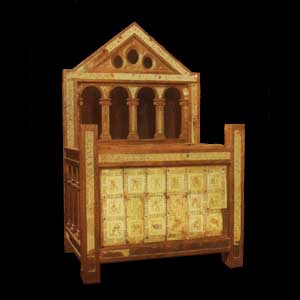
The Chair of Saint Peter.
The visit to his second Roman parish.
On the occasion of the First Sunday of Lent , the Holy Father Leo XIV made a pastoral visit to the Parish of the Sacred Heart of Jesus, located on Via Marsala, in the heart of Rome; it is his second pastoral visit. He invited the faithful to rediscover the meaning of Baptism , highlighting how this sacrament represents a dynamic grace that accompanies the entire life of the Christian. At the end, Pope Leo XIV went to the room where Don Bosco resided and met with the Pastoral Council, young people, priests, and the Salesian community in a parish hall.
In a area of Rome, the surroundings of Termini station, with a lot of street immigration. The Pope invited to be a «protective presence of proximity»: «That is why, dear ones, in meeting you today, I see in you a special presence of proximity, of closeness to the challenges of this region. In fact, there are many university students, people who travel daily to work, immigrants seeking employment, young refugees who have found in the neighboring headquarters, thanks to the initiative of the Salesians, the opportunity to meet Italian peers and carry out integration projects; and then there are our brothers and sisters without homes who find shelter in the spaces of Caritas on Via Marsala».
A specific invitation to be leaven: «In just a few meters, you can feel the contradictions of this time: the carefreeness of those who arrive and leave with all comforts, and those who have no home; the multiple possibilities for good and the unrestrained violence; the desire to work honestly and the illicit trafficking of drugs and prostitution. Your parish is called to take on these realities, to be the leaven of the Gospel in the mass of the territory, to be a sign of closeness and charity. I thank the Salesians for their tireless daily work and encourage everyone to continue being a small flame of light and hope right here».
The Angelus and Ukraine.
Before praying the Angelus, the Pope highlighted that Jesus experienced humanity: «After forty days of fasting, he felt the weight of his humanity: physical, hunger, and morally, the temptations of the devil. He experienced the same fatigue that we all experience on our path, and by resisting the devil, he showed us how to overcome his deceptions and snares».
«Four years have passed since the start of the war against Ukraine. I remain moved by the dramatic situation that all are living: how many victims, how many lives and families shattered, how much destruction, how much indescribable suffering! In truth, every war is a wound inflicted on the entire human family: it leaves behind death, devastation, and a trail of pain that marks generations. After the Angelus prayer, Pope Leo XIV renewed his call for peace in Ukraine after four years of conflict». «Peace is urgent: it is an urgent need that must find space in hearts and translate into responsible decisions. Therefore, I renew with force my call: let the weapons be silent, let the bombings cease, let a ceasefire be reached without delay, and let dialogue be strengthened to pave the way to peace». «I invite everyone to join in prayer for the tormented Ukrainian people and for all those who suffer because of this war and all conflicts in the world, so that the long-awaited gift of peace may shine in our days”.
The first spiritual exercises of Pope Leo XIV.
This papal retreat is interesting for the practice itself, for the preacher, and for the place. The three reveal something about the emerging configuration of Leo’s pontificate. The custom of the Pope spending a week in retreat with members of the Roman Curia dates back a century, to Pope Pius XI (1922-1939). He held the first retreat of this kind in 1925 and formalized it through an apostolic letter in 1929.
Canon law requires priests to make an annual retreat, the details of which are left to the priest’s discretion. Pius XI initiated a similar custom: turning the annual retreat into a community practice, held in the Vatican during Advent each year. This continued until Saint John XXIII, who broke the Advent tradition in 1962, holding the retreat in September to prepare for the opening of the Second Vatican Council the following month. His successor, Saint Paul VI—elected in 1963—moved the retreat to the first full week of Lent in 1964.
In 2014, his first full Lent as Pope, Pope Francis moved the retreat from the Vatican to a retreat house near Rome; he and the curia’s superiors arrived by bus, generating numerous photographs that circulated widely. He kept the retreat in that format until 2020, when he could not attend due to a cold, and then, in 2021, the community retreat was canceled due to the pandemic. Pope Francis did not hold the retreat in 2022, 2023, and 2024, resuming it in 2025, although he was hospitalized and did not attend. He died a few weeks later.
Pope Leo XIV has already restored several customs from recent pontificates that Francis had set aside in search of other solutions normally much more costly. Pope Leo says he wants to give continuity to his predecessor, but it is becoming increasingly clear that he will not be a Francis II.
During the first decades of the papal retreat, Jesuits were usually chosen as preachers, since the retreat followed the Spiritual Exercises of Saint Ignatius of Loyola. John XXIII invited others during his brief pontificate, including an Italian parish priest and a bishop. Each preacher has freedom to organize their theme and meditations. Paul VI began inviting prominent clerics to preach who already had a wide following. The Redemptorist Father Bernard Häring, moral theologian, was the first invited by Paul VI in 1964, a notable choice given some of Father Häring’s positions; he later disagreed with Humanae Vitae and Veritatis Splendor .
The most memorable was Pope Paul VI’s invitation to the Archbishop of Krakow to preach the retreat in 1976. Cardinal Karol Wojtyła was the first cardinal to receive this invitation, and his meditations, published under the title « Sign of Contradiction »—the words of Simeon about the Child Jesus at the Presentation—remain printed to this day. Less than three years after that Lenten retreat, Cardinal Wojtyła would reprise the key themes he preached in his inaugural homily as Pope in October 1978. Cardinal Wojtyła’s stellar turn 50 years ago diverted the Lenten retreat toward more prominent Church personalities. Many of the preachers were already cardinals or were created later: Blessed Eduardo Pironio, Anastasio Ballestrero, Carlo Maria Martini, Lucas Moreira Neves, James Hickey, Georges Cottier, Ersilio Tonini, Jorge Medina Estévez, Tomáš Špidlík, Christoph Schönborn, François-Xavier Nguyễn Vǎn Thuận, Angelo Comastri, Francis George, Francis Arinze, Albert Vanhoye, Giacomo Biffi, Gianfranco Ravasi, Laurent Monsengwo Pasinya, Angelo De Donatis. Cardinal Joseph Ratzinger preached the retreat in 1983, and his meditations then were the seeds that later bore fruit in his trilogy of biblical theology, Jesus of Nazareth .
Pope Leo has taken a bold decision in choosing Bishop Erik Varden of Trondheim, Norway, Trappist monk and one of the leading spiritual authors at this time. Norwegian Lutheran who converted to Catholicism while studying at Cambridge, Bishop Varden was elected abbot of his English abbey at age 39. Pope Francis chose him as the first native Norwegian bishop of Trondheim in 2019, despite having spent nearly 30 years in England. Bishop Varden is very popular among American Catholics. He participated in the Napa Institute conference last summer, gave the Erasmus Lecture annual in autumn for First Things , and his latest book, Towards Dawn: Essays in Hopefulness, was published by Word on Fire (2025). His website, Coram Fratribus , offers periodic spiritual reflections.
The Lenten retreat had long been held in one of the chapels of the Apostolic Palace, the Matilde Chapel, today better known for Rupnik’s mosaics. It continued there until 2013, when Pope Francis held it outside the Vatican. In 1996, on the occasion of the 50th anniversary of Pope John Paul II’s priesthood, the College of Cardinals made a financial donation to him, which he used to redecorate the Matilde Chapel. The commission went to Rupnik and the chapel was renamed Redemptoris Mater in honor of John Paul II’s Marian encyclical of that name.
Pope Leo XIII, to avoid certain controversies, moved the retreat to the Pauline Chapel , which is officially one of the Pope’s private chapels. The cardinals gather there before entering in procession to the Sistine Chapel for the conclave, and the newly elected Pope goes there to pray immediately after his election. As an additional advantage, the artworks are superior; Michelangelo’s twin works on the crucifixion of Peter and the conversion of Paul adorn the side walls. During the breaks, the entire second floor is open except for the library, including the Redemptoris Mater. It will not be amiss for the curia’s superiors to meditate on the consequences of abuses and for this to help resolve pending cases, especially the one related to Chiclayo that affects Pope Leo, before muddying his pontificate. The work of the Roman Curia focuses on managing abuses of law, office, and morals by bishops and priests. The Redemptoris Mater chapel is a good place to reflect on how to properly manage the wheat and the tares that grow together, often difficult to distinguish. Varden is “Illuminated by a Hidden Glory”. In the Apostolic Palace, that glory often hides behind human weakness, although at the same time Michelangelo makes it shine.
Exercises in the Sacred Palaces.
To lead this year’s meditations, Leo XIV personally summoned Archbishop Erik Varden, OCSO, of Trondheim, Apostolic Administrator of Tromsø and President of the Scandinavian Episcopal Conference. The first meditation was inaugurated with the celebration of the Second Vespers of the First Sunday of Lent, presided over by Cardinal Protodeacon Mamberti; the title «Entering Lent», where he offered a profound reflection on the meaning of this liturgical season.
Lent confronts us with the essential , inviting us to free ourselves from the superfluous to embrace an authentic spiritual struggle. With incisive words, he warned against the instrumentalization of the Gospel , stating that «any manipulation of Christian words and signs for other purposes must be vigorously combated». He insisted on the need to correct erroneous ideas not with indignation, but « by teaching and showing what the authentic spiritual struggle consists of ».
A central aspect of his speech was the concept of Christian peace , described not as the promise of an easy life, but as «the condition for a transformed society». Bishop Varden urged us to articulate the radical nature of this peace, which has its roots « in the just and courageous self-giving ». In this regard, he quoted the words of Saint John Climacus: « There is no greater obstacle to the presence of the Spirit in us than anger ». «For more than a thousand years, the Roman liturgy of the First Sunday of Lent has maintained as a fixed component a tractus of exquisite beauty that prepares for the Gospel, always that of Christ’s temptation in the desert».
The week’s program, titled «Illuminated by a Hidden Glory: A Lenten Path», will be structured around a daily rhythm of prayer and reflection. Each day, from Monday to Friday, will begin at 9:00 a.m. with the hours and two morning meditations and one afternoon followed by Eucharistic Adoration and the singing of Vespers. The spiritual path proposed by Bishop Varden will be inspired especially by Saint Bernard of Clairvaux and his Lenten sermons on Psalm 90, exploring themes such as freedom, the splendor of truth, and hope. The reflections will guide the participants toward a loving and lucid discipleship, to live Lent with a renewed spiritual impulse.
Religious tourism and Saint Francis.
In the context of the celebrations of the eighth centenary of the death of Saint Francis of Assisi, the exposition of his remains in the Papal Basilica of Saint Francis in Assisi highlights the radicalism of following Christ lived by the Poverello. Biagio Maimone is the correspondent in Italy for the World Network of Religious Tourism (RMTR) and believes that the exposition of Saint Francis’s relics represents a decisive step: «a turning point in the awakening of Franciscan spirituality», as it reminds the contemporary conscience of the need for an interior conversion. He wants the World Network of Religious Tourism to be inspired by what he calls «tourism of the soul»: not just a geographical journey, but an interior one. Sustainable tourism in the deepest sense, rooted in the Franciscan vision of protecting creation and human dignity. Sustainability, from this perspective, is not only environmental, but spiritual: it implies the transformation of the person, called to embark on a path of self-denial and self-revelation, of conversion and responsibility. The exposition of the saint’s relics is not limited to the liturgical dimension, but opens to a broader meaning.
Spin Time Labs.
It is a name that doesn’t tell us much; it is of a building occupied since 2013 in the Esquilino neighborhood, in the center of Rome. After the eviction of the Leoncavallo social center in Milan and Askatasuna in Turin, the Democratic Party and the entire Italian left are alarmed and mobilizing to defend Spin Time Labs, which they have always held up as an example of «positive urban regeneration». The Rome Court has ordered the Ministry of the Interior to compensate the building’s owner company with more than 21 million euros for not executing the eviction. «It is true that there are complications, but even here in Rome solutions have been attempted. With everyone’s good will, much effort, and a bit of imagination, I believe a solution can be found.»
In December, several actors, directors, and intellectuals, including Marco Bellocchio, Pierfrancesco Favino, Matteo Garrone, Alessandro Gassman, Elio Germano, and Nanni Moretti, signed a petition to avoid its eviction. Among them is Sabina Guzzanti, who in 2021 directed the documentary «Spin Time – Che fatica la democrazia!» filmed entirely inside the building. The Roman left has always defended and “pampered” the occupants of the former INPDAP headquarters, which in 2013 was conquered by Andrea Alzetta, a radical left-wing activist nicknamed “Tarzan”, a figure who also has excellent relations with the Vatican and the NGO Mediterranea. We all remember the actions of the ‘cardinal electrician’ in favor of these Roman occupations. Spin Time, in fact, has many illustrious friends and admirers, to the point that it recently also hosted Francesca Albanese , the controversial UN Special Rapporteur on the occupied Palestinian territories.
The German synodal party.
We are on exercises but the problems continue. The revolution longed for by the German Synodal Way is put to the test in the election of the president of the Episcopal Conference. There is a risk of a break around unions between same-sex people, celibacy, women’s priesthood, and the role of the laity, and, as if that were not enough, the synodals are preparing to monitor the bishops who reject the innovations.
The protagonists of the German Synodal Way showed discontent with Rome’s lack of response to the letters containing resolutions contrary to Church doctrine on homosexual unions, celibacy, women’s diaconate and priesthood, and the role of the laity. The goal now is to introduce a kind of oversight of the bishops, who, in essence, will have to justify themselves if they refuse to adopt the desired innovations. The synodals are in open contrast with the teachings of the Second Vatican Council and in particular with Lumen Gentium which recognizes to the bishops «the sacred right and duty before the Lord to make laws for their subjects, to judge and regulate everything pertaining to worship and the apostolate».
Lefebvrian schism yes, or no.
Another time bomb with a date. The Priestly Fraternity of Saint Pius X tries to demonstrate the inconsistency of the schism accusation, but the FSSPX starts from an incorrect interpretation of Lumen Gentium. Valid ordination is not enough to be a Catholic bishop: hierarchical communion is necessary. In addition to the recent declaration of its General Council, the Priestly Fraternity of Saint Pius X has included an Appendix that summarizes its reasons for believing that the episcopal consecrations against the will of the Pope, carried out in 1988 and 1991, and those announced for the next July 1, if not accompanied by a schismatic intention or attribution of jurisdiction, would not constitute a break in communion.
The Fraternity’s argument that episcopal consecration against the will of the Pope necessarily constitutes a schismatic act derives from an innovation introduced by the Second Vatican Council, when, in the dogmatic constitution Lumen Gentium , 21, it states, according to the FSSPX, that «the power of jurisdiction is conferred by episcopal consecration simultaneously with the power of Order». This statement contradicts traditional teaching, according to which episcopal consecration confers only the power of Order, while «the reception of the episcopal power of jurisdiction depends by divine right on the will of the Pope». It also contradicts the constant discipline of the Church and the consensus of theologians and canonists.
The Council , according to the Fraternity, teaches that the power of jurisdiction derives from episcopal consecration, and from this it is deduced that, for the conciliar Church, every episcopal consecration performed without the papal mandate, transmitting the power of jurisdiction (in addition to the power of ordination), which can only be conferred by the pope, constitutes a schismatic act. However, traditional doctrine, which distinguishes between the potestas ordinis , conferred in ordination, and the potestas iurisdictionis , transmitted not through the sacrament but by the will of the pope, this would allow, according to the FSSPX, in cases of necessity, the legitimate concession of the power of ordination even against the papal will, and would not constitute, by virtue of this distinction, a schism, as long as there is no schismatic intention.
«Truly I tell you, whatever you did for one of these least brothers of mine, you did for me.»
Good reading.