


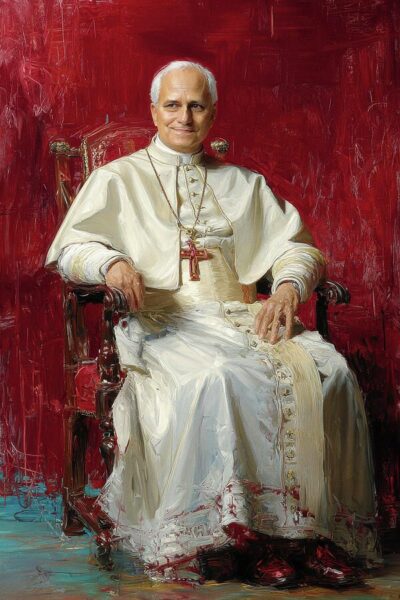
It’s Thursday, there are days, today is one of them, when we don’t know where to start. We often encounter days of information avalanche, without a doubt today is one of them, we’re going to try it counting on the benevolence of our readers.
Pope Leo XIV presided over Holy Mass on the 125th anniversary of the dedication of the church , founded by Leo XIII as the heart of the renewed Benedictine presence in Rome and throughout the world. After Holy Mass, Leo XIV shared some time with the monks. He visited the Primatial Abbey , listened to the account of their daily life, expressed his gratitude for the care they provided to the liturgy and for the custody of Gregorian chant , and asked them to pray for him. The Pope recalled that Leo XIII desired the construction of San Anselmo and the International Benedictine College to strengthen the presence of the Order in the Church and promote communion among the monasteries, establishing the Office of the Primate Abbot as a visible sign of this unity.
Representatives of the Roman Curia and the German Episcopal Conference met again to continue the dialogue agreed upon during the ad limina visit of the German bishops in November 2022. Previous meetings took place on July 26, 2023, March 22, 2024, and June 28, 2024. The official statement says that: «The dialogue was once again characterized by a sincere, open, and constructive atmosphere. Various points of the future statute of the synodal body of the Church in Germany (called the «Synodal Conference») were examined, such as its nature, composition, and responsibilities». On the part of the Roman Curia, Cardinals Víctor Fernández, Kurt Koch, Pietro Parolin, and Arthur Roche were present, as well as Archbishop Filippo Iannone O.Carm. On the German side Bishops Stephan Ackermann, Georg Bätzing, Bertram Meier, and Franz-Josef Overbeck attended, as well as their general secretary, Dr. Beate Gilles, and the CET spokesperson, Matthias Kopp. Archbishop Stefan Oster attended as a guest. This is the first meeting of this kind since the election of Pope Leo XIV.
Through a letter published by the Dicastery for the Doctrine of the Faith authorized the Bishop of Bayeux-Lisieux , Monsignor Jacques Habert, to «draft the corresponding decree and declare that the phenomenon of the alleged apparitions that occurred in Dozulé must be considered, definitively, as not supernatural, with all the consequences that this determination entails». The decision, approved by Pope Leo XIV, puts an end to a matter that spanned more than fifty years. Between 1972 and 1978 , in the French town of Dozulé , a woman named Madeleine Aumont claimed to have had 49 apparitions of Jesus Christ . The Bishop of Bayeux-Lisieux is now authorized to publish an official decree of non-supernaturality, which includes the prohibition of public worship and the recommendation not to promote the alleged apparitions in any way.
The «Bussola» offers us a Dossier on Mary Co-Redemptrix with reference to all the articles published these days on its page. «The Doctrinal Note of the Dicastery for the Doctrine of the Faith, Mater Populi Fidelis, seems flawed from the beginning, when the Prefect of the Dicastery, Cardinal Fernández, explains in his introduction the reason for dedicating a document to certain Marian titles». «A document that aims to review Marian titles related to the cooperation of the Blessed Virgin Mary in the work of salvation cannot omit a substantial section dedicated precisely to the development of this theme in the Magisterium of the Popes and in theological thought». El cardenal Fernández had no choice but to omit the teaching of the pontiffs , for if he had included it, he would have had to admit that Mary’s co-redemption and her mediation of all graces can be qualified, at minimum, as common doctrine. Benedict XV, for example, in the letter Inter sodalicia (March 22, 1918), recognized as «common teaching of the Doctors» that the participation of the Virgin Mary in the sufferings of her Son rightly grounds the affirmation that «she, together with Christ, has redeemed the human race».
After the news of the rehire of the two IOR officials fired last year by the Vatican bank for getting married beyond the Tiber, a question circulates: who will compensate the two spouses for all the suffering endured? In the Vatican, the losing party is not obligated to reimburse legal costs to the winning party. The internal Vatican union (ADLV) in a note circulated these days points out that in the face of a case of injustice, there would be no available protection instruments for employees. «For the moment, the only alternative is to embark on an odyssey that could last years, with unpredictable results. And moreover ¿are the principles of due process always guaranteed, which provide for equality of parties, reasonable duration, presumption of innocence, right to defense? ¿Shouldn’t there perhaps be in the ULSA (a kind of labor tribunal) a list of public defenders for those who do not have the economic conditions to defend themselves?». ¿What norm can prohibit, in fact, two people from getting married in conformity with the principles of canon law? And if this happens, ¿what measures are put in place to avoid an unjust dismissal? In light of the agreement, ¿will the IOR Regulation – evidently unconstitutional in Italy – remain in force? . A half-victory, they are rehired in a different place from where they were, the unjust norm is not changed at all. A patch to get out of the media scandal and little more.
And we come to a long article, rather a study, of which we can only make a small reference. You have it in L’angoscia di Papa Prevost. «In the authorized biography of Leo XIV there are coded messages that reveal the pontiff’s fears about abuses in Peru and tensions with Parolin. While the entire world press lyrically affirms his self-portrait every day, Prevost does nothing but sow clues of the opposite nature: as if he desperately wanted to inform us that he lives in fear and that his own shadow anguishes him». «Prevost tells Allen about his last meeting with Pope Francis, and you have to rub your eyes and reread it ten times to convince yourself that he really said it. An incredible meeting. Let’s first analyze the context. On March 24, Jorge Mario Bergoglio returned to Santa Marta, after a long hospitalization at the Gemelli Hospital, to die in his bed. For months there had been rumors of a conclave, and the next day, March 25, the Snap network wrote to Secretary of State Pietro Parolin and to the prefect of the Dicastery for the Doctrine of the Faith, Víctor Fernández, to report the alleged irregularities of Cardinal Prevost, prefect of the Dicastery for Bishops, who allegedly covered up pedophiles.
«I received a call asking me to go secretly to Santa Marta, and they told me: «Don’t tell anyone». The Pope wanted to see me. And they didn’t tell me anything else. So I didn’t tell anyone in the office, not my secretary, not anyone. I just disappeared and left. I went up the service stairs and no one saw me. Then, after he told me what he wanted, which had to do with work, bishops, and other matters he had in mind, I said: ‘For your information, Holy Father, I thought that maybe the reason you called me that way was because you wanted me to resign.’ We laughed together. When he was angry with someone, he told them clearly, and since they had told me to go and I knew he still wasn’t seeing many people, I thought: «What could have happened now?». But, of course, he didn’t ask me to resign».
«¿Why would he fear that the dying Pope called him to eliminate him? There are two possible answers, and one is more shameful than the other. The first is that Francis’s successor is officially accrediting the image of Bergoglio that has accompanied him in recent years within the Curia: a mentally unstable, vengeful, and capricious man, capable of dismissing bishops and cardinals without any clear reason». «The second reason is that Prevost feared that Francis would present him with the bill for the Quispe case, the one raised by Snap: in Peru, three sisters were abused as girls by a priest who accuses Prevost of covering it up when he was bishop of Chiclayo. He really feared it, as is clear in the immediate aftermath of the book, which focuses on what is described as a delegitimization campaign orchestrated precisely around the Quispe case».
«¿But how did it occur to the Pope to make this so private and, in fact, embarrassing thought public? «What apparently keeps him up at night is precisely this story of sexual abuse committed by a Peruvian priest about twenty years ago. (…) For two years, that is, long before becoming pope, Prevost has been tormented by the suspicion of having covered up the pedophile Eleuterio Vásquez González, known as Father Lute, despite the (almost) unanimous chorus of priests, bishops, Vaticanists, and journalists who consider those accusations false and instrumental, invented by a former Augustinian who has been in conflict with Prevost for about 30 years». The theme that stands out most is Prevost’s anguish, which Allen’s book captures with such clarity that it makes us wonder why the pontiff decided to get into trouble.
«The accusations against Prevost were considered false and opportunistic by almost all the international press, even after they were repeated the day after his election as pope. However, Prevost confessed to the whole world that, once the conclave began, he was concerned that «this sexual abuse matter could pose a problem» for his election as pope. Which, bluntly, could mean two things: either Prevost himself considered the Father Lute case a shameful secret, or the future pope feared that, within the conclave, the (supposedly false) accusations of covering up pedophilia could be misused by cardinals hostile to his election».
Prevost’s fear—confessed with such frankness—of losing the papal election due to Father Lute’s sexual abuses is probably another of the many strange episodes in this story. The Pope wants to address the issue to dispel doubts about his recent election, but he seems to do so without the necessary clarity and with disastrous results. Prevost insists on pointing out that, if the Quispe case had an unsatisfactory outcome, it was due to his transfer to Rome and, therefore, to no longer being able to handle the matter.
Among the many surprising revelations that Prevost has decided to include in his authorized biography, one that seems premeditated, and not the fruit of a distraction, refers to the existence of a hostile lobby that tried to weaken him before the conclave that elected him pope. This lobby is headed by Secretary of State Pietro Parolin, and used as a weapon to harm him the case of the three Quispe sisters. According to Ana María Quispe, Prevost allegedly covered up the pedophile priest, and today he seems so obsessed with this story that he constantly lets slip signs of anguish. Parolin was and remains pro nunc, as they say in the Curia, Secretary of State, that is, number two in the Catholic hierarchy. But Prevost’s authorized biography erases him from the story. Such clumsy defense could have an explanation. Prevost feels threatened and understands that the real attack comes from within the Vatican. And from that moment, even after his election as pope, he begins to spread coded messages to indicate to those who wish to know that Secretary of State Pietro Parolin was behind the campaign aimed at weakening one of the most dangerous competitors (the strongest, in retrospect) in the race to succeed Francis. Parolin didn’t even pretend to help Prevost and among the highly sensitive documents that Parolin keeps under lock and key is the «preliminary investigation» on Father Lute that Prevost, then bishop of Chiclayo, sent to Rome in July 2022, just three months after the conversation with the Quispe sisters.
Parolin knows the truth and plays dumb: «Regarding the comments and rumors about the actions of some heads of Roman Curia dicasteries in relation to abuse complaints when they were diocesan bishops, the investigations carried out by the competent authorities, through the examination of objective data and documentation, have revealed that the cases were handled ad normam iuris, that is, in accordance with the applicable regulations, and were referred by the then diocesan bishops to the competent dicastery for examination and evaluation of the allegations. The investigations carried out by the relevant authorities have not found, conclusively, any irregularity in the actions of the diocesan bishops». Prevost is today an anguished man not only for everything we have recounted, but also for the fear of losing control of the government of the Church.
And we continue with in-depth articles. Because they are easily accessible to our readers as they are in Spanish, we limit ourselves to citing and recommending them. In The Wanderer: «Shortly after Robert Prevost’s election as pope, there was almost universal enthusiasm among conservatives, but now opposition to the pope is reigniting. This is due in part to several decisions by Leo, but also to statements found in the recently published interview book, Leo XIV: Citizen of the World, Missionary of the 21st Century. This interview, in particular, further fuels the already heated debate about Leo’s qualities. You have it in «Do you think that I have come to bring peace on earth?» (Lk. 12,51). An initial attempt at a theological evaluation of the pontificate of Leo XIV
Also in The Wanderer we find a ‘tailor-made suit’ for our friend Tucho, it’s clear he knows the character very well. «When I saw Cardinal Tucho Fernández’s packaging in the presentation of the document Mater populi fidelis and the grimaces he was making, the first thing that came to mind was to tell him, with due respect to his purple, “Don’t play the cruel rat”. Because indeed, we all know that Fernández occupies a position that is too big for him and that he is there thanks to the nepotism and thirst for revenge that characterized Pope Francis, his benefactor. He has neither the preparation, nor the capacity, nor the temperament to hold such an important position in the Church. And the evidence is there for all to see. It’s not just the mess he got the Church into with Fiducia supplicans, but now he has gotten it into a new bind from which we don’t know how it will emerge and what wounds it will leave on the Mystical Body of Christ and on the figure of Pope Leo himself. You have it in «Don’t play the cruel rat» (Milonga by Enrique Maroni, 1930)
And we go with another hot topic: Why talk about the Heralds of the Gospel case today? First, the Heralds case seems representative of many cases that occurred during Pope Francis’s pontificate. The Sodalitium case also reflects a situation in Latin America that has become so polarized that it is difficult to distinguish good from evil, ideology from reality, and where errors and sins mix in such a way that every decision becomes politicized, thus concretizing that struggle between progressives and conservatives that, in reality, is increasingly absorbed by the faithful. So far, no abuses by the Heralds are known. The relentlessness could be justified by the number of accusations, but in reality, if charges are not proven in court, ¿why continue the attack? The Heralds of the Gospel case reminds us of many other Vatican trials in recent years, where the accused are caught in a media storm long before they can defend themselves. A situation that evokes Kafka’s character in The Trial, who finds himself prosecuted without knowing why and can do nothing but defend himself without knowing how.
Numerous accusations have been made against the Heralds of the Gospel. It is said that they disobeyed the Dicastery’s decision not to accept minors. In reality, it was the families of these minors, dismayed by this decision and by the violation of their rights, who took responsibility for keeping the children in a healthy and Catholic environment. The truth is that more than 30 civil and canonical accusations filed against the Heralds of the Gospel have ended well for them, as also attested by the commission appointed by the Holy See.
The most striking thing is that the Heralds emphasize that they were never informed of the reasons for the apostolic visitation or the appointment of the commissioner. The Heralds of the Gospel have been prohibited from receiving diaconal and priestly ordinations since 2019—contrary to the Dicastery’s own practice—and face obstacles to opening new houses. They can’t even receive new members. Everything is paralyzed in a process that seems endless. What will Leo XIV do now? This is the question that remains up in the air. Will he also listen to the Heralds of the Gospel’s version, allow them to defend themselves, or make a decision based on the Dicastery’s conclusions or the information it receives?
Gagliarducci also writes about the Heralds of the Gospel. «Among the legacy of Pope Francis’s pontificate, there is a matter involving a suspension and providing for a deferred intervention sine die due to accusations never really proven, even in cases where the civil processes initiated (30 in total) always concluded with dismissal or acquittal of those involved». We already have in our hands the detailed report, composed largely of original documents, titled The Commissariat of the Heralds of the Gospel, Chronology of Events 2017-2025, recently published in Italian, written in Portuguese and also available in a Spanish translation. It contains the history of the Heralds of the Gospel, from the decision of their commissariat in 2019, after an apostolic visitation that began in 2017. The Heralds have presence in 78 countries and a vocation to spread culture and create a civilization of love that pleased John Paul II so much, to the point that the Heralds were the first religious association erected by the Holy See in the new millennium. You have the full article in Spanish at The Case of the Heralds of the Gospel
The bishops of the United States elected Archbishop Paul Stagg Coakley of Oklahoma City as their new president at their fall plenary assembly in Baltimore. He is 70 years old and won the second round of voting with 128 votes against the 109 of his opponent, Bishop Daniel Flores of Brownsville, who became vice president. He has been at the head of the Archdiocese of Oklahoma City since 2011, as Secretary of the United States Conference of Catholic Bishops since 2022. He is also part of the board of directors of the Napa Institute , a conservative Catholic institution linked to political right-wing, which seeks the «reevangelization of the United States», and is an advisor to the Acts XXIX missionary initiative. The new vice president, Flores, 64 years old with family roots in Mexico, has stood out as a defender of migrants. His diocese, Brownsville, located in the southern tip of Texas, borders Mexico.
The United States Conference of Catholic Bishops voted in favor of «entrusting our nation to the love and care of the Sacred Heart of Jesus» . The consecration of the nation is an opportunity to «remind everyone that we have the responsibility to serve our nation by perfecting the temporal order with the spirit of the Gospel, according to the teachings of the Second Vatican Council ». To help Catholics prepare for the consecration, the bishops will develop resources for prayer, including a novena. The resources will also allow individuals and families to make their own consecration , and this will be carried out simultaneously across the country. Thomas Wenski, proposed a celebration during the bishops’ spring meeting in Orlando, Florida, in June, on the occasion of the Solemnity of the Sacred Heart of Jesus , and suggested inviting Trump, Vice President J.D. Vance, and other officials to attend.
The Catholic Church of the so-called «Global South» (episcopates of Latin America and the Caribbean, Asia, and Africa) will present its proposals to COP30 during a symposium held at the Santa Caterina da Siena College in Belém. The impression is that they are the last useful idiots left defending the climate scam. The symposium is titled: «The Catholic Church at COP30, on the paths of integral ecology: reflections on climate justice and ecological conversion». The perspectives on integral ecology contained in the document of the Global South episcopates, presented last July, will be presented. The Archdiocese of Belém hosts approximately 120 participants from ecclesiastical bodies, including the Secretary of State of the Holy See, Cardinal Pietro Parolin; the Apostolic Nuncio to Brazil, Archbishop Giambattista Diquattro; eight cardinals, nine archbishops, 26 bishops, as well as priests and laity. Yesterday, the bishops visited small boats, called hospital ships in the statements, Papa Francesco and San Giovanni XXIII, currently anchored in the river port of Icoaraci.
The United Nations has organized COP30. It is the usual, if not already obsolete, ecological spectacle, in which those present declare their willingness to «save» the world, with «significant» absences, mainly that of the United States, thus risking everything being reduced to mere grandiose proclamations, lacking credibility. The «Greengate» case, the scandal surrounding the funds (¡the whopping 7.4 billion euros!) that the European Union allocated to «green» NGOs to support the fight against climate change , thus influencing political decisions that harm the economy of the Old Continent. There has never been any transparency regarding the accounts, also because, from the beginning, the left and the greens joined forces to prevent the creation of a special investigation committee to clarify what happened. What is so important to hide? Why prevent the truth from being known about possible conflicts of interest related to public funds supposedly used to finance «green» NGOs? Frans Timmermans, the main architect of the so-called «Green Deal», is now facing a trial after the European Taxpayers Association filed a criminal complaint against him last July for alleged embezzlement of public funds.
Another one who has gone too far is the mayor of Marseille, Benoît Payan, canceled the screening of the film «Sacred Heart: His reign will have no end» at the municipal castle of La Buzine just one hour before it began. He argued that screening a religious film in a state venue constituted «an attack on secularism» and violated the French law on separation between Church and State. Stéphane Ravier, director and senator, filed an emergency appeal after the ban to revoke the city’s decision, which has been condemned for having been issued under “the false pretext of selective secularism”. The court ruled that the mayor’s ban “constituted a serious and manifestly illegal violation of freedom of expression, freedom of artistic creation, and freedom of artistic distribution”. “The mere screening of a film that may be considered religious in nature in a municipal cinema does not, in itself, violate the principle of secularism, as such screening does not express the municipality’s recognition of a religion nor indicate a religious preference on its part”. Sacré-Cœur is the work of Alliage, son of a British rocker and former lead singer of a popular French boy band. After a difficult period, during which he fell into alcoholism, he converted to Catholicism and dedicated his artistic career to music inspired by his faith. The film narrates the apparitions of Jesus Christ to Saint Margaret Mary Alacoque in 1675, during which he revealed his Sacred Heart to her and asked her to spread this devotion. «Behold this heart which has so loved the world and in return has received only contempt and ingratitude». “The devotion to the love of the heart of Jesus, as it disintegrated in France, returned to France through foreign missionaries who tell us: ‘You lost it along the way. We are bringing it back to you’”.
And to end with something lighter, we have a defense of the cassock, which, given the passions it arouses is not a simple garment and is also in fashion among the younger clergy. Kissing the cassock before putting it on was a habitual gesture among our venerable older priests . It is a visible sign of an invisible truth, a spiritual reality that precedes and transcends the fabric it is made of. It manifests a sense of belonging: that of one who has chosen to consecrate his life to God or to embark on the path toward that consecration; the priest publicly declares his belonging to God . It is a sign that unites him interiorly to his vocation and, at the same time, exposes him to the world, reminding him that he no longer lives for himself, but for Christ. The black of the cassock , therefore, is not a color of sadness, but of penance and humility, indicates that he is not the source of light, but the place where it is reflected. Wearing it means allowing the gaze of men, fixed on him, to be led further, toward Christ . The cassock, in this sense, is like the finger of the Baptist pointing to the Lamb of God.
«… the Kingdom of God is already in your midst».
Good reading.