Sunday of the Temptations, Saints' cause, Way of the Cross in St. Peter, strange appointments, the relics of St. Agatha and St. Francis, between Lent and Ramadan, Plagia resists disappearing, foci of resistance.
by SPECOLA |
It is Sunday, the first of Holy Lent, with the first sin and temptations as the central theme. Benedict XVI: «Reflecting on the temptations to which Jesus is subjected in the desert is an invitation to each of us to respond to a fundamental question: what really matters in my life? In the first temptation, the devil proposes to Jesus to turn a stone into bread to satisfy hunger. Jesus counters that man lives also by bread, but not only by bread: without a response to the hunger for truth, to the hunger for God, man cannot be saved (cf. vv. 3-4). In the second temptation, the devil proposes to Jesus the path of power: he leads him to the heights and offers him dominion over the world; but this is not God’s way: Jesus is very clear that it is not worldly power that saves the world, but the power of the cross, of humility, of love (cf. vv. 5-8). In the third temptation, the devil proposes to Jesus that he throw himself from the parapet of the Jerusalem temple and that God save him through his angels, that is, that he do something sensational to put God himself to the test; but the response is that God is not an object to impose our conditions on: he is the Lord of all (cf. vv. 9-12). What is the core of the three temptations that Jesus suffers? It is the proposal to instrumentalize God, to use him for one’s own interests, for one’s own glory and success. And therefore, in essence, to put oneself in the place of God, suppressing him from one’s existence and making him seem superfluous. Each one should ask himself: what place does God have in my life? Is He the Lord or am I?».
Decrees on the causes of the saints.
Pope Leo XIV authorized the Dicastery for the Causes of the Saints to promulgate the decree confirming the cult of the Servant of God Gabriel Mary, born Gilbert Nicolas, professed priest of the Order of Friars Minor and co-founder of the Order of the Most Holy Annunciation of the Blessed Virgin Mary. He was born around 1460 near Riom (France) and died on August 27, 1532, in Rodez (France). In the same audience, Leo XIV authorized the promulgation of the decrees on: the miracle attributed to the intercession of the Venerable Servant of God Béchara Abou-Mourad, professed priest of the Basilian Order of the Most Holy Savior of the Melkites, born on May 19, 1853, in Zahlé, Lebanon, and died on February 22, 1930, in Säidā, Lebanon. The heroic virtues of the Servant of God Francesco Lombardi, diocesan priest, born on February 24, 1851, in Terzorio, Italy, and died on February 12, 1922, in Bussana, Italy. The heroic virtues of the Servant of God Theophane, born Michael Koodalloor, professed priest of the Order of Capuchin Friars Minor, born on July 20, 1913, in Kottapuram, India, and died on April 4, 1968, in Ponnurunni, India. The heroic virtues of the Servant of God Fausto Gei, lay faithful, member of the Association of Silent Workers of the Cross, born on March 24, 1927, in Brescia, and died on March 28, 1968, in Brescia.
Oblates of Mary Immaculate.
Pope Leo XIV received in audience the Missionary Oblates of Mary Immaculate, on the bicentennial of their papal approval, and the Sisters of Our Lady of the Apostles, on the 150th anniversary of their foundation. They are two religious institutes united by a «missionary vocation». The motto chosen by the founder: «He sent me to evangelize the poor» . The congregation was founded in 1816 in Aix-en-Provence, while «Europe was shaken by complex and dramatic events», dealing with the aftermath of the French Revolution. Leo XIV recalled that the words and actions of St. Eugene «defended the dignity of the poor, workers and peasants, exploited as productive resources and ignored in the deepest needs of their humanity». The French bishop (1782-1861) demonstrated a «strong and provocative boldness» in sending religious from France to the world. «First to Canada, and then to other parts of the world: Europe, Africa and Asia». An important milestone was the start of missions in Asia in 1847, with the arrival in Ceylon and Sri Lanka, which marked the beginning of the congregation’s Asian presence with «an impressive flourishing of missionary and vocational growth».
The Policoro project.
It won’t mean anything to most of our readers, they have had an audience with Pope Leo. It depends on the National Office for Social and Labor Issues of the Italian Episcopal Conference, «The Pontiff has pointed out several social saints to us, a historical legacy and testimonies that we can draw inspiration from». Among the figures cited by Robert Prevost, St. Francis, St. Catherine, Father Mazzolari, Tina Anselmi, Father Puglisi, Annalena Tonelli, Marvelli, Frassati, Father Milani, Moro, Msgr. Tonino Bello and Bartolo Longo. «We are very satisfied with this forward-looking transition, with the willingness to take on new challenges. The Project itself is about to be remodeled with a new emphasis, such as internal areas, the socio-political sphere and the valorization of the artistic and cultural heritage of the dioceses».
Way of the Cross in St. Peter’s.
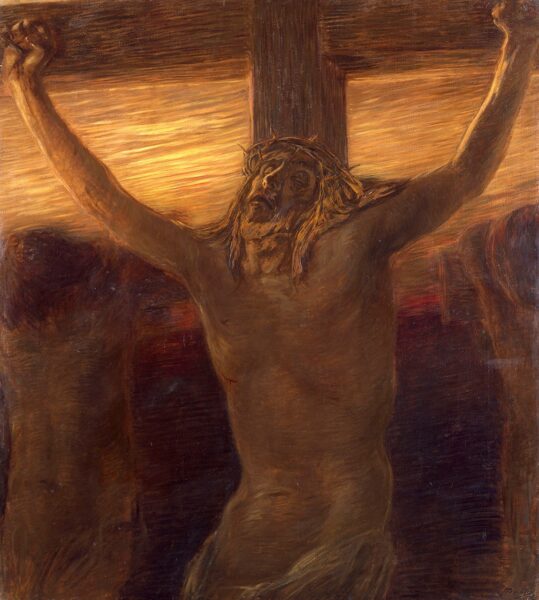
St. Peter’s Basilica is the fruit of the hand of the best artists of the time, among whom Michelangelo and Bernini stand out, no more no less. A contemporary Way of the Cross has been blessed that is part of the acts organized to celebrate the fourth centenary of the dedication of the Basilica (1626-2026) . The work was created by the Swiss artist Manuel Andreas Dürr , who won the competition called in 2023. The new paintings, framed by the artisans of the Fabbrica di San Pietro, will remain hanging along the walls of the central nave of the Basilica and around the Confession during the entire Lenten season. They will not be permanent, it is complicated to improve the Basilica and even more so in these times of decadence. Let us hope that it is an incentive for tourism to dedicate a few minutes to prayer. Our image today is one of them, forgive our readers, so much competition for this and competing with the greats, good thing it’s temporary.
The nuncio to the Netherlands.
The Pope has accepted the resignation from the office of Apostolic Nuncio to the Netherlands, Jean-Marie Speich. The regulation grants nuncios the right to submit their resignation upon reaching the age of 70 (and not 75), in line with the retirement of diplomats; Speich turned 70 in June 2025, a few months after being appointed by Pope Francis. If he had really planned to leave upon turning 70, he could have asked to remain in Slovenia until June 2025 and then retire. Strange, very strange, less than a year after his appointment as Nuncio to the Netherlands , the Nuncio Speich submitted his resignation. In recent years, Speich was involved in the turbulent Rupnik scandal because he was the one who had to deal with Rupnik when he requested to be welcomed in the diocese of Koper .
On June 13, 2023 , a month before being dismissed from the Society of Jesus, Rupnik sent a letter to Jurij Bizjak , then bishop of Koper. Rupnik requested to be welcomed ad experimentum in his diocese of origin. Bizjak spoke with the nuncio Jean-Marie Speich . Speich told the bishop Bizjak: «The incardination in Koper is an excellent solution . There is no problem because there are no convictions». But there was the conviction for having absolved the accomplice of the sin against the sixth commandment , with excommunication included , later revoked by Pope Francis himself and the scandal was also on the rise. The accusations could not be verified in the courts because Francis did not want to hold the trial. A case that follows the pattern of the Chiclayo abuses in which it is wanted to prevent, by all possible means, a process from being held before a court. Speich was the first bishop ordained by Pope Francis and it is known that Speich was very close to Marko Ivan Rupnik , who appointed several of his most faithful bishops , such as the current president of the Slovenian Episcopal Conference . The fact is that yesterday, the February 21, 2026, he submitted his resignation , less than a year after his appointment.
The bishop of Sassari.
Another strange appointment. After almost a year of vacant see the Archdiocese of Sassari recovers as bishop one of its parish priests. The new bishop is well known, born on October 24, 1959, Francesco Antonio Soddu was vice-rector of the Pontifical Regional Seminary of Cagliari from 1985 to 1987; later, he was also vice-rector of the Sassari archdiocesan seminary, a position he held until 1996. In recent months, the Apostolic Nuncio to Italy and San Marino has received numerous letters from local priests, concerned about the idea that the appointment would fall on a Sardinian prelate with a long tradition of ties to some Sassari clerics, a factor that contributed to the delay in the decision. This is not a common option, as it is generally avoided to entrust a church to those who bring with them already structured relationships developed over years of ministry in the area, precisely to reduce the risk that «old malcontents» influence pastoral government. Pope Francis sent him to Umbria in 2021 as bishop of Terni-Narni-Amelia. In Terni, moreover, he was involved in situations embarrassing , such as the inauguration of the entrance to the headquarters of the Masonic House of the Grand Orient of Italy on September 27, 2022. The archdiocese of Sassari covers an area of 1,978 km² and includes 60 parishes, with 132 priests, 3 permanent deacons and approximately 215,000 baptized. The previous bishop, Gianfranco Saba, never quite fit in, and has often maintained a posture of «seminary rector». Many priests have felt treated as eternal seminarians, in a climate that has fueled factions and divisions. With the appointment announced today, a significant part of the clergy hopes that the same dynamic will not repeat.
The relics of St. Agatha.
In Catania, Sicily, St. Agatha is everything, her relics will be exposed for the veneration of the faithful during the special Jubilee in the Chapel of St. Agatha inside the Cathedral. The Jubilee Year proclaimed by the Holy See to commemorate the 900th anniversary of the return of the relics from Constantinople.
The relics of St. Francis of Assisi.
The Papal Basilica of St. Francis hosts the historic and prolonged public exposition of the mortal remains of St. Francis of Assisi, in the context of the eighth centenary of his death (1226-2026). It will be possible to pray before the remains of the saint: «The exposition is one of the many initiatives that seek to demonstrate how the Saint of Assisi remains a gift for all today». The remains will be exhumed from the sarcophagus in the crypt, with the celebration of the transfer and Vespers in the lower church, presided over by Cardinal Artime. The final celebration will take place on March 22 in the upper church, presided over by Cardinal Zuppi.
Between Lent and Ramadan.
Postponement of exams to accommodate fasting students. It is happening in a school in Genoa, and the fast is not that of Lent, but the Islamic one. It is a unilateral «inclusion», in the name of secularism, which prohibits crucifixes in classrooms, but waves the white flag before the Koran. Ramadan is sacred but when we talk about crucifixes in classrooms, Christian traditions, the teaching of Catholic religion in schools and even literary masterpieces like the Divine Comedy , there are always those who invoke the secular nature of the State. Before the Koran the rigidity seems to fade and transform into a sinister doormat.
The director of a school distributed a formal communication to the faculty titled “Ramadan, precautions”, with the aim of “ guaranteeing the physical and mental well-being of the students and fostering an inclusive school climate ” during the Islamic month of fasting. The circular invites teachers to postpone exams and oral exams until after the first week of Ramadan, to schedule them preferably in the early morning and to avoid exams during the prayer vigil on the twenty-seventh day and the festival that ends the fast; physical education teachers, for their part, were asked to consider possible exemptions from practical classes. Fortunately, part of the faculty considered all this a direct interference in their professional autonomy, so a formal complaint was filed with the Regional School Office.
The Regional School Office of Liguria tries to calm the tensions. The message stated that «the initiative, as assured by the director, aims to promote an inclusive climate. It does not dictate prescriptive and generalized measures for school staff, but rather ‘advice’ and ‘indications’ to take into account the specific needs of students observing the fast». There is an official directive from the Ministry of Education on the school day during Ramadan, and each school operates independently, based on the mottos of multiculturalism, inclusion and «Love one another «. Post-Christian Western countries have no intention of fasting like Muslims; they no longer even observe the (much more lenient) one required for Ash Wednesday and Good Friday. Nor, it seems to us, do Western women intend to wear the full veil or travel in the trunk of cars like dogs, or to be beaten if they do not obey; or to give their twelve-year-old daughters in (multiple) marriages to forty-five-year-old men. No, certainly not. But they hate Christianity, and to destroy it, they give way to Islam. But in this ideological frenzy, source of intellectual blindness, they neither see nor understand that, in a few years, if we do not act, all this will become the way of life to which we will all have to submit, voluntarily or not, because Muslims make no concessions, and submission is their mission. Muslims are not at all in favor of inclusion, multiculturalism, tolerance or «let us love one another».
Paglia resists disappearing.
We were told that it was ‘joyful, due to age but it seems it was not so. On February 16 , the Pope received the participants of the Plenary Assembly of the Pontifical Academy for Life . As soon as the photos were published, Fabrizio Mastrofini , former spokesperson for Mons. Vincenzo Paglia in the Pontifical Academy for Life, published this comment: “Look at the photo: Pope Leo XIV in the front row with the cardinals and archbishops of the Pontifical Academy for Life , from left to right : Paglia , Mattasoglio , and after the Pope: Chomali , Simard , Fisher . The blue sign indicates Renzo Pegoraro , current president of the Pontifical Academy. But since he is a simple monsignor of the Curia, he steps aside and sketches an… uncanny smile…”On May 25, 2025 , Monsignor Renzo Pegoraro was appointed president of the Pontifical Academy for Life and it was commented that Vincenzo Paglia had been fired. We were trying to convince us that this was not true by the same ones who during the pontificate of Francis filled their mouths denouncing and labeling as » social media attacks » any criticism or reflection on Pope Francis.
Foci of resistance.
These are times of strange things, we take it from The Catholic Herald, a case that highlights the confusion, but also the foci of resistance to arbitrary restrictions in the Church of our time. The bishop ordains a priest using the pre-Vatican II rite despite Traditionis custodes A French bishop ordained a priest using the Pontificale Romanum pre-Vatican II , in a ceremony that reignited unresolved tensions over the implementation of Pope Francis’s restrictions on traditional liturgy. On Saturday, January 17, Mons. Alain Castet, 75 years old and emeritus bishop of Luçon, ordained Brother Thomas-Marie Warmuz as priest in Chémeré-le-Roi, west of France. The ordination took place in the Fraternity of St. Vincent Ferrer, an association of Dominican-inspired clerics known for its exclusive use of traditional liturgical rites. During the same ceremony, Brother André-Marie Mwanza was ordained subdeacon.
In December 2021, the Congregation for Divine Worship and the Discipline of the Sacraments declared that bishops are not authorized to confer Holy Orders using the old Pontificale. This clarification was issued in the form of Responsa ad dubia , in response to the questions raised by the motu proprio Traditionis custodes of Pope Francis. The responsa of December went further, addressing sacramental issues, including ordinations. They declared that the use of the old Pontificale Romanum is not permitted, not even in communities where the celebration of the traditional Mass has been authorized.
The ceremony in Chémeré-le-Roi raises questions about how Traditionis custodes and its subsequent clarifications are interpreted and applied in practice. Monsignor Castet, who led the diocese of Luçon from 2008 until his retirement in 2017, has made no public comments on the decision to use the old pontifical. Pope Francis later clarified that the Priestly Fraternity of St. Peter was not affected by the new restrictions and could continue to use the 1962 liturgical books throughout its sacramental life. The central problem is that Traditionis custodes has established a normative framework that aspires to clarity, but in practice operates with ambiguity. The result is not a fully consolidated legal regime, but a mosaic of case-by-case decisions that depends heavily on episcopal discretion, while limiting it.
«You shall worship the Lord your God and Him only shall you serve.»