


We start the week, the year 2025 is slipping away from us, we have one month left until Christmas and we continue with substantial articles. We must confess that with the death of Pope Francis, so peculiar, so singular, so chaotic, we thought that the media intensity would decrease substantially. We even thought, poor us, that we would enter a quiet period that would allow us to take a breather, rest for a few days, dedicate more time to developing the topics, nothing could be further from reality. Here we are, we continue daily and surprised to have topics and news that overwhelm us. The management of Pope Francis’s legacy will continue to be the theme that accompanies us for some time. The pontificate of Leo XIV cannot start until the thorny issues that mortgage it are resolved. Many families break relationships over the division of inheritance, seeking unity is good and necessary, but without a justice based on Truth, it can never happen.
Pope Leo XIV presided over the Holy Mass on the Solemnity of Our Lord Jesus Christ, King of the Universe, on the occasion of the Choirs’ Jubilee and the XL World Youth Day, celebrated in the dioceses under the motto: «You too bear witness, because you are with me». «Your task is to involve your brothers in the praise of God and to make them participate more fully in the liturgical action through song». The Pope recalled the universal anthropological dimension of song —«a natural and complete expression of the human being»—, quoting St. Augustine: «Singing is for those who love… song is proper to those who love». With a quote from St. Ignatius of Antioch: «From your unity and your harmonious love we sing to Jesus Christ… each one of you becomes a choir… sing with one voice».
After the Holy Mass, the Pope greeted the faithful before the Angelus prayer. He especially thanked the choirs present, as well as the faithful from several Ukrainian dioceses, asking them to take home the embrace and prayers of this Square. «With immense sadness I received the news of the kidnapping of priests, faithful and students in Nigeria and Cameroon… I make a fervent appeal for the immediate release of the hostages».
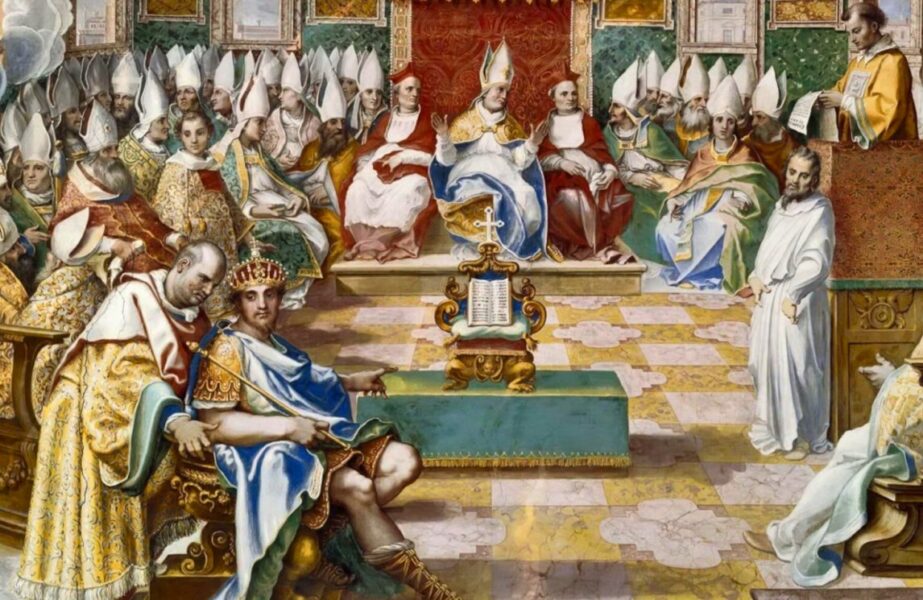
Pope Leo then recalled his upcoming apostolic journey, the first one, which includes his arrival in Turkey. «My apostolic journey to Turkey and Lebanon is approaching. The 1700th anniversary of the Council of Nicaea will be celebrated in Turkey. For this reason, the apostolic letter In Unitate Fidei is published today, commemorating this historical event». Signed on the Solemnity of Christ the King, Pope Leo XIV signed the Apostolic Letter In unitate fidei, his fourth letter, on the eve of his first apostolic journey, which from November 27 to December 2 will take him to Turkey, to ancient Nicaea , seat of the first Ecumenical Council (325). «The Council of Nicaea is not only an event of the past, but a compass that must continue to guide us toward the full visible unity of Christians». The beginning of the Letter clarifies the Pope’s intention: to call the Church to safeguard and transmit «with love and joy the gift received», expressed in the words of the Nicene Creed: «We believe in Jesus Christ, Only Begotten Son of God, who came down from heaven for our salvation». Leo XIV immediately connects the document to the context of his pontificate and the Holy Year of Hope: «I wish to encourage in the whole Church a renewed impulse toward the profession of faith». Rediscovering the Creed as a source of hope in an era marked by «threats of war and violence, natural disasters, grave injustices and imbalances».
The Pope reconstructs with precision the crisis that led to the Council of Nicaea: it is not a theological detail, but a fracture that affected the very essence of the Christian faith . Arius denied the full divinity of the Son; Emperor Constantine convened the Council because «along with the unity of the Church, the unity of the Empire was also threatened». As then, doctrinal divisions and mutual misunderstandings represent not only a wound for the Church, but a factor of instability in the world. The central section of the Letter is a Christological catechesis. The Fathers professed that the Son is «of the substance (ousia) of the Father […] begotten, not created, of the same substance (homooúsios) as the Father». And it emphasizes that the use of non-biblical terms was not a «Hellenization», but a way of defending the biblical faith , distinguishing it from doctrinal contamination. «He did not make God out of the man he was, but out of God he became man to divinize us». Leo XIV recalls that the Arians enjoyed the emperor’s support for years and that the Church was going through an «ecclesial night». «The ears of the people are more holy than the hearts of the priests». The faith of the people, their sensus fidei, was crucial to preserving orthodoxy. It is not primarily institutional strategies that guarantee the unity of the Church, but the fidelity of the people to the heart of the Gospel. It is the same desire evoked to the participants in the Symposium, when the Pope invited everyone to «pray together, imploring the Spirit for the gift of unity».
The Apostolic Letter is a call to conversion. Leo XIV asks: «What has become of the interior reception of the Creed today? Do we understand and live what we say every Sunday?». Three points arise: The question of God in an era of indifference: God is often irrelevant in people’s lives; and part of the responsibility falls on Christians «who do not bear witness to the true faith». The centrality of Christ: The Supreme Pontiff recalls that discipleship and salvation are inseparable from the cross and charity: «We cannot love God, whom we do not see, without also loving the brothers and sisters whom we do see». The encounter with Christ in the poor: «What we have done to one of these least ones, we have done to Christ». This is the point of encounter between theology and pastoral care. Leo XIV affirms that «what unites us is much more than what divides us». The Nicene faith is a «common source» for developing new forms of ecumenical synodality. The Pope excludes the «ecumenism of return», that is, the idea that others must return to a pre-existing form; nor the passive acceptance of the status quo. He proposes a forward-looking ecumenism , founded on reconciliation, the exchange of gifts, common prayer and mutual listening. In the center is Nicaea as the foundation of Christian identity : faith in the Son, «of the same nature as the Father». And it relaunches the Creed as the engine of mission .
Pietro Orlandi speaks again about the latest advances in the case of his sister’s disappearance, decades of rumors and countless unanswered questions. He hopes to attract the attention of Pope Leo : «I got in touch immediately, since there was never any progress with the previous Popes. They told me: ‘We’ll see…’. It would have been a wonderful day to remember her on the anniversary of her death, and the fact that he hasn’t said anything is not a good sign; I don’t consider it a good sign…» «Is the Vatican involved or not? Without a doubt, they are aware of what happened , and I believe that some from inside are responsible». Paolo Adinolfi , who disappeared on July 2, 1994 told Pietro that « Enrico De Pedis had told him that he had killed Emanuela Orlandi with a tie because he had been asked a favor. Then, the two entered, according to what the man said, a tunnel. This person described those places to me, and they are exactly as they are described today. He told me that Emanuela’s remains were there, or at least that’s what De Pedis told him. He also revealed that inside there was a pair of suitcases and some documents that implicated a lot of people . But for De Pedis, «they will never tear down this wall, that’s my guarantee». Currently excavations are being carried out at the Casa del Jazz in Rome which was created after the property was confiscated from organized crime, specifically from the treasurer of the Magliana gang. The villa was sold to the mafioso by the Vicariate of Rome and its sale was authorized by Cardinal Ugo Poletti.
Relations between the Vatican and Israel are at their lowest point. This is demonstrated by the editorials of L’Osservatore Romano and Civiltà Cattolica, and the statements of Pizzaballa and Parolin. As long as Netanyahu remains in power, it is unlikely that the situation will change. L’ Osservatore Romano , the official newspaper of the Holy See, dedicated an extensive article «Rabin’s Tomb and Peace». «The assassination of Rabin has undoubtedly changed the history of Israel, Palestine and the entire Middle East. And the river of blood and suffering that we have witnessed in the last two years has its origin in the incompleteness of the peace process that generated Rabin’s assassination. For this reason, the widespread narrative, which places the beginning of the tragedy on October 7, 2023, is insufficient and shortsighted; it ignores the truth and forgets». Heavy words like stones that seal, once again if necessary, the deep crisis that exists today in diplomatic relations between the Vatican and the State of Israel .
In recent days, another anniversary closely linked to the Catholic Church and the Jewish world has been celebrated: the 60th anniversary of the publication of the document from the Second Vatican Council , Nostra Aetate . This text refutes the centuries-old accusation of deicide launched against the Jews by the Church of Rome, affirms the clear and unquestionable rejection of antisemitism after the Holocaust and opens the door to dialogue between the Church and other religions of the world, starting with Judaism. It is no coincidence that last September, Civiltà Cattolica (the monthly Jesuit magazine always with the approval of the Secretariat of State) warned against the overlap of two levels: the historical-theological comparison and the relationship with the State of Israel, which must be judged according to the parameters of international law . And precisely by following this approach, the Church of Rome has reached a point that borders on the breakdown of institutional relations with Tel Aviv . This is something that no one naturally desires, but in reality it already seems to have become a reality. The visit to the Vatican last September by Israeli President Isaac Herzog , who had traveled to Rome to try to calm the spirits, was of little use. «Two peoples, two States», insists the Holy See, while Benjamin Netanyahu refuses to yield: a Palestinian State (recognized by the Vatican ten years ago) will never be established.
And we end with a very curious fact: in an average year, up to eleven Anglican clerics are received into the Catholic Church and approximately the same number are ordained. For more than thirty years, a constant current, largely unnoticed, has been flowing beneath the surface of British Christianity. Since 1992, former Anglican clerics have represented a third of all those who entered the Catholic priestly ministry in England and Wales. The story begins in 1992, when the General Synod of the Church of England approved the ordination of women. That vote did not immediately trigger a massive migration, but it did open a long and complex chapter in which issues of identity, tradition and conscience began to weigh on many Anglican priests. The authors of the study estimate that around 700 Anglican clerics, religious and even sixteen bishops from England, Wales and Scotland have joined the Catholic Church since 1992. What emerges is a panorama shaped not by dramatic ruptures, but by silent and firm decisions made over many years: decisions that are at once theological, personal and deeply costly.
«…this poor widow has put in more than all».
Good reading.