


Navidad romana con lluvias intensas y un frío más de lo habitual que está deslucido las celebraciones al aire libre. Misa del Gallo a las hora habitual el Italia, las diez, las doce en estas tierras se hace muy tarde, empezamos a las diez para terminar a las doce. San Pedro empieza a lucir algunas galas, las tiene, han estado años en el fondo del armario, algunas van saliendo, ayer vimos los siete candelabros, al fin, y los buenos. El Papa estrena mucera, esta ya le queda a su media y no como la que ha venido usado estos meses que era la preparada para el que saliera del cónclave y su fajín blanco vuelve a lucir el escudo papal.
Empezamos con las calendas que se cantaron al inicio de la Misa del Gallo. “Octavo Kalendas ianuarii. Luna quinta Innumeris transactis sæculis a creatione mundi, quando in principio Deus creavit cælum et terram et hominem formavit ad imaginem suam; permultis etiam sæculis, ex quo post diluvium Altissimus in nubibus arcum posuerat, signum fœderis et pacis; a migratione Abrahæ, patris nostri in fide, de Ur Chaldæorum sæculo vigesimo primo; ab egressu populi Israël de Ægypto, Moyse duce, sæculo decimo tertio; ab unctione David in regem, anno circiter millesimo; hebdomada sexagesima quinta, iuxta Danielis prophetiam; Olympiade centesima nonagesima quarta; ab Urbe condita anno septingentesimo quinquagesimo secundo; anno imperii Cæsaris Octaviani Augusti quadragesimo secundo; toto Orbe in pace composito, Iesus Christus, æternus Deus æternique Patris Filius, mundum volens adventu suo piissimo consecrare, de Spiritu Sancto conceptus, novemque post conceptionem decursis mensibus, in Bethlehem Iudæ nascitur ex Maria Virgine factus homo: Nativitas Domini nostri Iesu Christi secundum carnem.”
“Eighth Day of the Calends of January. Waning moon. Having passed innumerable centuries since the creation of the world, when in the beginning God created heaven and earth and formed man in his image; many centuries having passed since, after the flood, the Most High placed his bow in the clouds as a sign of covenant and peace; in the twenty-first century since Abraham, our father in faith, left Ur of the Chaldeans; thirteen centuries having passed since the people of Israel were led by Moses to leave Egypt; about a thousand years since David was anointed king; in the sixty-fifth week according to the prophecy of Daniel; in the one hundred and ninety-fourth Olympiad; in the year seven hundred fifty-two from the founding of the City; in the forty-second year of the reign of Caesar Octavian Augustus, with the whole world at peace, Jesus Christ, eternal God and Son of the Eternal Father, wishing to consecrate the world by his most pious coming, conceived by the Holy Spirit, and nine months having passed after his conception, is born in Bethlehem of Judea from the Virgin Mary, made man: The Nativity of Our Lord Jesus Christ according to the flesh.”
«St. Peter’s Basilica is a very large basilica… but, unfortunately, not large enough to accommodate you all.» With a greeting in four languages and thanks for the courage of those who stayed outside, Leo XIV wanted to inaugurate Christmas Eve 2025 in this way: walking to St. Peter’s Square, shortly before the Eucharistic celebration, to meet the faithful forced to follow the liturgy on screens. Pope Leo XIV in his homily for Christmas Mass, recalled that «exactly one year ago, Pope Francis stated that the Birth of Jesus rekindles in us ‘the gift and commitment to bring hope where it has been lost,’ because ‘with Him joy flourishes, with Him life changes, with Him hope does not disappoint.’» «With these words the Holy Year began.» The homily focused on the value of the person and the denunciation of an economy that «treats people as commodities.» In the final part of his homily, Pope Leo XIV recalled the full meaning of Christmas as a «celebration of faith, charity, and hope». Upon arriving at the sacristy, several concelebrants noticed a significant symbolic detail: for the first time, Leo XIV wore a band with his personal coat of arms embroidered on it, a custom banished by Pope Francis. This detail, observed and commented on immediately, was interpreted as a sign of attention to the form and tradition of the papal ceremonial.
The Pope’s intervention in the greetings to the curia continues to be discussed in many articles. «Is it possible to be friends in the Roman Curia? To have fraternal friendship relationships?» The question that Leo XIV posed to the Curia in his first Christmas speech was not a true call to personal conversion, involving language, relationships, and the way of serving. Because if—as he himself recalled—we really want «the love of Christ, which makes us brothers, to be manifested in our relationships,» certain words and behaviors are not mere slips: they are a moral defeat and a betrayal of the priestly ministry. Leo XIV recalled that «we need a Roman Curia that is increasingly missionary» and that communion is an urgent task ad intra. And then the question becomes inevitable: what mission can be sustained if, within the institution, a language of contempt survives that belies the Gospel? What communion can be born if the poison continues to circulate with the tranquility of those who feel covered, untouchable, protected? And, ultimately, how is it possible to be friends in a Roman Curia where vipers die quickly?
Interview with Zuppi, two pages, and it is very unusual and deserves to be highlighted first: the name of Jesus Christ never appears. The interview reveals a Christmas without the Child Jesus, nothing new for Zuppi, who seems to have a frequent inclination to speak in a «secular» way. The cardinal addresses numerous strictly political topics, from the war in Ukraine to Trump, from European rearmament to the «Albanian model,» from end-of-life legislation to differentiated autonomy. He is firmly in favor of rearmament within the Union and considers it a prerequisite for security and, therefore, for peace: «The EU needs effective unitary coordination, a prerequisite for a European army. Rearmament must be proportional to real security risks.» He wants the end-of-life law to be approved: «We hope the legislature complies with the rulings of the Constitutional Court.» He favors the recognition and integration of the homosexual community. In general, as can be seen, it is a secular political stance on secular issues that would have been appropriate even in the words of a lay interviewee, not a cardinal. To affirm that secularization is irreversible and positive, a stance confirmed in this interview, is imprudent and dangerous. Insisting on combining non-negotiable principles with democratic pluralism leads us nowhere.
Christmas interview, Jean-Claude Hollerich: «The main point: This year, 2025, was special because of the death of Pope Francis… I was very close to him. Upon returning from the hospital, he summoned several cardinals to say goodbye. I was one of them. Ten days before his death, I met with him. I spoke with him for about fifteen minutes. It deeply moved me. Did he know it was the end? He knew, but he said nothing. It was evident that he was very ill. I thought he would have to return to the hospital. But he was determined to give the Easter blessing. Against his doctor’s advice, he insisted on taking a lap around St. Peter’s Square. He finished, and then he passed away.
Then there was the conclave. I was number 66, according to the order of nomination. It was a beautiful experience of prayer, marked by great cordiality. We talked a lot among ourselves, just like before the conclave, when the groups of cardinals met. From the moment I entered, I understood that Cardinal Prevost would be a solid candidate. Cardinal Prevost became Leo XIV. How were his first steps? Very good. We will have to get used to him, because he is different from Francis. He is 70 years old, but very athletic. How has your role in Rome evolved? I have returned to normality as a cardinal. With Pope Francis, I was part of the inner circle, but not with the new pope. I have seen him twice in audience and we get along very well. I will do everything possible for his pontificate to be a success.
He presided over the beatification of fifty young French Christians, aged 20 to 35, who volunteered for forced labor in Germany to provide Catholic support to those who were compelled to do it. The Nazis prohibited this religious aspect. When they were discovered, they were killed. They knew death was imminent, but they did it. Beatifying them was an honor. I was tasked with representing the Pope. About forty French bishops and two German ones concelebrated in this beautiful cathedral, illuminated by the light after its restoration. The stained glass windows had not been cleaned since the Middle Ages, giving them a completely different perspective.
This year that ends is also that of Mary Co-Redemptrix and Mediatrix. An article today collects some wonderful texts taken from Antonio Royo Marín. «In Mary, divine motherhood is the ontological foundation of her union with Christ in the hypostatic order and in the purpose of our redemption, by virtue of which the Most Holy Virgin rises above the common level of other men, intimately associating herself with Christ in the hypostatic order and in the purpose of the Incarnation.
According to statements from promoters and media hype, the assisted suicide bill in the United Kingdom should have been approved without major difficulties. However, after more than a year, the bill’s approval process remains stalled, and there is a possibility it will not be approved before the end of the parliamentary session period in the spring of 2026. The parliamentary debate was marked by deep divisions among MPs and heated debates in both houses, despite widespread media support for assisted suicide. A detailed survey conducted by the British alliance Care Not Killing revealed that assisted suicide was not a public priority at all. Citizens wanted the government to reduce waiting lists, improve care for cancer patients, fund mental health services, provide assistance to people with disabilities and children with special educational needs, and improve funding for palliative care and hospital care. When asked to prioritize from a list of options, legalizing assisted suicide was the least popular of the 11 possibilities, with support from only one in eight people.
And we are wrapping up. Nowadays, priests rarely speak of hell and heaven, almost out of fear that reference to the last times might seem out of place or inappropriate for contemporary sensitivity. However, these very realities remind man of the purpose for which he was created and the irrevocable destiny toward which his soul is oriented. Silence about hell and heaven does not make these ultimate realities less true or less decisive; on the contrary, it makes them dangerously forgotten. The eternity is not merely a future reality: it casts its shadow and its light on the present, on our daily life. St. Gregory the Great teaches that «the present life is like a seed: what is sown now will be reaped in eternity.» St. Alphonsus Liguori: «eternity depends on a moment, and that moment is the present.» Heaven is an unimaginable reality: it is the fullness of all desirable goods, the eternal ecstasy of the beatific vision. Centuries will pass without diminishing the happiness of the elect; in fact, the certainty of possessing the Supreme Good eternally will infinitely increase its sweetness. Spiritual goods are inexhaustible, as shown by spiritual friendships that are born on earth. When these friendships endure over time and remain always new, without satiety, it is a sign that they are of divine origin. And in Heaven these friendships will be renewed, as well as family ties with our loved ones, rediscovered in the light of God, to never be separated from them again. The blessed live in the inexhaustible joy of loving and being loved, in a life that continually flourishes without boredom or weariness. Christmas is the first vision of God granted to man; Heaven will be the last, definitive and eternal.
It is impossible to take a census of outdoor nativity scenes, in churches, shrines, basilicas, abbeys, cathedrals, and private homes. Two years ago, a survey was conducted in Italy, which yielded a significant result: the nativity scene has returned to six out of ten families, and interest is expected to increase. Love for this tradition is driven both by the desire to return to traditional spirituality and by the opportunity to pause before the beauty and charm of religious Christmas.
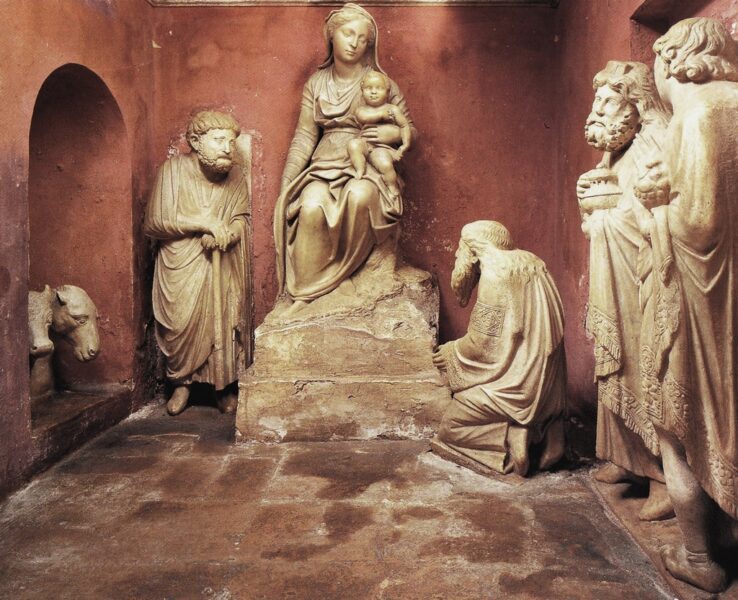
Our image today is of St. Mary Major in Rome, which houses the oldest nativity scene on the planet. The idea was Pope Nicholas IV’s, who in 1288 commissioned the sculptor, architect, and urban planner Arnolfo di Cambio to create a life-size sculptural representation. The three Magi are depicted adoring the Child Jesus along with St. Joseph. While the statue of Mary, who holds the Child in her arms, was thought to be from the 16th century, after a recent restoration, it is believed to be the original statue partially retouched in the 1500s. Between 1290 and 1292, Arnolfo di Cambio rebuilt a nativity scene in the form of a chapel, intended to highlight the relics of Bethlehem; for this reason, the basilica was then called St. Mary ad Praesepem. Nicholas IV—the first Franciscan pope—showed special devotion to the reliquary of the hay on which the Child rested.
Merry and holy day of the birth of Our Lord Jesus Christ according to the flesh!
«No one has ever seen God; the only Son, who is at the Father’s side, he has made him known.»
Good reading.
Il Santo Natale e il Paradiso
La Natividad más antigua del mundo
Zuppi il politico e un Natale che può fare a meno di Gesù
Intervista col Santo, i rischi dell’IA che ci avvicina a Matrix
Regno Unito, sul suicidio assistito un esempio di democrazia pilotata
Leone XIV: prima della messa di Natale saluta i fedeli sotto la pioggia, “tante grazie per essere qui questa sera anche con questo clima”
Il Papa a sorpresa in piazza San Pietro ringrazia i fedeli: «Siete qui anche con la pioggia»
Papa Leone XIV invita ad ammirare la sapienza del Natale
Santo Natale. Leone XIV: «Per illuminare la nostra cecità, il Signore ha voluto rivelarsi da uomo all’uomo»
Le cardinal Hollerich se confie sur les dernières heures du pape
L’omelia di Papa Leone alla messa di Natale: “Un’economia distorta induce a trattare gli uomini come merce, così si nega Dio”
Leone XIV: alla messa della notte di Natale, “il Giubileo si avvia al compimento, tempo di gratitudine e missione”
Che gli umili si aggrappino all’umiltà di Dio
Cresce l’interesse e l’amore per il Presepio
De Maria numquam satis
Il Santo Natale e il Paradiso
Shock in Vaticano. Il cerimoniere addita la Curia e i cardinali come “culattoni”