


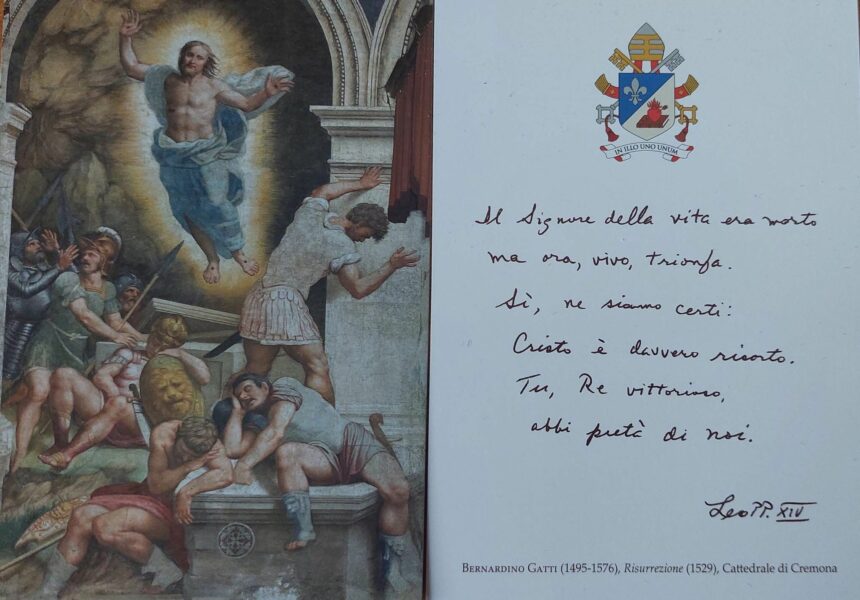
l The Lord of life was dead
but now, alive, he triumphs.
Yes, we are certain:
Christ is truly risen.
You, victorious King,
have mercy on us.
Leo PP. XIV
This is the text of the official greeting from Leo XIV on his first Easter, our image of today, it is also a change and for the better, compared to recent years. It is the one received by all the ‘superiors’ of the Roman Curia and all official bodies. With it we start today, having already celebrated Angel Monday and with another very busy day, following the pattern we have lived in all these days.
Regina Coeli.
l Easter Monday Regina Coeli: «Dear brothers and sisters, Christ is risen! Happy Easter!». Leo XIV focused on the fact that women proclaim Christ’s victory over death, while the guards spread the version that Jesus did not rise and that his body was stolen. «This contrast leads us to reflect on the value of Christian witness and the honesty of human communication. Often, in fact, the truth is obscured by fake news, as it is said today, that is, by lies, allusions, and unfounded accusations». The truth is often obscured by lies, allusions, and unfounded accusations, but the truth does not remain hidden: it comes to meet man, alive and luminous, capable of illuminating even the densest darkness. Leo XIV remembered Pope Francis, who died on Easter Monday last year.
Preaching in the desert.
Interview with Parolin: «We must support the Pope’s voice against war». «We cannot hide behind a finger: the voice of the popes is prophetic» and «the bishop of Rome is a moral authority whose importance has increased since he lost his temporal power. But it is a voice crying in the desert if it does not receive support and concrete assistance». «Think of John Paul II’s work for freedom in the countries of Eastern Europe under the Iron Curtain: his voice was supported and encouraged because that action was in the interest of Western countries. But when, after the miraculously almost bloodless fall of those systems, the same pontiff pleaded not to embark on the first and then the second Iraq war, he was abandoned by the same people who until recently had praised him». The distance from the great world powers «must never prevent us from maintaining an open dialogue with everyone».
Regarding the relationship between world leaders and the Christian faith, particularly the White House, Parolin commented: «It doesn’t bother me that politicians refer to Christian values and point to them as the guide for their actions. I speak in general and for all», but «the question is that the Christian faith, with its consequences, is not an exhibition of various products whose choice is left to the buyer». «We cannot say that we love and defend life and that we care only for the life of the unborn without considering that life is also that of migrants who die at sea, that of women and children who have nothing to eat, that of peoples devastated by the weapons we produce and sell, that of those who demand the right to freely choose their faith».
The torn tunic.
A year ago, Pope Francis exclaimed that the Church seemed like a torn tunic and that the disciples were divided; now Leo holds the cross of Good Friday with a firm hand, leading the procession through the Colosseum.
The Way of the Cross of 2026, accompanied by quotes from St. Francis of Assisi, shows a pontiff who has taken charge of the Church and wants to guide it gradually and confidently toward a new stage. The Easter rites of this year highlight the characteristics of the new pontificate: the careful fusion between tradition and reformist impulse. The Holy Thursday Mass is symbolic . The apostles whose feet the pope washes, repeating Christ’s gesture, are no longer men and women of diverse origins, not even non-Catholics; in Rebibbia prison there are up to twelve women of various nationalities and confessions, as happened with Bergoglio in 2024. The rite has returned to the Cathedral of St. John Lateran, and the «apostles» are once again represented by men : eleven priests of the Diocese of Rome and the spiritual director of the Roman major seminary.
It was those same days when Leo XIV wrote to the French bishops, urging them to find concrete solutions to «generously include» those who were sincerely attached to the Tridentine Mass in Latin, taking into account the guidelines of the Second Vatican Council. During the so-called Chrism Mass on Holy Thursday in St. Peter’s, Leo, addressing the priests, expressed the most advanced points of ecclesial reformist reflection: the imperative to «not harden our identity, our place in the world»; the conviction that the Gospel cannot reach the poor «if we approach them with the symbols of power»; and the need for clerics never to forget that «we bear the weight of the errors and sins of those who preceded us».
Prevost does not have the spontaneity of an improvised speaker; one must always discern the clarity of his messages within complex speeches. Nothing is left to chance. On the same day he restored the foot-washing rite to its traditional roots, Leo delivered a sermon to the priests in which he cited exclusively four figures : John Paul II, Cardinal Carlo Maria Martini, Pope Francis, and Óscar Arnulfo Romero. The passage in which Pope Francis emphasizes the urgency of not clinging to the strongholds of the past, but of facing the changes of the times, was deliberate. «New cultures continue to emerge in which the Christian is no longer accustomed to being a promoter or generator of meaning, but receives from them other languages, symbols, messages, and paradigms that offer new orientations for life, often contradictory to the Gospel of Jesus».
Pope Leo and Opus Dei.
Gareth Gore was in California on business when he received an unexpected call: the Vatican wanted to schedule a private audience with the Pope. The news left him stunned. In 2024, after nearly a decade of investigation, Gore published Opus , an investigation into the abuses allegedly perpetrated by Opus Dei. The book reconstructs a series of accusations ranging from psychological manipulation to human trafficking, from conditioning confessions to the use of drugs to manipulate members. Opus Dei categorically rejects these accusations.
There is an interview with Gore How is it possible that the journalist who wrote the most critical book on Opus Dei is invited to speak with the Pope? Honestly, I still don’t know for sure. I was traveling in the United States when a friend of mine from Peru, very close to the Pope, called me. He told me that the pontiff had heard of me and wanted to meet me in person. I hung up the phone and thought for a moment: is this real? I contacted the Vatican, thinking no one would answer. Instead, almost immediately I received a message from someone high-ranking: «Yes, the Holy Father wishes to meet with you. Please let me know when you are available».
How much do you think Leo XIV already knew about Opus Dei? It’s hard to say. Opus Dei is known for infiltrating the Vatican. It’s very likely that there are people inside who filter the information that reaches the Pope; some for deliberate reasons, others simply because in any large institution, the leader can’t know everything. What did you want to tell him in that limited time? I wanted him to understand something fundamental: Escrivá told his members that the idea of Opus Dei came directly from God, and he captured this vision in lavish detail. Those writings are the source of all forms of control, manipulation, and political maneuvering that the organization still exercises today. Reforming Opus Dei is extraordinarily difficult precisely because its founder is venerated as a saint: the Pope cannot simply say «stop doing these things,» because true believers will continue to believe that those practices are God’s will.
How did he behave during the audience? I entered with a huge sense of responsibility, but also with some recklessness. I had decided not to worry about offending or breaching protocol. I thought: no one else has had this opportunity. If they let me out after five minutes, I can live with that. I presented him with a stack of confidential internal documents, giving him a direct and unfiltered view of what it’s really like to live in Opus Dei. I didn’t know how he would react. And how was it? Everything went perfectly. He asked very insightful questions. The meeting lasted much longer than planned. There were two cameras and, at the end, the Pope told me it had been his decision to allow the cameras in and make the meeting public. Clearly, he wanted to send a message to Opus Dei: he takes these accusations very seriously.
The founder of Opus Dei told his members that they were part of a militia fighting against the «enemies of Christ.» From its beginnings, it has been a political group that uses religion as a cover. In Washington, they have systematically worked to infiltrate circles of power, with extraordinary results. Today, Opus Dei is one of the most influential forces within the MAGA movement. Kevin Roberts, president of the Heritage Foundation and promoter of Project 2025, regularly visits the Opus Dei center in Washington. Leonard Leo, architect of the conservative shift in the Supreme Court, is on the board of the Opus Dei center in the capital. The list is long. It is an exclusive group, accessible only by invitation and aimed at the elite: politicians, judges, businessmen, journalists, and academics. The irony is evident: while the leader of the Catholic Church fights against war and inhumane migration policies, Opus Dei uses Christian identity as a tool to promote a deeply authoritarian and conservative agenda. This is not faith, it is political calculation.
Opus Dei described Gore’s book as plagued with «errors, distortions, and unfounded accusations,» rejecting the accusations of political control and involvement in business activities.
Hypothesis about Jesus.
The best-known title of Messori, these days it is the subject of much news in Italy with his death. It is curious how the regime media and addicts try to nullify his growing influence. Even the newspaper of the Italian bishops, expensive and useless, of course paid for by the faithful, dismisses with «He was not an apologist». When he signed the contract for the interview with John Paul II , an international bestseller like the previous Report on the Faith with Ratzinger, Messori never forgot that he was above all a journalist, hence his brilliant interviews. He is the apologist par excellence in a world of mediocrity, a world that, without him, continues sunk in insignificance amid jealousies, differences of opinion, and clericalism. Let us hope that the Lord finds someone to replace him.
«Father»
«Father» by Salvatore Cernuzio , book published today, April 7, offers an unpublished portrait of Pope Francis , confirming the singularity of this Pontiff. The author, Vatican media journalist , enjoyed a friendship with Pope Francis and was among his close ones in the last years of his life. A privilege that, according to Cernuzio, was born from a letter delivered almost on impulse during a papal flight in 2021 , followed by an unexpected phone call: «Good evening, I am Pope Francis ». From that moment, a relationship marked by meetings , phone calls , jokes, laughter, reflections on faith and the Church , afternoons in Casa Santa Marta sharing ice cream (in a bowl, «to be able to eat more») and gifts for the journalist’s four young children and his wife. And confidences about Sergio Mattarella («He is an enlightened man»), about Giorgia Meloni and about who would become his successor, Cardinal Robert Francis Prevost («He is a saint»).
«This book was born as an act of gratitude toward a man, a Pope, who changed everyone’s life and touched the hearts of many». His energy and his pain for the «fragmented Third World War «, as he himself had repeatedly defined the numerous ongoing conflicts: «I didn’t expect it… I thought that Syria was something unique, then there was Yemen , the tragedy of the Rohingya in Myanmar , when I went there and saw that there was a world war …» «It hurts me to see the dead , young men, both Russians and Ukrainians , I don’t care, who do not return. It’s hard», he said, with the hope of being able to go to Kyiv and Moscow on a trip «together» , although he never received a response from Putin and the only contact was with the minister Sergey Lavrov , who, after the famous assault on the Russian embassy to the Holy See , suggested in a letter that he speak with Kirill . «Almost as if he wanted to minimize his possible contribution to a simple conversation between churchmen. For the Pope it had been a disappointment «. Among the Pope’s concerns there was also the situation in Gaza , which «he lived with anguish ». The journalist confirmed that a trip to the Strip was in his plans , «under any circumstances, perhaps at Christmas to spend the holidays in the parish of the Holy Family.
Finally, ordinations of the Heralds of the Gospel.
And in a great hurry: «In the joy of the Lord’s Resurrection, the Heralds of the Gospel will live a singular moment of grace with the ordination of 31 deacons and 26 new priests, on April 11 and 12, in celebrations marked by the solemnity and hope of the Church». The ordination of deacons conferred by Monteiro Guimarães, emeritus archbishop of the Military Archdiocese of Brazil. On Divine Mercy Sunday, the celebration of the ordination of the new priests will be presided over by Damasceno Assis, emeritus archbishop of Aparecida, pontifical commissioner.
After an inexplicable and scandalous procrastination, they have finally arrived, and this can only be a very direct order from Pope Leo, it is well known that at lower levels they were very opposed and have been for years. Preventing without just cause, and in this case all were unjust, a diaconal or priestly ordination is to deprive the people of God of the sacraments. Here we talk about things to eat and they are very serious, let us hope that this is a step forward to leave behind an absurd and ridiculous situation that leaves the Holy See in a very bad light, and a congregation of religious lost in dozens of useless commissioners. There are many orders that are dying amid galloping decomposition and this does not seem to be a problem.
Abortions and crypto-abortions in Italy.
The Ministry of Health presented its annual report on the implementation of Law 194: in 2023, 65,746 official abortions were performed. A new record was reached in the sale of «emergency contraceptives,» responsible for countless crypto-abortions. Just a few days ago, ISTAT warned that Italians are on the path to extinction because there are more doctors in obstetrics and gynecology departments than newborns. And the main reason for the constant decline in the Italian population is that they die before being born. This is not just an Italian problem: the WHO informs us that 3 out of 10 pregnancies end in abortion.
A new civilization.
When anthropologist Margaret Mead was asked what she thought was the first sign of civilization in an ancient culture, she did not mention stone tools, clay pots, or hunting weapons. Mead pointed to a human femur that had been fractured and then healed. In the animal kingdom, a broken leg is equivalent to a death sentence: the animal cannot escape danger, hunt, or drink water. A healed femur indicates that someone took the time to care for the injured animal, bandaging the fracture, splinting it, and feeding it until the bone healed. Civilization begins when the community accepts the fragility of others as an imperative of care. This archaeological «callus» is the physical proof that humanity is born in the precise instant when cooperation and compassion arise.
Venezuela today is that fractured femur that urgently requires the intervention of a community of care. On the tortuous path toward national reconciliation, mediation is not a position of indifferent neutrality, but an imperative of political charity. Mediating in communication implies sacrificing oneself —renouncing immediate rhetorical victory— to safeguard the common good, understanding that the ultimate goal is not to win the argument, but to heal the social fabric. If civilization began with a healed femur, our national reconstruction will begin when we commit to bandaging, treating, and healing the deep fracture that divides us, allowing the «callus» of our brotherhood to make us stronger and raise us up again.
«Catholic Saints of America»
Inspired by St. Carlo Acutis, the National Shrine of Our Lady of Champion in Wisconsin invites Catholics to celebrate the 250th anniversary of the United States this summer, joining in prayer and learning about American saints and blesseds. «They founded schools, cared for the sick, served the poor, and gave witness to the Gospel through lives of sacrifice, service, and unwavering love for Jesus Christ». «Their example shows us what it really means to be a faithful Catholic and an American». From July 1 to 9, «Catholic Saints of America» will include a special novena, an exhibition in honor of Americans who are saints or on the path to sanctity, and the opportunity to venerate their relics. Among the relics or remains of St. Elizabeth Ann Seton, Blessed Solanus Casey, and Blessed Stanley Rother will be on display. «There are fewer than 15 American saints and just over 70 people whose causes for canonization have been opened». «Each of these saints has a beautiful story and a powerful example, yet very few people know them». «We don’t have saints from 2,000 years ago; we have saints of today».
A very Catholic Easter.
«I have seen the Lord!».
Good reading.