


Venezuela Post-Chavista?
Today we cannot start in any other way than with Venezuela. The world is not just changing; it has changed, and we are just finding out. The United States sent Delta Force to the heart of Venezuela’s capital to remove the fraudulent acting president and his wife, Cilia Flores; this is a fact that has never been seen before. The closest comparison would be the capture in Panama of Manuel Noriega, also by special forces, in 1989. Like Noriega had done, Maduro declared his victory in disputed elections, and as happened with the Panamanian general, the United States has also accused the Venezuelan leader of being involved in drug trafficking. Noriega had taken refuge in the Vatican embassy, where he remained for 11 days. Finally, he was persuaded to leave after the use of «psychological warfare,» specifically: constantly blasting rock songs at full volume from bands like The Clash, Van Halen, and U2; a very sophisticated torture, no doubt. Transferred to the United States, he was convicted of drug-related crimes.
President Trump expressed his intention to continue controlling Venezuela «as long as necessary» and also that «our huge American oil companies, the largest in the world, intervene in the country, spending billions of dollars, repairing the severely damaged oil infrastructure, and beginning to generate income for the country.» «We are appointing people and we will inform you who they are.»
The Bishops of Venezuela.
In the first hours after the U.S. incursion, the Venezuelan Episcopal Conference did not issue significant statements. Days before the U.S. special forces operation, the Venezuelan bishops had expressed their critical distancing from both the threatening U.S. military deployment off the coasts of Venezuela and the country’s political situation. The Venezuelan Episcopal Conference noted that the time of the celebration of Jesus’ birth had been marked in Venezuela by «repeated and contradictory reports of military actions near our coasts with deplorable loss of lives» and by the «presence of a foreign military power in international waters of the Caribbean Sea.» The bishops called for an «unarmed and disarmed» peace, echoing the words used in numerous appeals by Pope Leo XIV. In the same message, the Venezuelan episcopate recalled «the deprivation of liberty of national and foreign citizens due to their different political opinions,» the «generalized impoverishment» of the population, resulting from «galloping inflation» and an «destabilized economy.»
Embassy of Venezuela to the Holy See.
The Pope Leo, the Vatican, and Venezuela.
On many occasions, we have stated that the world is changing, the balances born from the Second World War have ended. Today’s news is, without a doubt, what happened yesterday in Venezuela. The Vatican and Pope Leo XIV maintain a silence that cannot stem from ignorance of what has happened. Parolin was nuncio in Venezuela for four years, from 2009 to 2013. The friend Edgar Robinson, very discreet, especially in these months of Leo’s pontificate, is from Venezuela and is presumed to know something about his homeland. If that weren’t enough, we have Pope Leo, American from the United States and Peruvian by adoption; yesterday was a heart-stopping day in Venezuela, and yet, absolute silence. It is very striking that a church that seems to have chosen to speak on useless topics keeps a thick silence when something transcendental happens in a majority Catholic country.
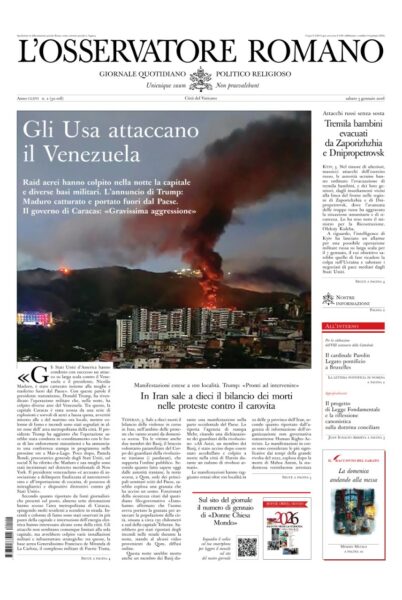
The official Vatican newspaper, L’Osservatore Romano, opened its Saturday edition with the U.S. airstrikes against Venezuela, in the capital, Caracas, and in several military bases in the country; the main image on the front page shows a dense column of smoke rising over an urban area. L’Osservatore Romano emphasizes that the situation remains “highly volatile,” with growing uncertainty about the political, social, and humanitarian consequences of the attack. The Holy See’s newspaper defines itself in its header as a “political-religious daily”— it fulfills the role of informing and reflecting the life of the Church and acts as a medium for the dissemination of the Pope’s voice, but it is not a direct spokesperson for the Vatican. The idea of the headline is clear: “United States attacks Venezuela.” The Vatican newspaper —which has no correspondents in Venezuela— bases itself on other journalistic information to describe the bombings in the country that occurred after an operation ordered by the U.S. government; the military operation included the capture of President Nicolás Maduro and his wife. The article in L’Osservatore Romano – written in Italian- also reported the reaction of the Caracas Government, which qualified the events as a “gravest aggression” and denounced a direct violation of national sovereignty.
For the moment, there has been no official comment from the Vatican or from Leo XIV, who may refer to the situation in Venezuela this morning after praying the Angelus this Sunday. On December 2, upon his return from his first international trip to Turkey and Lebanon, the Pope expressed his concern about the risk of Trump invading Venezuela. The Pontiff assured then that he was following the situation closely, both through the Venezuelan bishops and the apostolic nuncio. “Regarding Venezuela, at the level of the episcopal conference, with the Nuncio, we are seeking ways to calm the situation, seeking above all the good of the people, because so often those who suffer in those situations are the people, not the authorities.” “It is better to seek ways of dialogue even pressure, economic pressure, but seeking another way to change if that is what they decide to do in the United States.” Parolin denounced the existence of “unjust prisons” and “oppressed” in the country on October 21. During the Mass of thanksgiving for the canonization of the first two Venezuelan saints: “Only thus, dear Venezuela, will it pass from death to life! Only thus, dear Venezuela, will your light shine in the darkness, your darkness will become noon, if you listen to the Word of the Lord who calls you to open the unjust prisons, break the locks of the shackles, set the oppressed free, break all the shackles”.
Why has the Vatican, now represented by an American Pope, not yet felt the need to openly condemn the U.S. aggression in Venezuela? Why this deafening silence, even when in other parts of the world papal words are so clear?Does the American Pope also suffer from the same geopolitical myopia that has accompanied the rhetoric of the «double standard» for decades? That one according to which some attacks are «violations of international law» while others are treated as «stabilization operations,» «necessary pressure,» or «defense of democracy»? The lack of even the slightest press release on the U.S. attack is shocking. Peace is not an abstract concept: it is wounded flesh, peoples strangled by sanctions, sovereignty trampled in the name of an order that changes face but not logic. Silence, in some cases, is not neutrality, but a clear choice.
Concert and Audiences.
In addition to Venezuela, we have more news, and yesterday, Pope Leo attended a Christmas concert in the Sistine Chapel performed by the Pontifical Musical Chapel, the Sistine. Another detail of the return of music to the Vatican after more than a decade of silence.
Pope Leo XIV received the mayor of Rome, Roberto Gualtieri, in a private audience at the Vatican. The mayor delivered food to the needy and a nativity scene, carved from a hollow trunk by some inmates of Rebibbia who work in the prison’s carpentry workshop.»It was an emotional and intense conversation and meeting, with an extraordinary personality attentive to both the problems of the world and those of the city of Rome, of which he is bishop.» The Pope thanked the mayor, the municipal administration, and the city of Rome for their commitment to the Jubilee. He also met with the president of the Lazio Region, Francesco Rocca: «Today I met with the Holy Father Leo XIV in audience at the Apostolic Palace. It was a deeply emotional moment, not only institutionally, but also, and above all, humanly. During the meeting, I wanted to express the concrete support of the Lazio Region to the most vulnerable people with a simple but significant gesture: the donation of 2,000 meals to the Diocese of Rome’s Caritas, in support of the daily work of reception and listening in the area».
Pope Leo XIV has appointed Professor Ulisse Corea, associate professor of Civil Procedural Law at the University of Rome Tor Vergata, as applied judge of the Tribunal of the State of the Vatican City. Corea, as is now customary in the Vatican, has no prior experience in canon law or Vatican law.
Where there is a statement is regarding what happened in Switzerland, and Pope Leo XIV joins the mourning of the families and of the entire Swiss Confederation. Telegram of condolences sent on behalf of the Holy Father to Monsignor Jean-Marie Lovey, Bishop of Sion, Switzerland.
The new application official of the Governorate of the State of the Vatican City is dedicated to Saint Carlo Acutis (1991-2006). It is the www.vaticanstate.va and was designed so that access to information is even simpler, immediate, and accessible from mobile devices. The different sections include the saint of the day, news, interviews, videos, and links to other institutions of the Governorate: Philatelic and Numismatic Marketing, Vatican Museums, Vatican Pharmacy, Vatican Post Office, Pontifical Villas, and the Vatican Observatory.
The Cathedral of Brussels.
Pope Leo XIV appoints Parolin his papal legate for the celebration of the eighth centenary of the Brussels Cathedral, scheduled for January 11. “We ourselves must become the house of God, and what was done when buildings were erected now happens when the faithful gather diligently: because by believing we are like logs cut from the forests and stones from the mountains.” In the Latin letter, dated December 10 and published today, the pontiff recalls that “in 1226 Henry II, Duke of Brabant, began to build a new and majestic temple, increasingly embellished over time, dedicated to Saint Michael the Archangel and Saint Gudula, virgin, which in the past obtained the dignity of co-cathedral of the Archdiocese of Mechelen-Brussels”.
The Biblical Citations.
A revealing detail. In the discourse pronounced by the Pope during the celebration of the First Vespers of the Solemnity of the Most Holy Mary, Mother of God, and in the Te Deum of thanksgiving from last year, December 31, 2025, all the biblical citations follow the official translation of the Italian Episcopal Conference of 1974, not the official one of 2008; and it is not the first time this has happened. It is difficult to consider it a coincidence
What is SEEK?
The Bulletin of the Holy See Press Office has published the video message from Pope Leo XIV to the participants of SEEK26 . SEEK was born in a culture different from the European one and is a great Catholic conference for young adults and university students; it is not an academic congress nor a simple festival, nor a mini World Youth Day. It is an intensive week of Christian life lived seriously, an intense time to get truly involved. A true vocational journey, comparable in approach to youth vocational pastoral care as we know it in our churches, but lived on a much larger scale and not limited to a single diocese. For five days, from January 1 to 5, thousands of young people between 18 and 30 years old freely choose a demanding program: daily Holy Mass, extended Eucharistic Adoration, the sacrament of Confession, and deep biblical catechesis.
Vespers of the Consistory.
Pope Francis only convened one extraordinary consistory during his twelve years of pontificate, a fact that provoked repeated criticism from cardinals who complained about the limited collegial consultation. The extraordinary consistory of January 2026 will be the first time that the majority of the cardinals gather since the conclave that elected Leo XIV. Before the conclave, many had few opportunities to meet or exchange opinions; the next meeting will be a moment of unity both practical and symbolic, as Pope Leo gathers a College that still does not know itself. That letter, sent to the cardinals in mid-December and signed on December 12, feast of Our Lady of Guadalupe, has become a central element for understanding the meeting. Pope Leo XIII described four main points for debate, probably centered on two themes per day. These included a renewed reflection on the Evangelii gaudium «for a renewed and joyful impulse in the proclamation of the Gospel», an in-depth study of Praedicate evangelium, with special attention to the relationship between the universal Church and the particular Church, synodality as an instrument of effective cooperation with the Roman Pontiff, and a detailed theological, historical, and pastoral reflection on the liturgy, citing the Sacrosanctum Concilium. The news of the planned meeting first emerged on November 6, when the Vatican Secretariat of State sent a brief communication to the cardenals stating that «the Holy Father Leo XIV plans to convene an extraordinary consistory for January 7 and 8, 2026». We will be here to report it, but what is clear is that the extraordinary consistory is not a mere protocol act convened out of pure formality. It is the first important institutional act of Pope Leo XIV that will seek to unite a geographically and ideologically diverse College of Cardinals, listen to it, and define how he intends to govern the Church.
The Bell of San Remo.
The bell of San Remo that will ring every day to remind us that we must defend life scares the demons who are accustomed to being very loose in these convulsive times. The regional councilor for equality of Liguria, Laura Amoretti, wrote an extensive letter to Pope Leo XIV asking him to urge the anti-abortion movement to stop the bell ringing. «Initiatives of this type risk becoming a public judgment». But the bishop of San Remo, for once and without setting a precedent, seems to have it very clear and does not hide: «It serves to remind that abortion is not a right, but a crime».
Pederasty and Reincorporation.
It is not a unique case, and we still haven’t learned. Father Michele Mottola was sentenced to nine years in prison for abusing an 11-year-old girl in the Caserta area. There is strong controversy in the diocese of Aversa over his reincorporation. Bishop Monsignor Angelo Spinillo allowed Don Michele to march alongside him during the procession of Saint Stephen the Protomartyr in Qualiano immediately after Christmas, along with other priests and numerous children who served as altar boys, and, in the following days, in the closing celebration of the Jubilee in the cathedral. The reincorporated man was suspended from his positions and sentenced to nine years, which he fully served. It remains scandalous that a priest convicted of pederasty is allowed to continue exercising, even participating in public processions alongside children. The diocese probably thought that time had eased the indignation and pain of the victims, but evidently it was not so. The scandal has forced the bishop to issue a statement justifying the issue as an «exceptional exemption» to participate in the procession «in light of that Christian hope of penance and redemption.» Father Mottola has served the penalties imposed by the State and Ecclesiastical Courts, but remains subject to a series of restrictions.
The West Has Stopped Believing.
Moral relativism, initially promoted as a tool for coexistence, has transformed into a refusal to judge anything. The idea that all cultures are equal in dignity has imperceptibly transformed into the assertion that all cultural practices are equivalent in value and outcomes. This is totally false. Freedom of expression, women’s rights, judicial independence, scientific research, and the separation of politics and religion did not arise everywhere by chance. They are historically Western constructions, shaped over centuries, often at the cost of violent internal conflicts. Considering them interchangeable with systems that deny them is not tolerance; it is intellectual abdication. Identity politics has accelerated this process by replacing citizenship with categories of grievances. The individual is no longer primarily a citizen subject to common laws, but a member of a community hierarchically structured according to a supposed degree of historical victimization. The law, once voluntarily blind, is now expected to prioritize skin color, origin, or ideology. In practice, this leads to unequal application of the law, selective outrage, and a judicial system increasingly reluctant to impose the same norms on everyone. When equality before the law becomes negotiable, trust in institutions collapses quickly.
of the banner flag
Venezuela entire
keeps of its Virgin the loves».
Good reading.
Leone XIV: su incendio Crans-Montana, “compassione e sollecitudine per i familiari delle vittime”
Investigatore Biblico. “Il Papa cita la Bibbia CEI 1974, non la 2008: una preferenza che interroga”
Leone XIV: nomina Ulisse Corea giudice applicato del Tribunale Vaticano
Leone XIV: nomina il card. Parolin legato pontificio per VIII centenario Cattedrale Bruxelles
Il silenzio del Papa americano: Vangelo e il Venezuela dimenticato.
La cattura di Maduro esattamente 35 anni dopo l’arresto di Noriega
Sacerdote pedofilo in processione coi bambini: è scontro sul ritorno di don Mottola, condannato per abusi su minore
Dall’inquietudine del cuore alla missione: oltre le contrapposizioni ideologiche
Arresto Maduro, Rai e Mediaset stravolgono i palinsesti: salta il Festival del Circo di Montecarlo e Porro rimpiazza Benigni
Venezuela. Il presidente dei vescovi: «Fiducia in Dio e nel nostro popolo»
Dopo 36 anni gli Usa replicano in Venezuela il caso Noriega
il blitz USA, le incertezze sul futuro e le ultime preoccupazioni espresse dai Vescovi
Nuova «app» ufficiale del Governatorato dello Stato della Città del Vaticano
Papa Leone XIV incontra in udienza privata il sindaco Gualtieri e il Presidente della Regione Rocca
El periódico del Vaticano abre su portada con el ataque de Estados Unidos a Venezuela
Sanremo, una lettera al Papa per fermare i rintocchi della campana anti-aborto
What to expect from the extraordinary consistory
L’Occident n’a pas perdu ses valeurs. Il a cessé d’y croire
Help Infovaticana continue informing