


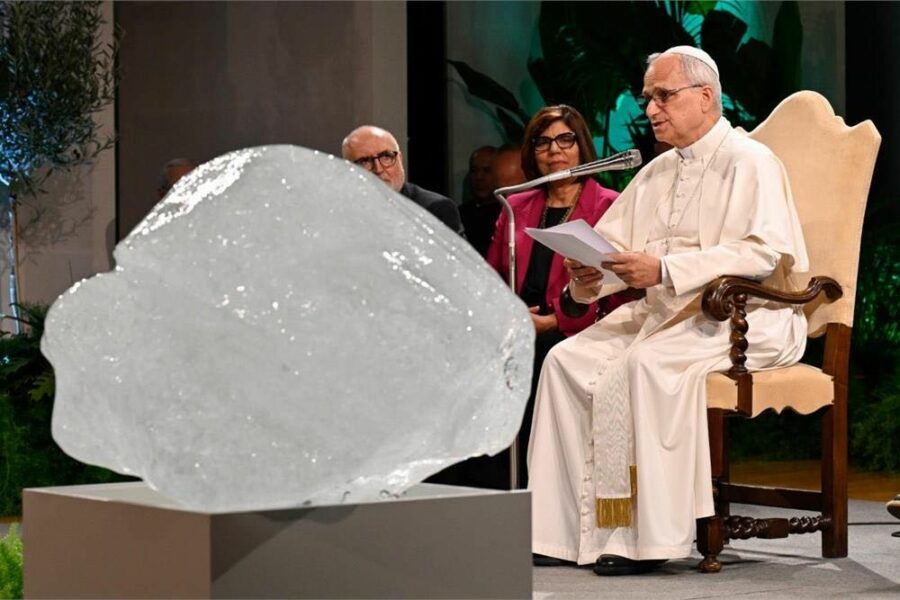
Pope Leo XIV met with the participants of the Conference «Reviving Hope» in Castelgandolfo convened to commemorate the tenth anniversary of the publication of the encyclical Laudato si’ . The event took place in the center of the Villa Cybo, one of the villas in the papal complex ceded by Paul VI to the Focolares. A very low-level event with measured attendees, lots of dance music and lots of green projection. The Pope attended at the end with a short speech, all in a room absent of any religious symbols, and we are in Vatican territory, and with a strange stone ‘presiding’ over the event, a block of ice blessed by the Pope.
No one explained to us what the stone in question was doing there, but the theme of the stone is something else, especially if it is rough, a term used in Freemasonry for the principles on which the sect rests. It is said that the Worshipful Master is the cornerstone of the lodge. The rough stone is the emblem of the formless and irregular stone that the apprentices roughen. A rough stone is ready to be worked, and, according to the mason’s talent, it can become a work of art or the cubic stone that will be part of the social building’s structure. The rough stone is the symbol of the primitive age and of the human being (man/woman) without instruction in a natural state, but who has all the potential to evolve. In the Masonic ‘chapel’ of the United Nations, the only one existing in the building cataloged as a place of meditation, there is a huge cubic stone at the center. Everything smells of repressed aprons, the cross is in the way and we are left with the rough stone, we’re in trouble.
In his speech, the Pontiff intertwined memory and perspective, gratitude and challenge, emphasizing once again the urgency of an ecological conversion that transcends superficiality, but truly transforms the lives of people and communities. Leo XIV highlighted how Francis’s analyses and proposals—from the paradigm of integral ecology to the call for dialogue and the invitation to address the root causes of the crises—have generated a transversal movement that continues to grow. «The challenges identified in Laudato Si’ are even more relevant today than ten years ago. They are not just social or political problems, but above all spiritual ones: they call for conversion.»
The speech concluded with a question, with the force of a collective examination of conscience: «God will ask us if we have cultivated and protected the world He created, for the benefit of all and of future generations, and if we have cared for our brothers and sisters. What will our response be?». With these words, Leo XIV entrusted the participants with a task that concerns not only the memory of a document, but also the concrete responsibility toward the future of humanity and creation.
In recent days, some of the decisions adopted by Pope Leo XIV have been made public, among them, the appointment of a second personal secretary stands out, a task entrusted to the Reverend Don Marco Billeri , a priest of the Diocese of San Miniato, a canonist. The weekly of his diocese interviews: «I am living this moment with great unease, according to the very etymology of the word, alternating between the opposing impulses of hope and fear. In fact, on one hand, it fills me with emotion, astonishment, and gratitude toward the Holy Father for this request, with the hope that it will be of greater help to his ministry, but on the other, I glimpse the gravity of the service. Many other thoughts also come to mind, especially the faces of people whose vision and contact I will somehow be more limited in, the contexts I will have to leave behind, and, in general, many questions about material matters related to the imminent move to the Holy See. I admit that sometimes I feel the risk of getting lost in these thoughts, and then the question that the Master asks the disciples in chapter twenty-two of the Gospel of Luke immediately comes to mind: ‘When I sent you [two by two without carrying anything]… did you lack anything?’ And they answered: ‘Nothing.’ And also the words of Manzoni when he says: ‘God never disturbs the joy of His children, except to prepare a more secure and greater one for them.’ I know that I have not sought any of this, that if the Lord allows it, evidently good and growth can arise from this path, and this thought consoles me. I understand that it is not an exhaustive response, but it is something that comes and goes in my mind.» «What I am starting is a service with a deadline. It is not something definitive; I remain a priest, son of this land, legally incardinated here, and when the Holy Father deems it appropriate, I will return to the diocese, assuming the commitments the Bishop wishes to assign me.» «My person and my experience are limited: I will carry out this service for a limited time, but if this experience rekindles in some people the affection and remembrance in prayer for the Holy Father and for those who work with him, then it will undoubtedly have already fulfilled its purpose.»
From October 1 to 14, the Palazzo della Cancelleria, the seat of the Holy See’s tribunals, will host an exhibition dedicated to the millennium of the Abbey of Montserrat. After its passage through Brussels, the exhibition arrives in the Italian capital with the aim of presenting Montserrat as an example of the contribution of the Rule of Saint Benedict to the construction of Europe. The official inauguration will be on Friday, with the presence of representatives of the Roman Curia, Abbot Manel Gasch, the Millennium Commissioner, Bernat Juliol, and the president of the Generalitat, Salvador Illa, who was received by the Pope yesterday.
The Trump administration has once again found itself facing a Pope. The press secretary, Karoline Leavitt, rejected on Wednesday the suggestion made on Tuesday by Pope Leo XIV that people who support the «inhuman treatment of immigrants in the United States» may not be «pro-life.» Leo XIV: «Whoever says they are against abortion but in favor of the death penalty is not really pro-life.” Leavitt said that “I would reject that there has been inhuman treatment of illegal immigrants in the United States under this administration,” then criticized the immigration policies of former President Joe Biden and highlighted some of the violent crimes committed by undocumented immigrants. “This administration is trying to enforce the laws of our nation in the most humane way possible, and we are upholding the law.” “We do it on behalf of the citizens of our country who live here.” The press secretary is Catholic and prays regularly with her staff before her press conferences, she did not mention the Pope. A Vance spokesperson refused to comment on Leo XIV’s statements.
It’s in all the media, even some high-ranking ecclesiastics have joined the topic of the Global Sumud Flotilla. The flotillas constituted an instrument of maritime action against Israel under the aegis of the Free Gaza Movement , especially from 2009, when the Tel Aviv government imposed a naval blockade on the Gaza coasts to limit Hamas’s ability to smuggle weapons and military material. On May 31, 2010, the Gaza Freedom Flotilla , consisting of six ships and approximately 700 activists from more than 50 countries, attempted to break the naval blockade, forcing Israel to intervene militarily, resulting in the death of nine activists in clashes at sea. Since then, the flotillas have continued their activities, although with greater caution. In 2011, the Freedom Flotilla II – Stay Human was attempted, but many ships did not depart or were intercepted. In the following years, missions such as the Women’s Boat to Gaza (2016) and the Freedom Flotilla III (2015) were organized. In 2018, the Freedom Flotilla Coalition launched a new operation against the naval blockade, which was dismantled by Israeli forces.
The Flotilla does not have a single national identity, but is the product of a fluid and transnational coalition that unites far-left militants, LGBTQ activists, ecologists, journalists, and some parliamentarians. The ideological nature of this coalition is no secret. The Flotillas present themselves as convoys of activists, non-governmental organizations, and volunteers who exploit their humanitarian rhetoric and the apparent indeterminacy of their means and objectives to gain a clear political advantage.
Some organizers of the Flotilla have had direct and documented contact with Hamas leaders, the benefit the movement obtains from them is evident: each mission that challenges the Israeli blockade is used as proof of international support for the Palestinian cause. Iran, despite not having a direct role in organizing the ships, uses the Flotilla narrative to legitimize its anti-Israeli and anti-Western stance. The Flotilla networks also involve Muslim activists in Europe, North America, and Asia, which reinforces the transnational Islamic dimension of the initiative, which is not limited to Gaza or the Middle East, but involves followers of Allah from all over the world.
All this happens just when Donald Trump proposes the first credible peace plan in the Middle East, accepted by almost all Arab countries. The terrorist attack of October 7 contributed to the collapse of the so-called «Abraham Accords» of 2020, which Trump himself had championed. Hamas leaders did not risk their lives in that attack nor foresee Israel’s harsh reaction. Today they know that if they reject the US proposal, » hell will break loose «. Will Hamas embark on the path of collective suicide or, as is more likely, avoid self-sacrifice, leaving any dramatic or ridiculous event that may still occur limited to the dilapidated flotilla ?
The government of Canada announced more than 13 million dollars in funding for pro-abortion groups under the Sexual and Reproductive Health Fund, which is mainly allocated to abortions and radical LGBT groups. “The Access for All Program provides support to marginalized populations so they can access abortion services through emergency funds for travel and logistical support.” The Contraception and Abortion Research Team at the University of British Columbia received 4.3 million dollars to “address the information, access, and appropriate care needs on abortion for key groups, including Indigenous people, racialized people, migrants, homeless people, 2SLGBTQI+, youth, and people with disabilities and/or complex health issues.” The opposition condemns the funding and argues that taxpayers’ money that supports “reproductive health” should be allocated to families who have children, not to those who kill their children “it is the government paying people to destroy Canada’s future.” Under the former Prime Minister Justin Trudeau, the Liberals led the most pro-abortion government in Canada’s history, spending more than a billion dollars since 2020 to promote abortion and contraception in the country and abroad. Abortion has killed more than four million unborn babies in Canada since its legalization in 1969, which is approximately equivalent to the population of Alberta.
«The adoption of a minor is permitted to spouses, to one of the spouses who lives with the child’s parent, or to the surviving spouse; exceptionally, even to a single person if it benefits the best interest of the child. The decision corresponds to the judge.» «Parents have the right to decide on their children’s participation in extracurricular activities. Education on intimate life and sexual behavior can only be imparted with the consent of the legal representative.» «The Slovak Republic recognizes the biologically determined sex of man and woman,» which, in essence, reflects what is already specified in the Constitution regarding marriage: «the unique union between a man and a woman.» In normal times, these objectives would not have required entering the Constitution, not even ordinary law. In normal times, everyone’s common sense would have sufficed to recognize the obvious. But living in exceptional times requires exceptional means to recognize the obvious again. And so, the old seems new.
And we end with an interesting study by Federico Frattini , dean of the Graduate School of Management at the Polytechnic of Milan. It offers an interesting perspective on the papal succession style, identifying the lessons that business executives can learn from it. «Of all the aspects that characterize the history of the Vatican, the change of leadership is the most current and the closest to the corporate world. It is a phenomenon that entails significant complexity or a drastic decrease in performance. Consider the change of ownership in family businesses, when the founder and owner leaves operational functions, which usually creates an impasse: managing three generational transitions is a feat, and only one in ten achieves it optimally.»
The theme of «stability» should not be analyzed and interpreted so much in relation to the figure of the Pope, but rather in relation to one of the peculiarities of the Catholic Church: being an institution with more than two thousand years of history and traditions, transmitted to our days thanks, in part, to its ability to manage leadership changes with rigor and methodically. Clear procedures, communication rules, and a shared (and official) phase of vacant see of power (no Pope is elected without a two-thirds majority, a rule in force since 1179) have allowed it to remain stable. The «secret» of this stability, according to experts from Hogan Assessments, who have studied this aspect from a management perspective, lies precisely in a system that ritualizes and reduces the risks of transitions from one Pope to another, and prioritizes elements of structure and consensus as key resources in the process.
Frattini: «Succession is usually conceived as an event, when in reality it is a process that must be codified, starting much earlier. A fundamental step in leadership transitions is linked to the ability to cultivate the talents that will become the bearers of the company’s vision under the new direction and to the ability to bring the past into the future. The leader does not exercise leadership alone, but only if he shapes the organization’s culture, integrating and internalizing its values, especially those related to people.»
«Beware of despising any of these little ones…»
Good reading.